UVC Is Often Seen as a Health Upgrade—But It’s Also a Financial One
When people think about UVC air treatment, they often focus on health benefits:
Cleaner indoor air
Reduced microbial contamination
Improved wellbeing
But one of the most overlooked advantages is financial return.
UVC technology is not just an air quality solution—it is an asset protection strategy.
The Hidden Cost of Dirty HVAC Systems
Heat pumps and HVAC systems naturally accumulate:
Dust and debris
Moisture build-up
Mould and biofilm on coils
Organic contaminants from indoor air
Over time, this build-up affects system performance in several ways:
1. Reduced Efficiency
Dirty coils reduce heat transfer efficiency, forcing systems to work harder.
2. Higher Energy Consumption
When systems struggle, they consume more energy to maintain temperature.
3. Increased Maintenance Requirements
More frequent cleaning and servicing is required to maintain performance.
4. Premature Equipment Wear
Ongoing strain can shorten the operational lifespan of components.
Why Cleaning Alone Doesn’t Solve the Problem
Routine servicing is essential, but it is reactive.
Once a system is cleaned:
Contaminants begin accumulating again immediately
Moist environments allow regrowth
Airborne particles continue circulating through the system
This creates a continuous cycle of build-up and cleaning.
The Role of UVC in Protecting HVAC Systems
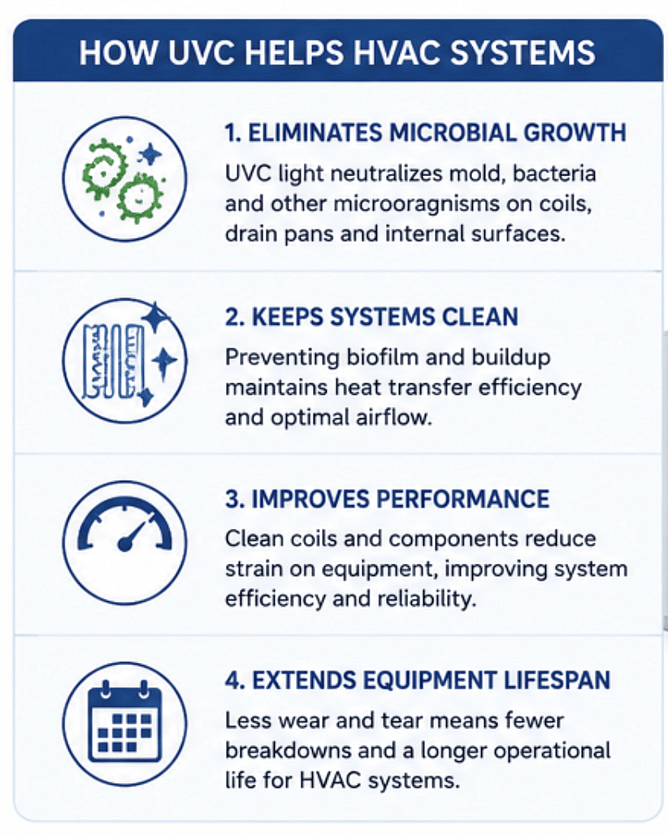
UVC technology works inside the system to prevent microbial growth from establishing on critical components such as coils and internal surfaces.
This helps:
Keep coils cleaner for longer
Reduce biofilm formation
Maintain airflow efficiency
Lower system resistance over time
Instead of cleaning after contamination occurs, UVC helps prevent contamination from forming.
Extending Equipment Lifespan
By maintaining cleaner internal components, HVAC systems can operate closer to their intended design efficiency for longer periods.
This can contribute to:
Reduced wear on mechanical parts
Fewer breakdowns
More stable long-term performance
Delayed replacement cycles
For commercial buildings, this can significantly impact capital expenditure planning.
Energy Efficiency Gains
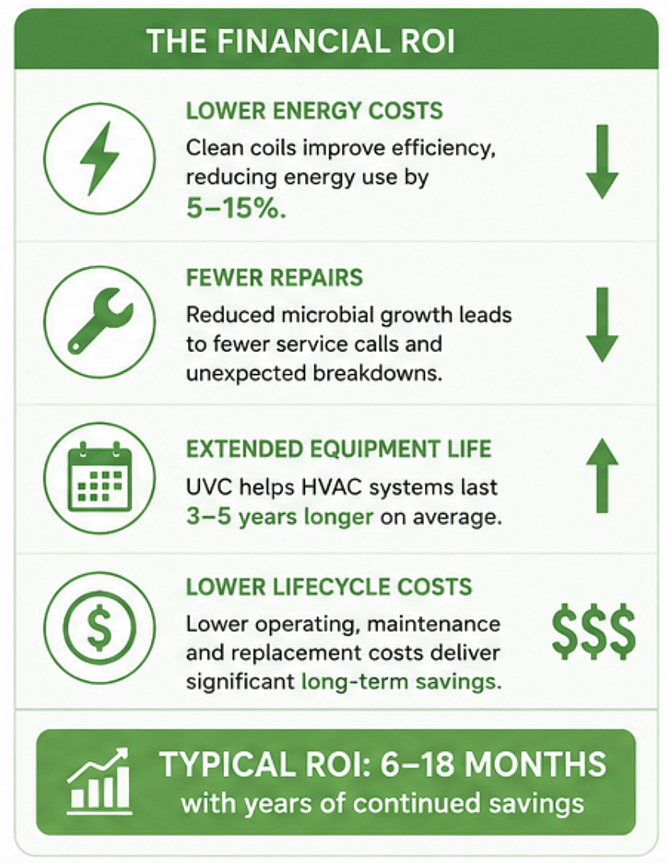
Cleaner heat exchange surfaces improve system efficiency, which can lead to:
Reduced energy consumption
Lower operational costs
More stable heating and cooling performance
Over time, these efficiencies compound into meaningful savings.
UVC as an Investment, Not an Expense
While UVC systems require upfront installation, their value is realised over time through:
Reduced maintenance frequency
Lower cleaning costs
Improved HVAC efficiency
Extended equipment lifespan
This positions UVC as a long-term investment in building performance rather than a short-term operational cost.
The Bigger Picture: Total Building Performance
Modern building management is increasingly focused on total performance—not just comfort.
That includes:
Energy efficiency
Asset longevity
Indoor environmental quality
Operational cost control
UVC contributes to all four.
A Smarter Way to Manage HVAC Systems
Instead of repeatedly cleaning and repairing systems after contamination occurs, UVC introduces a preventative layer that supports continuous performance.
It shifts HVAC management from reactive maintenance to proactive protection.
The Bottom Line
Every HVAC system is an investment.
UVC helps protect that investment while also improving the quality of the air it delivers.
Cleaner systems last longer. More efficient systems cost less to run. Healthier air benefits everyone inside the building.
That’s where the real return on investment begins.