Children Spend Most of Their Day Breathing Indoor Air
In schools and early childhood centres across New Zealand, children spend up to 6–8 hours per day indoors.
That means the quality of indoor air is not just a comfort factor—it is a health and wellbeing factor that directly affects learning environments every single day.
Yet indoor air quality is still one of the least addressed elements in many education buildings.
The Reality of Air in Busy Learning Environments
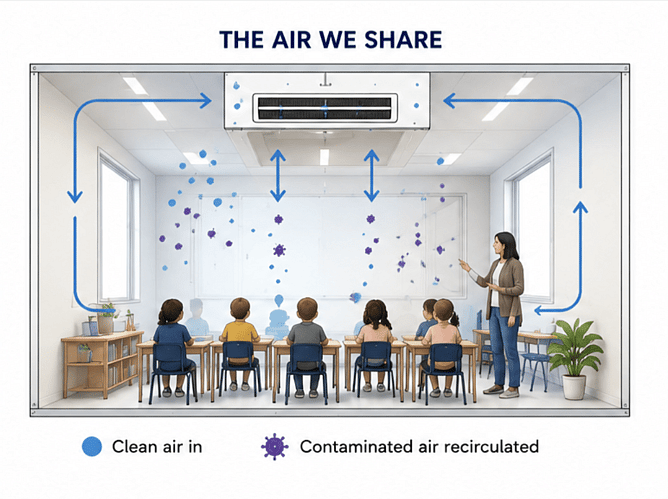
Classrooms and ECE centres are high-occupancy spaces where air is constantly shared and recirculated.
Common contributors to indoor air issues include:
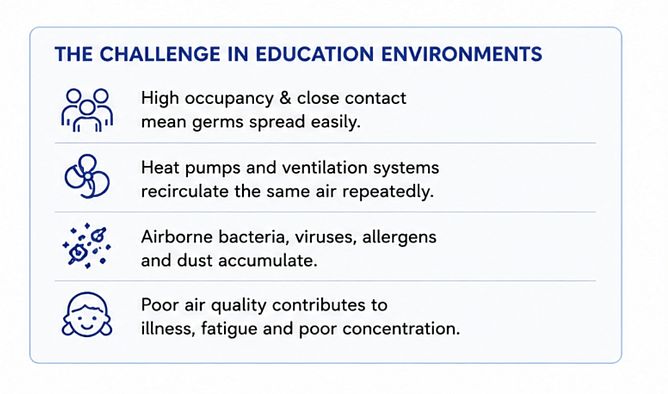
Close proximity between occupants
Frequent seasonal illness transmission
Poor ventilation during colder months
Heat pumps recirculating the same air
Dust, allergens, and airborne particles
Moisture and humidity from daily activity
This combination creates an environment where airborne contaminants can accumulate quickly.
Why Traditional Ventilation Isn’t Always Enough
Even in buildings with mechanical ventilation or heat pumps, air is often filtered but still continuously recirculated.
Filters can capture some particles, but they do not address:
Microbial growth inside HVAC systems
Biofilm formation on internal components
Airborne viruses and bacteria circulating in real time
Recontamination within the system itself
As a result, air may be conditioned—but not necessarily sanitised.
The Impact on Children and Staff
Poor indoor air quality in education environments can contribute to:
Increased spread of seasonal illness
Higher absenteeism among students and staff
Reduced concentration and cognitive performance
Worsened allergy and asthma symptoms
General discomfort in learning spaces
While no single factor causes these outcomes, indoor air quality plays a significant supporting role.
The Missing Layer: Continuous Air Treatment
Many education facilities rely on cleaning protocols, opening windows when possible, and basic filtration systems.
However, these approaches are intermittent or passive.
What is often missing is a continuous, system-integrated layer of air treatment.
How UVC Technology Supports Healthier Learning Environments
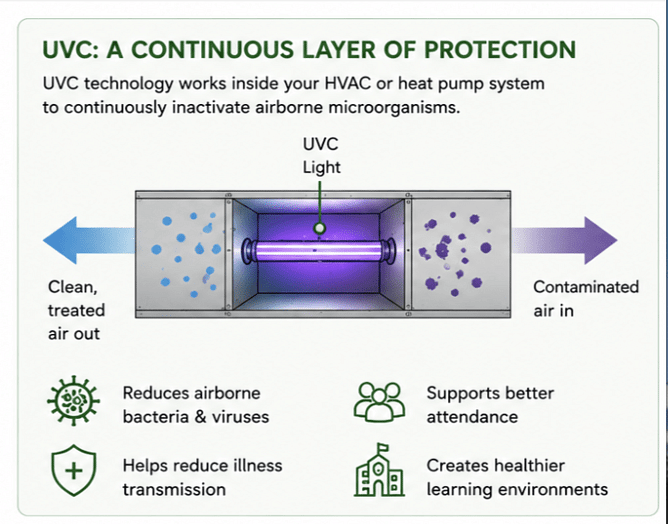
UVC technology provides continuous microbial control within HVAC and heat pump systems used in schools and ECE centres.
It works by:
Inactivating airborne bacteria and viruses
Reducing microbial build-up inside air systems
Helping maintain cleaner air as it circulates
Operating continuously without disrupting daily activities
This creates a consistent background level of protection that works while the building is in use.
A Practical, Passive Solution
One of the key advantages of UVC in education settings is that it is:
Passive (no behaviour change required)
Continuous (24/7 operation)
Non-intrusive (installed within existing systems)
Low maintenance (minimal ongoing intervention)
This makes it particularly suitable for busy environments where operational simplicity matters.
Supporting Better Learning Outcomes
While air quality is only one factor in education performance, improving it contributes to:
Fewer disruptions from illness
Better attendance consistency
Improved comfort in classrooms
Healthier environments for vulnerable children
The Future of Healthy Education Buildings
As expectations around student wellbeing continue to rise, indoor air quality will increasingly become part of how we define a “healthy school.”
UVC technology provides a way to elevate existing building systems into something more proactive—supporting cleaner, safer air for the next generation.
Because learning environments should support health, not compromise it.