The Frustration Every Property Owner Knows Too Well
You clean it. You treat it. You repaint it. You pay for remediation.
And yet… a few months later, the mould is back.
For many New Zealand homeowners, landlords, and building managers, mould feels like an endless cycle that never fully goes away.
The truth is, most mould remediation only treats the visible problem—not the system that is continuously reintroducing it.
The Real Source of Recurring Mould
Mould is not just a surface issue. It is a biological organism that spreads through microscopic spores.
Even after visible mould is removed, spores often remain in:
Heat pump and air conditioning coils
Ventilation ducting
Fan units and internal components
Ceiling cavities and wall spaces
Damp, poorly ventilated areas
These hidden environments are often dark, humid, and consistently supplied with airflow—perfect conditions for regrowth.
So even when surfaces are cleaned, the building itself can still be distributing mould spores through the air.
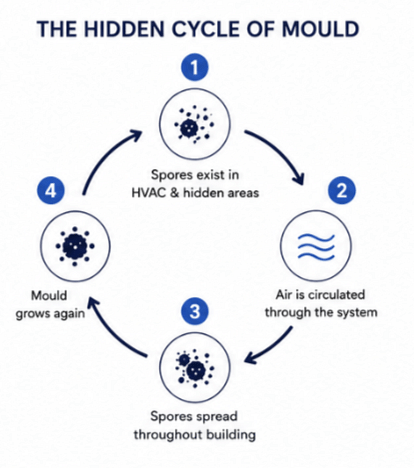
The Role of HVAC and Heat Pumps in Recontamination
Most New Zealand homes and buildings rely heavily on heat pumps or HVAC systems for heating and cooling.
While these systems improve comfort, they also:
Circulate indoor air repeatedly
Pull air across internal moisture-prone components
Collect dust and organic material
Provide a pathway for spores to spread throughout a building
This means a system that is meant to improve air quality can unintentionally become part of the problem.
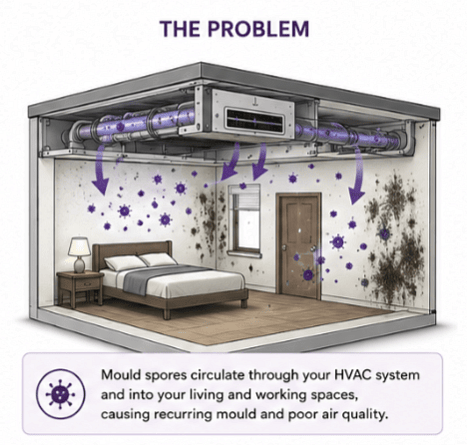
Why Traditional Cleaning Isn’t Enough
Standard mould remediation focuses on:
Removing visible mould
Treating affected surfaces
Improving ventilation
Addressing moisture sources
While these steps are essential, they do not provide continuous protection.
Once treatment is complete, regrowth can begin again if conditions remain favourable inside the air system.
Mould does not wait for the next cleaning cycle.
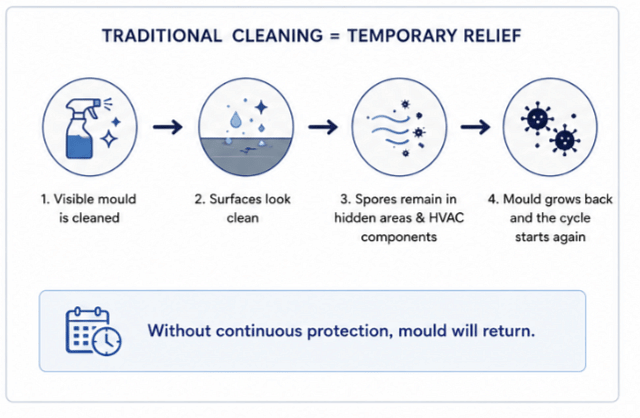
The Missing Layer: Continuous Protection
This is where many buildings are missing a critical piece of the puzzle.
Even with good maintenance and cleaning schedules, there is no ongoing mechanism preventing microbial regrowth inside HVAC systems.
That gap is why mould often returns.
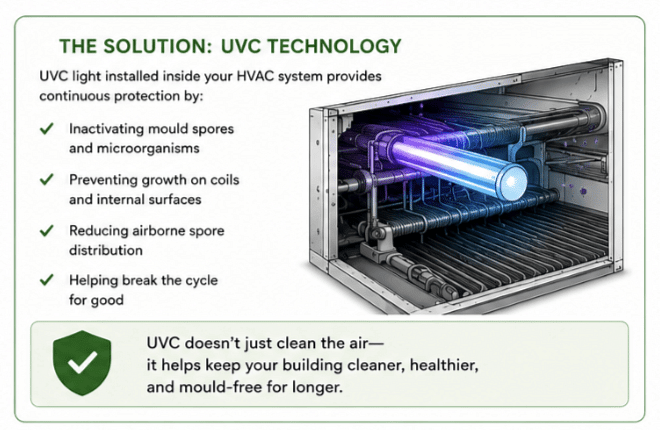
How UVC Technology Changes the Equation
Ultraviolet Germicidal Irradiation (UVC) provides continuous microbial control inside air systems.
Installed within heat pumps or HVAC systems, UVC works by:
Inactivating mould spores
Disrupting microbial DNA and reproduction
Preventing biofilm formation on coils and surfaces
Reducing the ability of contaminants to spread through air circulation
Instead of reacting to mould after it appears, UVC helps prevent it from establishing in the first place.
Breaking the Cycle for Good
When UVC is used as part of a building’s air quality strategy, it helps break the recurring mould cycle by targeting the source of recontamination: the air system itself.
This means:
Less regrowth between remediation cycles
Cleaner internal HVAC components
Reduced airborne spore distribution
Improved long-term indoor air quality
A Shift in How We Think About Mould
Mould is not just a cleaning problem.
It is an air system problem.
Until that is addressed, buildings will continue to experience the same cycle of remediation and return.
The Future of Mould Management in NZ Buildings
As New Zealand continues to focus on healthy homes and healthy buildings, the approach to mould must evolve from reactive cleaning to continuous prevention.
UVC technology offers a long-term solution that works silently in the background, helping keep buildings cleaner, healthier, and more stable over time.
Because mould control shouldn’t be a cycle—it should be a system.