The Answer Might Surprise You
If you've been researching ways to improve the air quality in your home or workplace, you've probably come across two common technologies: HEPA filters and Ultraviolet Germicidal Irradiation (UVC).
Many people assume they're competing technologies—but they're not.
In fact, HEPA filtration and UVC serve different purposes, and when used together, they create one of the most effective indoor air quality solutions available.
So, what's the difference? And which one is right for your home or building?
Let's break it down.
What Is a HEPA Filter?
HEPA stands for High-Efficiency Particulate Air.
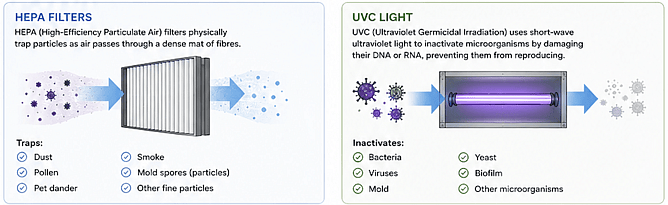
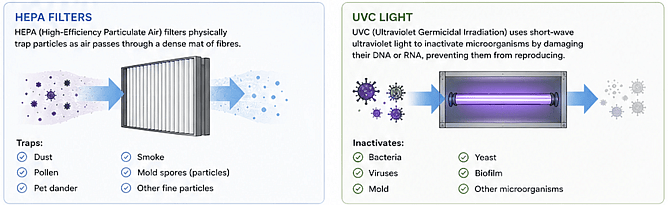
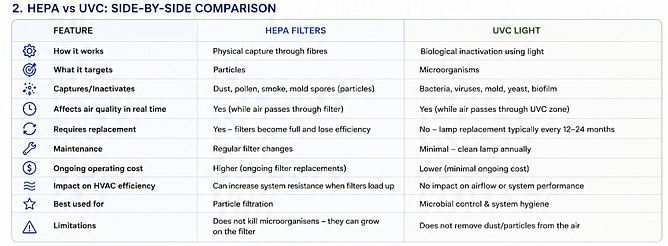
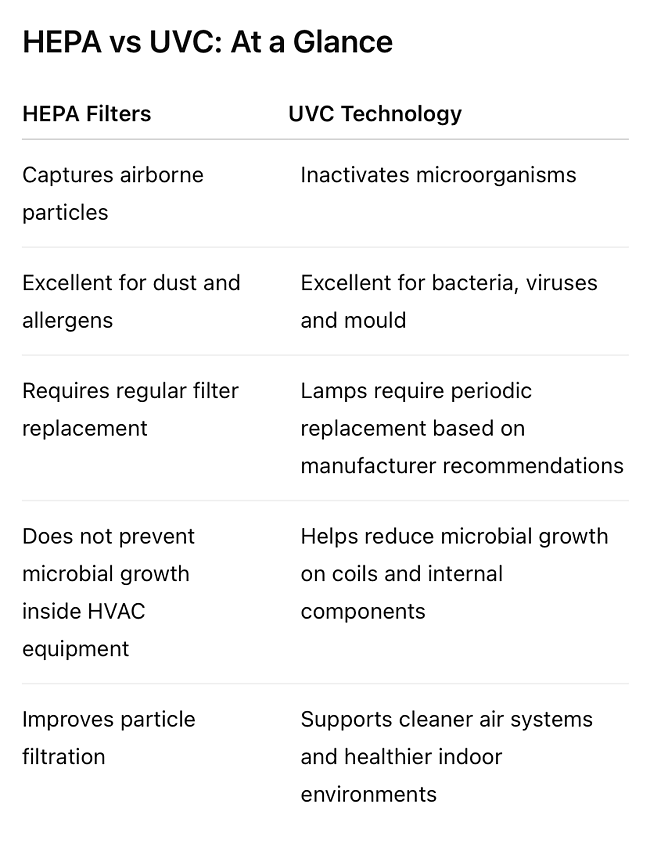
A HEPA filter works by physically trapping tiny airborne particles as air passes through a dense network of fibres.
A quality HEPA filter can capture at least 99.97% of particles that are 0.3 microns in size, including many particles that are both larger and smaller than this most penetrating particle size.
HEPA filters are excellent at removing:
Dust
Pollen
Pet dander
Smoke particles
Many mould spores
Fine airborne particles
This makes them particularly effective for improving air quality for allergy and asthma sufferers.
However, it's important to understand what a HEPA filter doesn't do.
What a HEPA Filter Can't Do
A HEPA filter is designed to capture particles—not destroy them.
That means bacteria, mould spores and other microorganisms can become trapped within the filter media.
While high-quality HEPA systems are designed to retain these contaminants, the filter itself does not inactivate or sterilise them. As filters become loaded over time, they require regular replacement to maintain airflow and performance.
HEPA filtration is incredibly effective—but it addresses only one part of the indoor air quality equation.
What Is UVC Technology?
Ultraviolet Germicidal Irradiation (UVC) uses a specific wavelength of ultraviolet light to inactivate microorganisms by damaging their DNA or RNA, preventing them from reproducing.
Unlike HEPA filtration, UVC doesn't capture particles.
Instead, it targets biological contaminants such as:
Bacteria
Viruses
Mould
Yeast
Fungi
Biofilm-forming microorganisms
When installed inside a heat pump or HVAC system, UVC works continuously to help keep internal components cleaner while treating microorganisms carried through the airflow.
Different Technologies. Different Jobs.
One of the easiest ways to understand the difference is to think of it this way:
HEPA is like a net.
It catches unwanted particles as they pass through.
UVC is like a sanitiser.
It inactivates microorganisms so they can no longer reproduce or continue contaminating the system.
One captures.
One neutralises.
Neither replaces the other.
Why Hospitals Often Use Both
Hospitals, laboratories, pharmaceutical facilities and other critical environments rarely rely on a single air treatment technology.
Instead, they commonly combine multiple layers of protection.
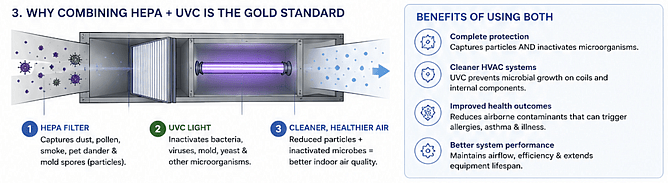
A HEPA filter removes airborne particles from the air stream.
UVC technology helps reduce microbial contamination within the air handling system and on internal HVAC components.
This layered approach helps create cleaner, healthier indoor environments while supporting ongoing HVAC hygiene.
It's a strategy that is now becoming increasingly common in commercial buildings, schools, healthcare facilities, and high-performance homes.
Which Technology Is Better?
The better question is:
What problem are you trying to solve?
If your goal is reducing dust, pollen and allergens…
HEPA filtration is an excellent solution.
If your goal is reducing microbial growth inside your HVAC system…
UVC technology is the better choice.
If your goal is the healthiest indoor environment possible…
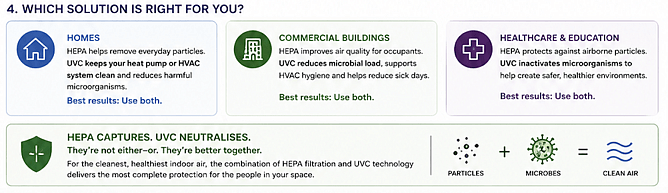
The answer is both.
Each technology addresses a different aspect of indoor air quality, and together they provide a more complete solution than either can achieve alone.
The Hidden Advantage of UVC
One of the biggest differences between HEPA and UVC is where they work.
HEPA filters primarily clean the air passing through the filter.
UVC also helps protect the HVAC system itself.
Inside many heat pumps and air conditioning systems, moisture can allow mould and biofilm to develop on evaporator coils, drain trays and other internal components.
Over time, this build-up can:
Reduce airflow
Lower energy efficiency
Increase maintenance requirements
Create unpleasant odours
Contribute to poor indoor air quality
By helping prevent microbial growth on these surfaces, UVC supports cleaner equipment, improved performance and can contribute to extending the lifespan of your HVAC system.
This makes UVC not only an indoor air quality solution, but also an investment in protecting one of the most valuable mechanical systems in your home or building.
Which Buildings Benefit Most?
The combination of HEPA filtration and UVC technology can benefit almost any indoor environment, including:
Homes
Offices
Schools and early childhood centres
Healthcare facilities
Retirement villages
Hotels
Gyms
Commercial buildings
Hospitality venues
Manufacturing facilities
Wherever people spend time indoors, cleaner air can support healthier, more comfortable spaces.
The Future of Indoor Air Quality
As New Zealand continues to focus on healthier homes and better-performing buildings, indoor air quality is becoming just as important as temperature, insulation and energy efficiency.
The conversation is shifting from simply filtering air to actively improving its quality.
HEPA filters and UVC technology each play an important role in that future.
Together, they don't just clean the air—they help create buildings that support the health of the people inside them.
Looking Beyond Clean Air
At AirTechnologies NZ, we believe indoor air quality should be treated as an essential part of every healthy building.
Whether you're protecting your family at home, improving conditions in a workplace, or designing healthier commercial spaces, understanding the strengths of both HEPA filtration and UVC technology is the first step toward making informed decisions.
Because when it comes to the air we breathe every day, the best solution isn't choosing between HEPA and UVC—it's understanding how they work together to create cleaner, healthier indoor environments.