Could Your Building Be Affecting How You Feel?
Have you ever walked into a building and, after a few hours, started to experience:
Headaches
Fatigue
Difficulty concentrating
Dry or irritated eyes
A blocked or runny nose
Dry throat
Coughing
Allergy-like symptoms
Then, after leaving the building, the symptoms gradually disappeared?
If so, you may have experienced something known as Sick Building Syndrome (SBS).
Despite the name, it doesn't mean the building itself is "sick." Rather, it's a term used to describe situations where occupants experience symptoms that appear to be linked to time spent in a particular building, without a single identifiable illness or cause.
As New Zealand continues to focus on healthier homes and workplaces, understanding Sick Building Syndrome has never been more important.
What Is Sick Building Syndrome?
Sick Building Syndrome is a term used to describe a collection of symptoms experienced by people spending time inside certain buildings.
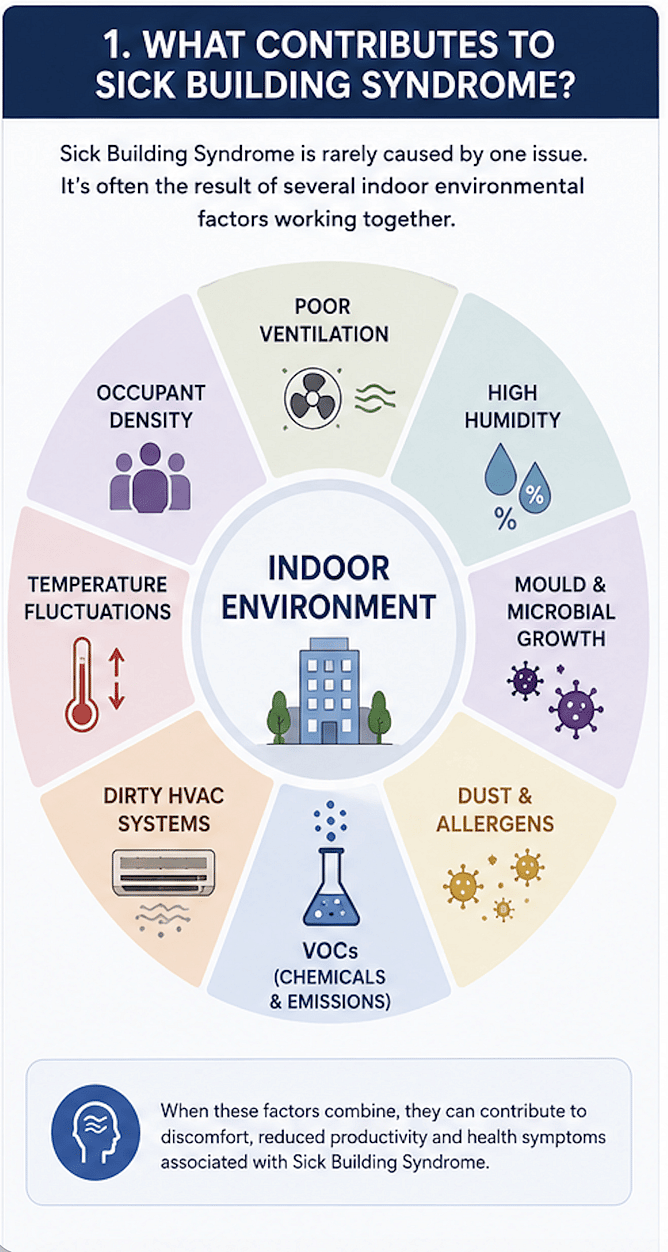
Unlike diseases with one clear cause, SBS is usually linked to multiple environmental factors working together.
These may include:
Poor indoor air quality
Inadequate ventilation
High humidity
Temperature fluctuations
Airborne dust and allergens
Volatile Organic Compounds (VOCs) from furnishings, paints or cleaning products
Microbial contamination, including mould and bacteria
Poorly maintained HVAC or heat pump systems
Often, no single issue is responsible. Instead, several small problems combine to affect the comfort and wellbeing of building occupants.
Why Indoor Air Quality Matters
Most of us spend around 90% of our lives indoors.
Whether we're at home, work, school, the gym, or a shopping centre, we're constantly breathing indoor air.
Yet while we pay close attention to nutrition, exercise, sleep, and mental wellbeing, Indoor Air Quality (IAQ) is still one of the most overlooked aspects of health.
The air inside a building can contain:
Dust
Pollen
Mould spores
Bacteria
Viruses
Pet dander
Smoke particles
VOCs
Moisture and humidity
When these contaminants accumulate, they can contribute to an indoor environment that feels stuffy, uncomfortable, or irritating for some occupants.
The Hidden Role of HVAC Systems
Most people assume that if their heat pump or air conditioning system is running, their air must be clean.
Unfortunately, that's not always the case.
Inside every HVAC system are components such as:
Cooling coils
Fan barrels
Drain trays
Internal air passages
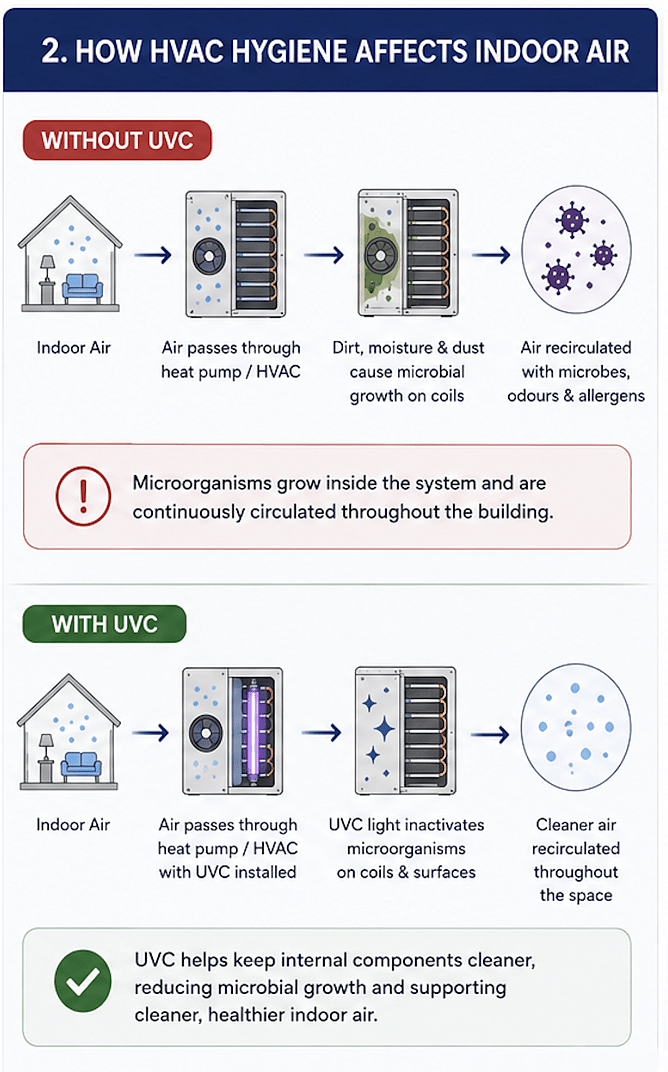
These areas are regularly exposed to moisture and airborne particles.
Over time, this creates an environment where mould, bacteria and biofilm can develop if systems are not properly maintained.
Every time the system operates, air passes over these internal components before being distributed throughout the building.
This is why HVAC hygiene is becoming an increasingly important part of modern building management.
Signs Your Building May Have Poor Indoor Air Quality
While only a professional assessment can determine the condition of a building, common warning signs include:
Persistent musty odours
Condensation problems
Visible mould growth
Occupants frequently experiencing headaches or fatigue indoors
Allergy symptoms that improve after leaving the building
Stale or stuffy air
Excessive dust
Heat pumps producing unpleasant smells
These signs don't necessarily mean a building has Sick Building Syndrome, but they may indicate that it's time to investigate the indoor environment more closely.
Modern Buildings: More Efficient, But More Sealed
Today's buildings are designed to be energy efficient.
Improved insulation, double glazing and airtight construction help reduce heating and cooling costs.
However, there can be a trade-off.
When fresh air exchange is limited, contaminants may remain indoors for longer unless ventilation and air treatment systems are designed and maintained effectively.
A warm building isn't always a healthy building.
Comfort and indoor air quality are closely linked—but they are not the same thing.
Creating Healthier Indoor Environments
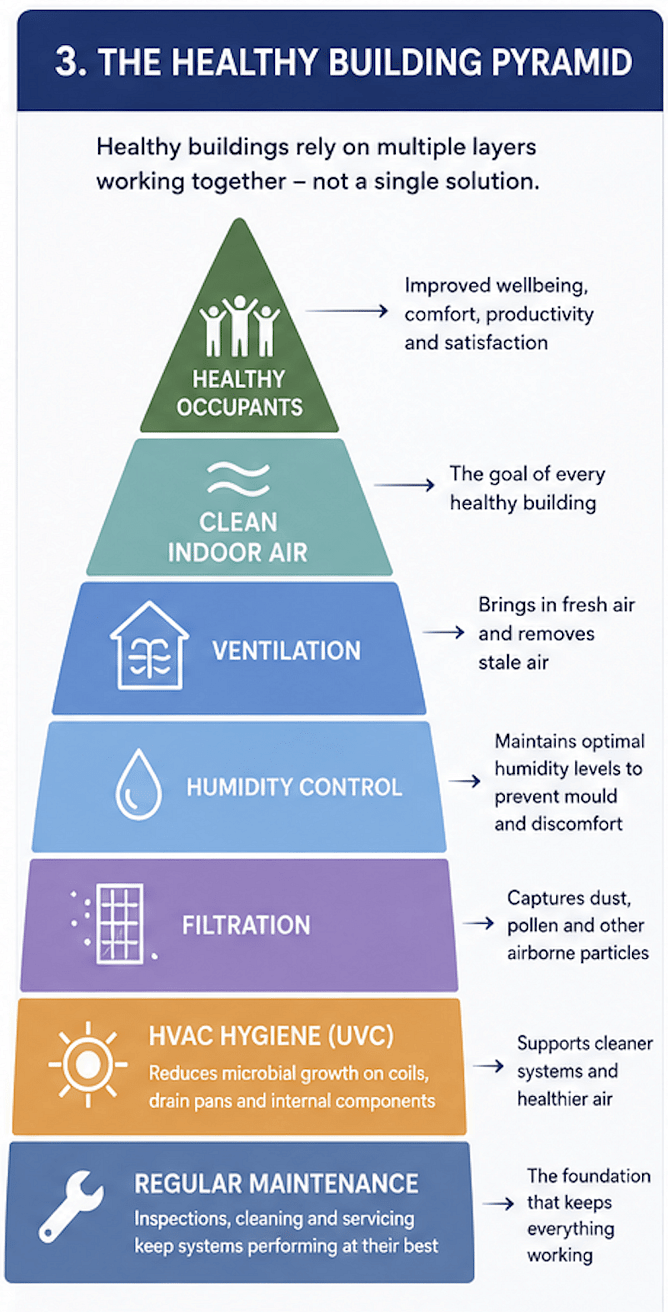
Improving indoor air quality usually involves several strategies working together.
These may include:
Regular HVAC servicing
Good ventilation
Managing indoor humidity
High-quality filtration
Prompt mould remediation
Routine building maintenance
Continuous microbial control where appropriate
There is rarely one single solution.
Instead, healthier buildings are created through multiple layers of protection.
Where UVC Fits In
Ultraviolet Germicidal Irradiation (UVC) is increasingly being used as part of comprehensive indoor air quality strategies around the world.
Installed inside HVAC systems and heat pumps, UVC helps:
Reduce microbial growth on internal components
Keep evaporator coils cleaner
Minimise biofilm build-up
Support cleaner air circulation
Maintain HVAC hygiene between servicing
Rather than replacing regular maintenance or filtration, UVC complements them by addressing microbial contamination at its source.
Healthy Buildings Are the Future
For years, building owners focused on three things:
Heating
Cooling
Energy efficiency
Today, there's a fourth priority:
Occupant wellbeing.
People increasingly expect the buildings they live, work and learn in to support their health—not simply provide shelter.
Indoor air quality is becoming a key part of that conversation.
Forward-thinking organisations are recognising that healthier indoor environments can contribute to greater comfort, improved satisfaction, and better-performing buildings.

A Smarter Way to Think About Buildings
Imagine if we treated the air inside our buildings with the same importance as the food we eat or the water we drink.
We wouldn't knowingly consume contaminated water.
We carefully choose nutritious food.
Yet many of us spend almost our entire day breathing air that we've never really thought about.
As awareness grows, Indoor Air Quality will become one of the defining features of healthy buildings across New Zealand.

The Air You Breathe Matters
At AirTechnologies NZ, we believe healthier buildings begin with healthier air.
Our advanced UVC solutions are designed to integrate directly into existing heat pumps and HVAC systems, helping improve HVAC hygiene, reduce microbial growth, and support cleaner indoor environments.
Because the healthiest buildings aren't just comfortable—they're designed with the people inside them in mind.