Mould is one of the most persistent indoor air quality problems in New Zealand.
It can appear on walls, ceilings, windows and furniture — but some of the most important mould growth in a building can be happening somewhere you cannot easily see it: inside your heating and air conditioning system.
This raises an important question:
Can UVC actually kill mould?
The short answer is yes — UVC can inactivate mould and other microorganisms when the right wavelength, intensity and exposure time are achieved. However, UVC is not a magic solution for an existing mould problem. It works best as part of a broader approach that addresses moisture, ventilation, filtration and HVAC hygiene.
Let's look at what the science says.
What is mould?
Mould is a type of fungus that reproduces by releasing microscopic spores into the environment.
Mould spores are naturally present in both indoor and outdoor air. They become a problem when they encounter the conditions they need to grow — particularly:
Moisture
Warmth
Organic material
Poor ventilation
Condensation
Persistent humidity
Once established, mould can release spores and other biological particles into the surrounding environment.
This is why simply wiping away visible mould doesn't necessarily solve the underlying problem.
If the moisture source remains, mould can return.
So, can UVC kill mould?
Yes.
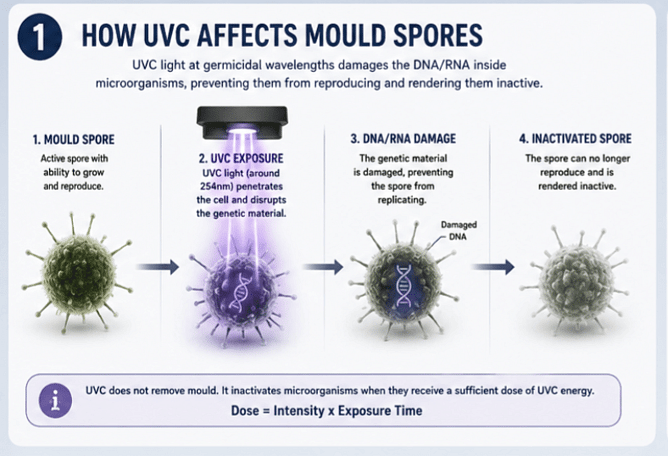
Germicidal ultraviolet-C radiation can damage the DNA and RNA of microorganisms, preventing them from reproducing and, depending on the dose, rendering them inactive.
UVC has been studied for decades as a method of microbial control and is used in applications ranging from healthcare and laboratories to water treatment, food processing and HVAC systems.
Mould is more complex than many bacteria and viruses because fungal spores can be relatively resistant to environmental conditions. This means the effectiveness of UVC depends heavily on dose.
It isn't simply a matter of installing a UVC lamp and assuming everything exposed to it will instantly disappear.
How does UVC affect mould?
UVC works by delivering ultraviolet energy to microorganisms.
At germicidal wavelengths, typically around 254 nanometres (nm) for traditional low-pressure mercury UVC lamps, the radiation can damage the genetic material of microorganisms.
For mould spores, sufficient UVC exposure can cause damage that prevents them from successfully reproducing.
Think of it like this:
UVC energy → damages microbial DNA/RNA → prevents replication → microorganism is inactivated
However, there is an important distinction:
UVC doesn't "clean" mould away.
If you have visible mould growing on a wall, carpet or ceiling, installing a UVC lamp won't remove the physical mould growth.
The source of moisture needs to be identified and corrected, and contaminated materials may need to be professionally cleaned or removed.
Where UVC becomes particularly interesting is airborne microorganisms and microorganisms growing inside HVAC systems.
Why mould inside HVAC systems matters
Heating and air conditioning systems can provide several of the conditions microorganisms need to grow.
Inside an HVAC system you may have:
Moisture
Condensation
Dust
Organic particles
Warm surfaces
Limited access for cleaning
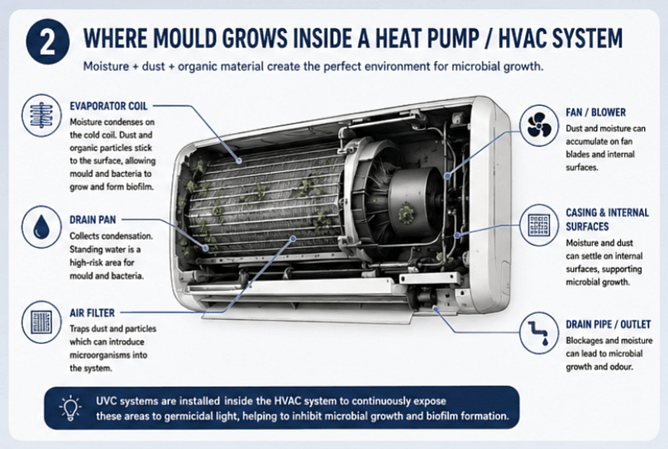
One area of particular concern is the evaporator coil.
As warm air passes across a cold coil, moisture can condense on its surface. Dust and airborne particles can accumulate on the wet surface, creating an environment where microorganisms can establish themselves.
Over time, microbial growth can contribute to what's known as biofilm.
Biofilm is a layer of microorganisms and organic material that can adhere to a surface.
And once established, it can be difficult to remove completely.
UVC and HVAC coils
This is where UVC can provide an important additional layer of protection.
A properly designed UVC system can be installed within an HVAC or heat pump system so that the relevant components receive continuous or scheduled UVC exposure.
The objective isn't simply to treat the air as it passes through.
The UVC can also provide exposure to surfaces such as:
Cooling coils
Drain pans
Internal HVAC surfaces
Other areas where moisture and microbial growth may occur
This can help reduce or inhibit microbial growth and biofilm formation when the system has been correctly designed and sized.
The result can be a cleaner HVAC environment and reduced biological contamination within the system.
But will UVC stop mould coming back?
This is where it is important to be realistic.
UVC does not fix the cause of mould.
If a building has a leaking roof, plumbing leak, rising damp, excessive condensation or persistently high humidity, installing UVC won't solve the underlying moisture problem.
The first step should always be identifying and addressing the source of moisture.
Think of mould prevention as a system:
1. Control moisture
Fix leaks, condensation and water intrusion.
2. Improve ventilation
Remove excess humidity and bring in appropriate amounts of outdoor air.
3. Remove existing mould
Clean or remediate contaminated materials appropriately.
4. Improve filtration
Use appropriate filtration to capture airborne particles and spores.
5. Maintain HVAC systems
Keep coils, filters, drain pans and other components clean.
6. Consider UVC
Use UVC as an additional layer of microbial control within the HVAC or air purification system.
UVC works best as part of this overall strategy — not as a replacement for it.
UVC vs mould: what can it actually do?
It's useful to separate three different situations.
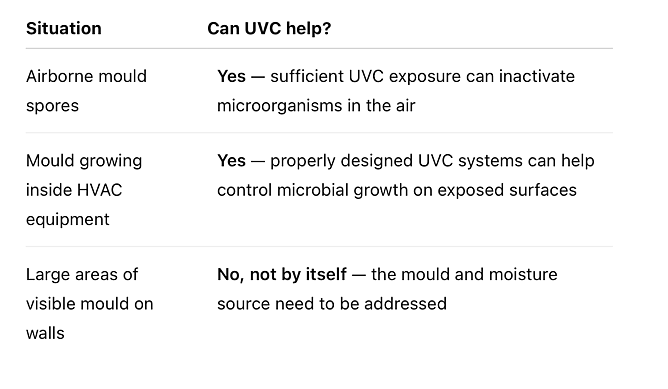
This distinction is important.
UVC is a microbial control technology, not a mould-remediation service.
Why UVC dose matters
One of the biggest misconceptions about UVC is that simply having a UV lamp somewhere in a room or duct automatically makes the air "sterile."
It doesn't.
The effectiveness of UVC depends on factors including:
Wavelength
The UVC source needs to produce germicidal radiation at an appropriate wavelength.
Intensity
How much UVC energy reaches the microorganism?
Exposure time
How long is the microorganism exposed?
Air velocity
Fast-moving air may reduce exposure time.
Distance
UVC intensity decreases as distance from the source increases.
System design
Lamp placement, reflective surfaces, airflow and equipment geometry all affect the delivered dose.
This is why professional system design matters.
A high-powered lamp installed in the wrong location isn't necessarily more effective than a correctly designed system.
What about mould spores travelling through the air?
Mould spores are extremely small and can become airborne.
When airborne spores pass through an appropriately designed UVC treatment zone, they can receive a dose of germicidal UV energy.
If the delivered dose is sufficient, the UVC can damage the spore's genetic material and reduce its ability to reproduce.
This is one reason HVAC-based UVC can be useful.
Instead of attempting to disinfect an entire room directly, UVC can be installed inside the air-handling pathway.
Air continually passes through the treatment zone as the HVAC system operates.
That creates repeated opportunities for airborne microorganisms to receive UVC exposure.
Does UVC kill mould on surfaces?
Potentially — but the answer is more complicated.
UVC can be effective against microorganisms on exposed surfaces when the surface receives a sufficient dose.
However, real-world surfaces aren't always easy to irradiate.
Mould can grow in:
Cracks
Crevices
Behind materials
Under dust
Inside porous materials
Areas that don't receive direct UVC exposure
UVC is essentially line-of-sight.
If the radiation can't reach the microorganism, it can't deliver the required dose.
This is another reason why HVAC UVC installations need to be carefully designed.
Can UVC replace a HEPA filter?
No.
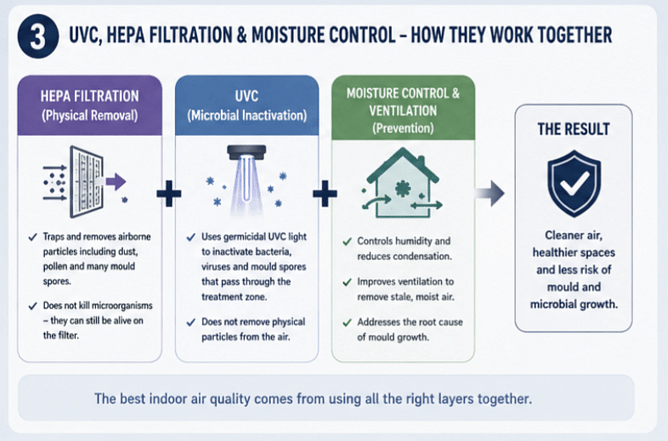
UVC and HEPA filtration perform different jobs.
HEPA filtration
A HEPA filter physically captures very small airborne particles, including many particles in the size range associated with mould spores.
UVC
UVC doesn't physically remove particles from the air.
Instead, it uses ultraviolet energy to inactivate microorganisms that receive sufficient exposure.
This means the two technologies can complement each other.
For example:
Filtration → captures particles
UVC → inactivates susceptible microorganisms
This layered approach can be particularly useful where indoor air quality is a priority.
What about an ordinary heat pump?
Many New Zealand homes rely on heat pumps for heating and cooling.
But a heat pump is more than just a heater.
During operation, indoor air continuously passes through the unit.
Over time, dust and biological material can accumulate within the system, particularly around filters, coils and condensate components.
Regular professional heat pump cleaning remains important.
UVC can then provide an additional layer of microbial control within the system.
For homeowners concerned about recurring musty smells, mould or HVAC hygiene, a combination of:
cleaning + moisture control + filtration + UVC
may provide a more comprehensive approach than relying on any single technology.
Is UVC safe?
UVC can be harmful to skin and eyes when people are directly exposed to germicidal UV radiation.
That's why UVC systems need to be designed so that occupants aren't exposed to the lamp's radiation.
In HVAC applications, UVC lamps are typically installed inside the equipment or ductwork where the radiation is contained.
This is very different from simply placing an exposed UVC lamp in an occupied room.
A professionally installed system should be designed with appropriate shielding, installation procedures and safety considerations.
Never look directly at an operating germicidal UVC lamp or expose your skin or eyes to it.
What about ozone?
Another important consideration when choosing an air purification system is whether the technology produces ozone.
Not all UV technologies are the same.
Some UVC systems use wavelengths and lamp designs intended for germicidal applications without intentionally generating ozone, while other ultraviolet technologies can generate ozone.
If you're considering a UVC system for your home or business, ask the supplier:
"Does this system generate ozone?"
and request the relevant technical information.
At AirTechnologies NZ, our UVC air purification solutions are designed around controlled UVC treatment within HVAC and air purification applications.
How long does UVC take to kill mould?
There isn't one universal answer.
The effectiveness of UVC depends on the delivered dose, rather than simply the number of seconds a lamp is operating.
Two systems can use identical lamps but produce very different results because of differences in:
Lamp output
Distance
Airflow
Exposure time
Lamp placement
Temperature
Surface reflectivity
System geometry
Lamp age
This is why claims such as "one UVC lamp kills all mould" should be treated cautiously.
Effective UVC is about dose and system design.
What does the science actually tell us?
The scientific evidence supporting germicidal UVC is well established, but it's important to interpret it correctly.
Research demonstrates that UV-C radiation can inactivate a wide range of microorganisms, including bacteria, viruses and fungi, when sufficient UV dose is delivered.
However, laboratory results don't automatically translate into identical real-world performance.
A controlled laboratory experiment may expose a microorganism directly to a known UVC dose.
An HVAC system is much more complicated.
Airflow, humidity, dust, shadows, surface contamination and lamp placement can all influence the actual dose received.
Therefore, the better question isn't:
"Does UVC kill mould?"
It's:
"Can a properly designed UVC system deliver enough germicidal UV exposure to meaningfully control mould and other microorganisms in this particular application?"
And the answer is yes — when the system is correctly designed, installed and maintained.
UVC isn't a mould-remediation solution — it's a prevention and control tool
This distinction is critical.
If you already have extensive visible mould in your building, don't simply install a UVC lamp and assume the problem is solved.
Instead:
Find the moisture source.
↓
Fix the moisture problem.
↓
Remove or remediate existing mould.
↓
Clean and maintain the HVAC system.
↓
Improve ventilation and filtration.
↓
Consider UVC as an additional microbial-control measure.
This approach addresses both the cause and the ongoing risk.
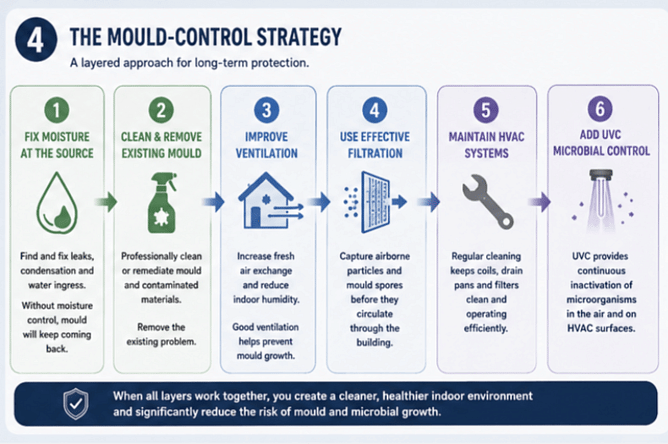
Could UVC help prevent mould inside your HVAC system?
Potentially, yes.
And this is one of the most useful applications of UVC technology.
Rather than waiting until microbial growth becomes a visible problem, UVC can be incorporated into an HVAC system as a preventative layer of microbial control.
When correctly designed, UVC can continuously or regularly expose susceptible microorganisms to germicidal UV radiation as the HVAC system operates.
That can help reduce microbial growth on exposed HVAC surfaces and contribute to cleaner air-handling equipment.
The bottom line
Can UVC really kill mould?
Yes.
UVC can inactivate mould and other microorganisms when they receive a sufficient germicidal dose.
But UVC isn't a substitute for mould remediation, moisture control or proper HVAC maintenance.
The strongest approach is to think about indoor air quality as a layered system:
Moisture control
Ventilation
Filtration
HVAC maintenance
UVC microbial control
Together, these measures can help create a cleaner and healthier indoor environment.
For homes and businesses where mould, biofilm or HVAC hygiene is a concern, a professionally designed UVC system can be an additional tool for controlling microbial growth — particularly within heat pumps, air conditioning systems and commercial HVAC equipment.
Thinking about adding UVC to your HVAC system?
AirTechnologies NZ supplies UVC air purification and sterilisation solutions for homes, businesses and HVAC systems throughout New Zealand.
If you're dealing with recurring mould, musty HVAC smells, poor indoor air quality or concerns about microbial growth inside your air conditioning system, talk to our team about whether UVC could be suitable for your application.
Good indoor air quality starts with understanding what's actually in the air — and what's happening inside the system delivering it.