UVC technology is becoming increasingly popular for improving indoor air quality and controlling microorganisms inside heating, ventilation and air conditioning systems.
But if you're considering installing UVC in your home, there's an important question to ask:
Is UVC safe?
The answer is yes, UVC can be used safely in homes when the system is properly designed, installed and contained.
However, UVC is not something that should be treated like an ordinary household light.
Direct exposure to germicidal UVC can damage the eyes and skin. The safety of a UVC system therefore depends heavily on where the UVC is installed, how it is contained, how it is controlled and whether the installation prevents occupants from being exposed to the radiation.
For residential HVAC applications, this is one of the major advantages of installing UVC inside the heat pump or HVAC system, rather than using an exposed UVC lamp in an occupied room.
Let's look at what homeowners need to know.
What exactly is UVC?
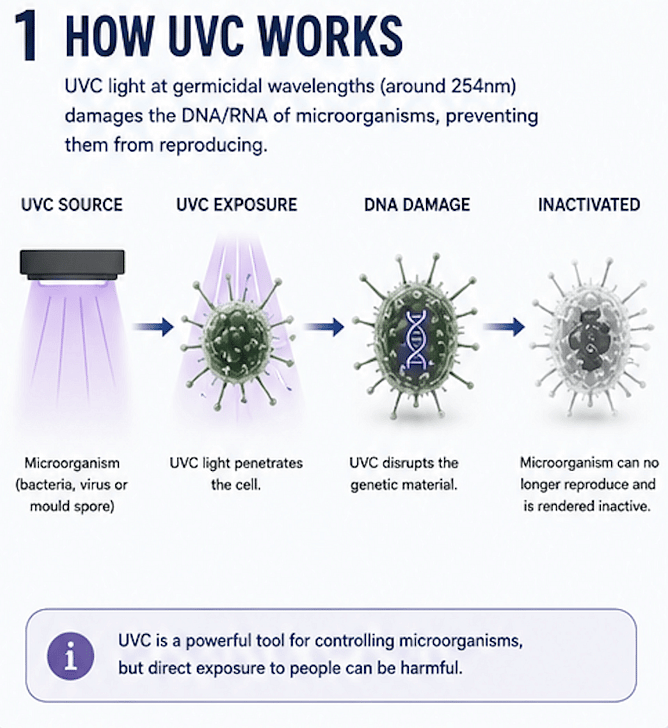
Ultraviolet-C, or UVC, is a portion of the ultraviolet spectrum.
UVC has shorter wavelengths and higher energy than UVA and UVB. Germicidal UVC is used because ultraviolet radiation can damage the genetic material of microorganisms, preventing them from reproducing.
A commonly used germicidal wavelength is around 254 nanometres (nm), particularly from traditional low-pressure mercury lamps.
UVC has been used for decades in applications including:
HVAC systems
Air treatment
Water treatment
Healthcare
Laboratories
Food processing
Commercial buildings
ASHRAE also has specific testing standards for UVC systems used in HVAC applications, including methods for evaluating airborne microbial inactivation and UVC performance on irradiated HVAC surfaces.
But there's an important distinction:
UVC can be useful for controlling microorganisms, but direct exposure to germicidal UVC isn't safe for people.
Is UVC harmful to people?
Direct exposure to germicidal UVC can be harmful.
The FDA states that UVC exposure can cause skin injury and eye injury, including photokeratitis — essentially a painful inflammation of the eye caused by excessive UV exposure.
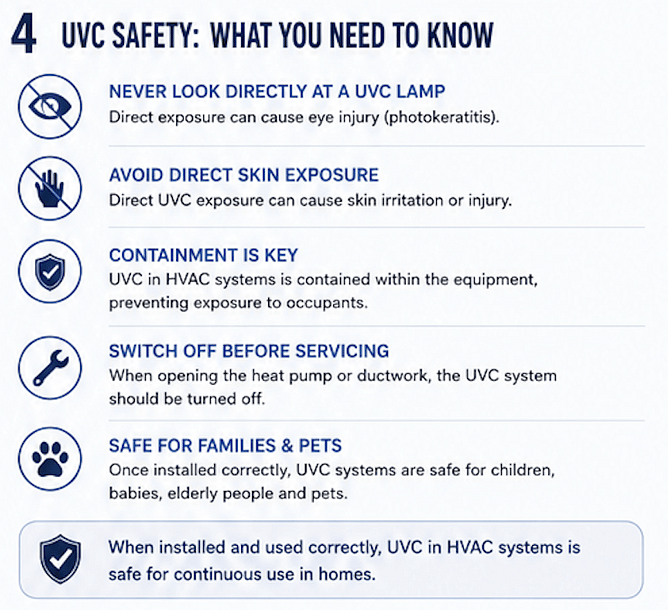
This is why you should never deliberately look at an operating germicidal UVC lamp or expose your skin or eyes to it.
The good news is that this doesn't mean UVC can't be used safely in occupied buildings.
It means the system needs to be designed so that people aren't directly exposed to the UVC radiation.
This is similar to many other technologies we use safely every day.
The technology itself can present a hazard, but proper engineering controls can prevent people from coming into contact with that hazard.
The difference between an exposed UVC lamp and HVAC UVC
This is one of the most important things for homeowners to understand.
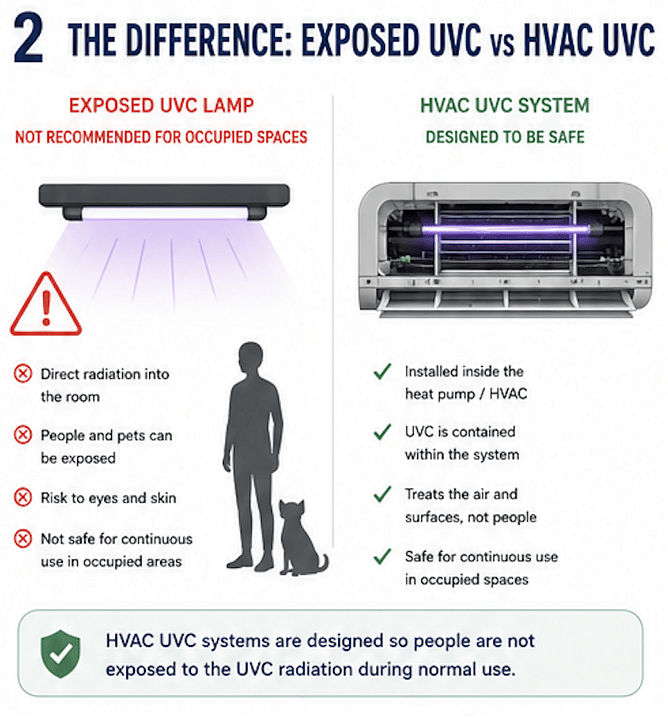
There is a major difference between:
An exposed UVC lamp sitting in an occupied room
and
A UVC system installed inside a heat pump or HVAC system.
An exposed lamp can potentially irradiate people directly.
An HVAC UVC system is installed within the equipment or air-handling pathway, where the UVC radiation is contained.
The objective is:
Treat the air and HVAC components — without exposing the occupants.
ASHRAE's guidance on germicidal ultraviolet systems specifically recognises the importance of preventing or minimising occupant exposure to germicidal UV radiation.
How does UVC work inside a heat pump?
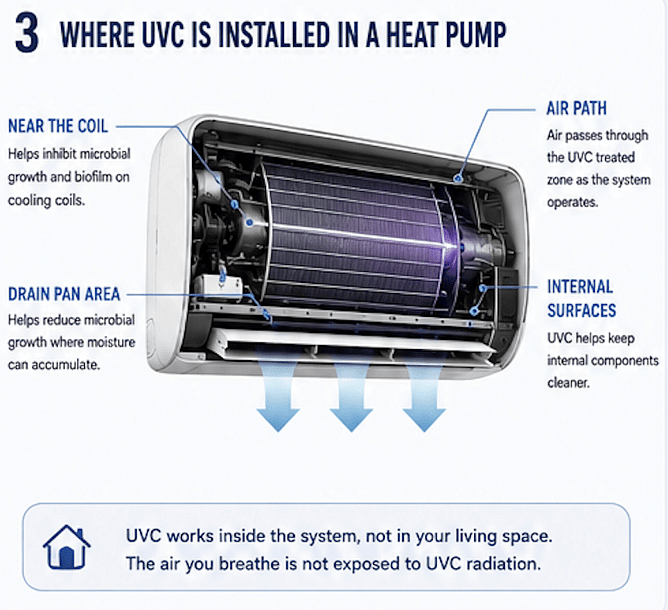
Imagine the inside of a heat pump.
Air enters the indoor unit, passes through the filters and coil, and is then distributed back into the room.
Over time, dust, moisture and organic material can accumulate inside the system.
This can contribute to microbial growth and biofilm, particularly around areas such as cooling coils and condensate components.
A properly installed UVC system places the UVC source within the HVAC equipment.
As the system operates, the UVC provides germicidal irradiation within the treatment area.
This can help:
Inactivate susceptible airborne microorganisms
Reduce microbial growth on exposed HVAC surfaces
Help inhibit biofilm formation
Support cleaner internal HVAC components
Complement normal HVAC cleaning and maintenance
The UVC itself remains contained within the equipment.
Can you see UVC light?
Some UVC lamps may produce a faint visible glow, depending on their construction.
However, the visible glow isn't what makes UVC germicidal.
UVC is largely invisible to the human eye.
This is important because you shouldn't use the absence of visible light as an indication that a UVC lamp is safe to look at.
If a UVC lamp is operating, treat it as a source of potentially hazardous UV radiation regardless of what you can see.
What happens if someone accidentally looks at UVC?
Direct UVC exposure to the eyes can cause an injury called photokeratitis.
It can feel similar to having something gritty or sandy in your eyes.
Symptoms can include:
Eye pain
Redness
Light sensitivity
Excessive watering
A sensation of something being in the eye
The FDA notes that UVC eye injury can occur after relatively short exposure to sufficiently intense UVC radiation.
This is why safety features and installation practices matter.
If a UVC lamp is installed inside an HVAC unit, access to the lamp should be controlled and people should not be able to view the operating lamp during normal use.
What about your skin?
Direct UVC exposure can also cause skin injury.
The FDA advises avoiding direct skin exposure to UVC radiation.
Again, this is why containment is fundamental to safe HVAC UVC design.
A homeowner shouldn't be exposed to the UVC lamp as part of normal operation.
If the HVAC unit needs to be opened for servicing, the UVC system should be switched off and appropriate safety procedures followed.
What about children and pets?
This is a common concern for families.
Children and pets should not have direct access to operating UVC lamps.
The safest approach for residential applications is to use a properly installed system where the UVC source is contained within the HVAC equipment.
This means the family can continue using the room normally while the UVC system operates within the HVAC system.
The same principle applies to:
Babies
Young children
Elderly people
Pets
Visitors
Anyone else occupying the home
The goal is simple:
The UVC should treat the HVAC system and air — not the people living in the home.
What about ozone?
Ozone is another important consideration when choosing an air purification system.
Some ultraviolet technologies can generate ozone depending on the wavelength and lamp design.
Ozone is not something you want to introduce unnecessarily into an occupied home.
The FDA notes that some UVC lamps can generate ozone, which may irritate the respiratory system.
This means homeowners should ask questions before purchasing any UV or air purification product.
Ask:
Does the system generate ozone?
What wavelength does the system use?
Is the UVC source contained during normal operation?
What safety features are included?
What happens when the HVAC access panel is opened?
A reputable supplier should be able to answer these questions clearly.
Don't confuse UVC HVAC systems with cheap UV wands
This is particularly important.
There are consumer products on the market that use exposed UVC lamps or handheld UV wands.
The FDA has issued warnings about certain UV wands because testing found that some could expose users to unsafe levels of UVC radiation within seconds.
These products are fundamentally different from a properly designed in-duct or HVAC-mounted UVC system.
With a handheld lamp, the user is deliberately bringing the UVC source close to their body and looking at or handling the device.
With an HVAC installation, the UVC source is designed to operate within the equipment and away from normal occupant exposure.
So when someone asks:
"Is UVC safe?"
the better question is:
"Is this particular UVC system safely designed and installed for its intended application?"
What makes an HVAC UVC installation safer?
There are several important considerations.
1. Containment
The UVC radiation should remain within the HVAC equipment or designated treatment zone.
2. Correct installation
The UVC lamp needs to be installed in the appropriate location within the system.
3. Access control
People shouldn't be able to directly view or access an operating UVC lamp during normal operation.
4. Safety procedures
When equipment needs to be opened for cleaning or maintenance, the UVC system should be switched off.
5. Appropriate system design
Lamp output, placement, airflow, distance and exposure time all influence performance.
6. Suitable materials
UVC can degrade some plastics, rubber and other materials over prolonged exposure.
The system therefore needs to be installed with consideration for the materials surrounding the UVC source.
ASHRAE's HVAC guidance includes dedicated information on germicidal UV systems, including safety, installation and commissioning considerations.
Can UVC damage your heat pump?
UVC can affect some materials over time.
Certain plastics, rubber, fabrics and other materials can degrade when repeatedly exposed to UV radiation.
This doesn't mean UVC shouldn't be installed inside HVAC equipment.
It means lamp positioning and material compatibility need to be considered during system design.
A properly selected and installed system should take the surrounding equipment and components into account.
This is particularly important for long-term installations where the UVC system may operate for thousands of hours.
What happens when the heat pump is serviced?
This is another reason professional installation matters.
A technician may need to open the heat pump to:
Clean the filters
Clean the coil
Inspect components
Replace parts
Service the fan
Inspect the UVC system
The UVC system should be switched off before someone accesses the lamp.
An installation should also make it clear that the UVC source is present.
ASHRAE's guidance includes safety warnings for UVC systems installed inside air-handling equipment and specifically cautions against overriding safety devices.
Is UVC safe to run continuously?
Yes — when the UVC system is designed for continuous operation and is properly contained.
In fact, continuous or extended operation is one of the advantages of HVAC-based UVC.
Rather than relying on someone to remember to switch an air-treatment device on and off, the UVC system can operate as part of the HVAC system.
This provides ongoing exposure of the treatment area to germicidal UVC.
However, operating time should always follow the manufacturer's specifications and installation requirements.
What about UVC and air quality?
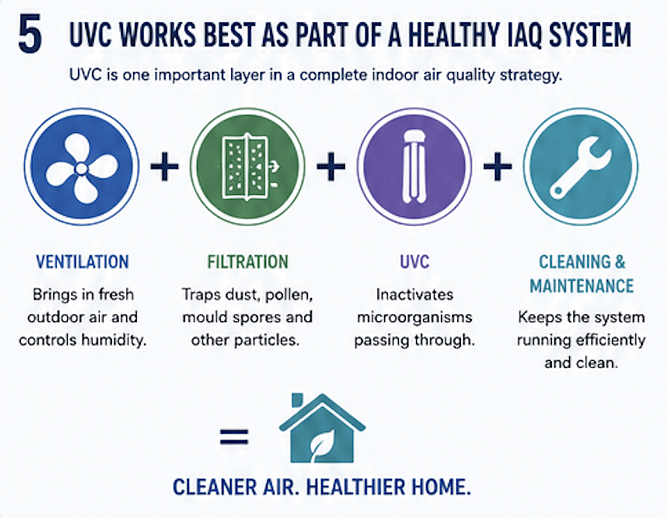
UVC isn't designed to replace ventilation or filtration.
Each technology performs a different role.
Ventilation
Brings appropriate amounts of outdoor air into the building and helps remove indoor contaminants.
Filtration
Physically captures particles from the air.
UVC
Uses germicidal ultraviolet energy to inactivate susceptible microorganisms that receive sufficient exposure.
These technologies can work together.
For example:
Ventilation + filtration + HVAC maintenance + UVC
can provide a more comprehensive indoor air quality strategy than relying on any single technology.
Is UVC safe for people with allergies?
UVC itself isn't an allergy treatment.
However, reducing certain microorganisms and maintaining cleaner HVAC equipment may be relevant to an overall indoor air quality strategy.
It's important not to make the leap from:
"UVC can inactivate microorganisms"
to:
"UVC will cure allergies or respiratory conditions."
Those are very different claims.
If someone in your household has a medical condition or significant respiratory sensitivity, indoor air quality should be discussed with an appropriate healthcare professional as well as being addressed through sensible environmental controls.
Is UVC safe in bedrooms?
A properly installed, contained HVAC UVC system can be used in residential spaces including bedrooms, provided the system is designed for that application.
The important factor isn't whether the room is a bedroom, lounge or office.
It's whether the UVC radiation is properly contained and prevented from directly exposing occupants.
This is particularly important in bedrooms because people may spend many hours there.
A contained HVAC installation means the UVC operates inside the equipment rather than exposing the room's occupants to germicidal radiation.
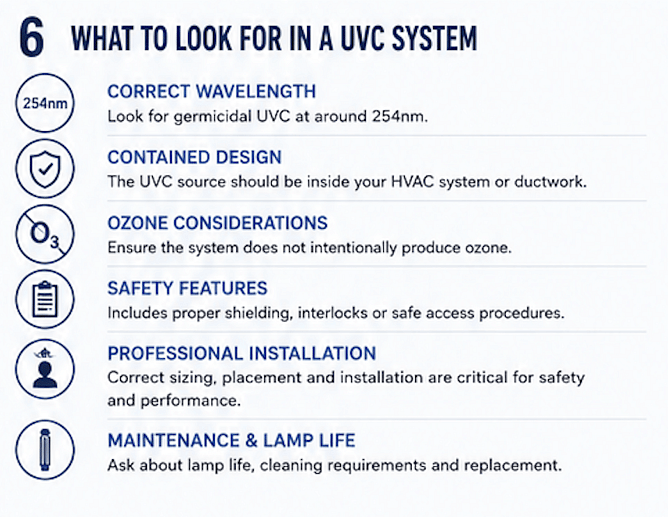
What should homeowners look for when buying a UVC system?
Don't simply choose a UVC product based on wattage or price.
Ask the supplier:
1. What wavelength does it use?
Find out what type of UV radiation the system produces.
2. Where is the UVC installed?
Is it inside the HVAC system, inside a duct, or exposed in the room?
3. How is occupant exposure prevented?
A reputable supplier should be able to explain this.
4. What happens when the HVAC unit is opened?
Ask about shutdown procedures or safety interlocks.
5. Does it generate ozone?
This should be clearly explained.
6. How is the system sized?
UVC effectiveness depends on more than lamp wattage.
7. What maintenance is required?
Ask about lamp life, cleaning and replacement.
8. Has the system been independently tested?
Look for appropriate technical data and recognised testing methods.
ASHRAE Standard 185.1 provides a testing method for UVC lights used in air-handling units or air ducts to evaluate airborne microorganism inactivation, while Standard 185.2 addresses UVC performance on irradiated HVAC surfaces.
What about UVC installed in an existing heat pump?
One of the advantages of HVAC UVC technology is that it can potentially be integrated into existing equipment.
However, not every heat pump or HVAC system is identical.
Installation needs to take into account:
Available space
Internal geometry
Airflow
Coil position
Electrical requirements
Access for maintenance
UVC exposure to surrounding materials
Safety and containment
A proper assessment should therefore happen before installation.
UVC safety isn't about avoiding UVC — it's about controlling exposure
This is perhaps the most important point of the entire article.
UVC is powerful enough to inactivate microorganisms.
That same energy means direct human exposure needs to be controlled.
The solution isn't to avoid UVC altogether.
The solution is to engineer the system so that:
The microorganisms receive the UVC.
The people don't.
That's the fundamental principle behind contained HVAC UVC systems.
So, is UVC safe in homes?
Yes — when properly designed, installed and contained.
Direct exposure to germicidal UVC can injure the eyes and skin, so exposed UVC lamps should never be used casually around people.
But UVC installed correctly inside an HVAC or heat pump system is a very different application.
A properly designed system can provide ongoing microbial control within the HVAC system while keeping the UVC radiation away from the people occupying the home.
The key considerations are:
Correct wavelength + Correct installation + Containment + Appropriate safety controls + Proper maintenance = A safer HVAC UVC installation
The bottom line
UVC isn't inherently "safe" or "unsafe."
The application and installation matter.
Direct exposure to germicidal UVC should be avoided.
But when UVC is professionally installed inside a heat pump, duct or HVAC system, the radiation can be contained within the equipment while providing ongoing microbial control.
For homeowners considering UVC, don't just ask:
"Does it work?"
Ask:
"How does it work, how is it installed, and how is occupant exposure controlled?"
Those are the questions that matter.
At AirTechnologies NZ, we specialise in UVC air purification and sterilisation solutions designed for integration with residential and commercial HVAC systems.
If you're considering UVC for your home and want to know whether it is suitable for your heat pump or air conditioning system, talk to the AirTechnologies NZ team about your application.
Important safety note
This article is provided for general information and is not a substitute for the manufacturer's installation instructions, professional electrical/HVAC advice or applicable safety requirements.
Never look directly at an operating germicidal UVC lamp or deliberately expose skin or eyes to UVC radiation.
For installation, servicing or modification of a UVC system, use appropriately qualified professionals and follow the manufacturer's safety instructions.