We spend a huge amount of time inside our homes — but how often do we think about the air we're breathing?
Indoor air can contain a mixture of dust, pollen, mould spores, bacteria, viruses, allergens, particles, gases and other pollutants. In a home that is poorly ventilated, damp, cold or inadequately maintained, these contaminants can build up.
And in New Zealand, indoor air quality can be particularly important.
Our homes need to balance warmth, insulation, ventilation and moisture control. Improving one area without considering the others can sometimes create new problems. For example, making a home more airtight can improve energy efficiency, but without adequate ventilation, indoor moisture and pollutants may accumulate.
The good news is that there are practical things homeowners can do to create cleaner, drier and healthier indoor environments.
In this guide, we'll explain how to improve indoor air quality in a New Zealand home — and where technologies such as filtration and UVC can fit into the bigger picture.
What is indoor air quality?
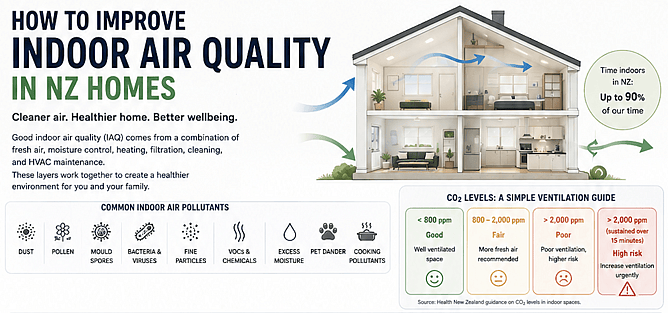
Indoor air quality, or IAQ, refers to the condition of the air inside a building and the presence of pollutants or contaminants that may affect comfort, health or wellbeing.
Common indoor pollutants include:
Dust
Pollen
Mould spores
Bacteria
Viruses
Fine particles
Pet dander
Volatile organic compounds (VOCs)
Smoke
Cooking pollutants
Excess moisture
Carbon dioxide (CO₂)
Not all of these pollutants are dealt with in the same way.
For example:
Ventilation helps bring in fresh outdoor air and remove stale air.
Filtration captures particles.
Moisture control helps prevent dampness and mould growth.
Heating helps maintain a warmer, drier indoor environment.
UVC can provide an additional layer of microbial control within appropriately designed HVAC systems.
Good indoor air quality therefore isn't about finding one "magic" product.
It's about getting the different layers working together.
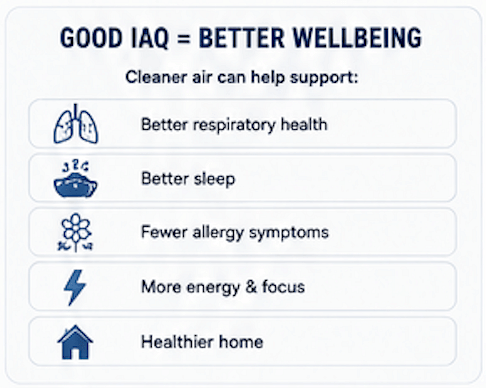
Why does indoor air quality matter in New Zealand?
New Zealand homes can experience challenges associated with dampness, condensation, insufficient heating and ventilation.
Environmental Health Intelligence New Zealand's 2025 analysis of 2023 Census data found that 29.2% of rental households and 13.1% of owner-occupied households reported dampness, while 22.9% of rental households and 10.4% of owner-occupied households reported mould.
Health New Zealand also recommends keeping homes warm and dry, noting that cold, damp homes can increase the risk of respiratory illnesses and other health problems.
Mould is particularly important because its growth is strongly linked to moisture.
The World Health Organization identifies moisture, temperature, ventilation and building materials among the factors influencing mould growth.
So improving indoor air quality isn't simply about making the air "cleaner."
It's also about creating an indoor environment where moisture and pollutants are properly controlled.
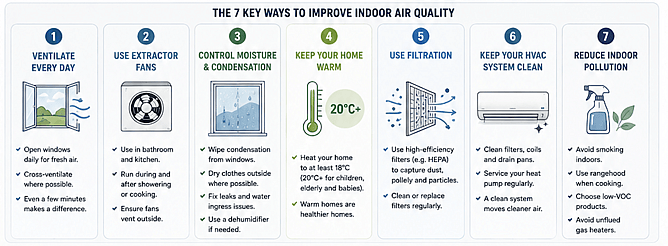
1. Ventilate your home every day
One of the simplest ways to improve indoor air quality is also one of the most important:
Bring fresh air in and stale air out.
Everyday activities add moisture and pollutants to the air.
Think about what happens inside a typical home:
Showering creates steam.
Cooking produces moisture and particles.
Drying clothes releases water vapour.
Breathing produces CO₂ and moisture.
Cleaning can disturb dust and particles.
Candles and other combustion sources can release pollutants.
People and pets introduce particles and biological material.
Without adequate ventilation, these contaminants can accumulate.
Health New Zealand recommends opening windows or doors to improve ventilation and suggests opening windows on opposite sides of a room where possible to help create airflow.
During cold or wet weather, Health New Zealand suggests alternatives such as partially opening a window or opening a window or door for several minutes at a time rather than leaving everything open continuously.
A simple habit:
Open your windows every day when practical and safe.
Even a short period of effective cross-ventilation can help refresh indoor air.
2. Use your kitchen and bathroom extractor fans
Kitchens and bathrooms are two of the biggest moisture-generating areas in a home.
Every shower, bath and cooking session can release significant amounts of water vapour into the indoor environment.
That moisture needs somewhere to go.
Use your extractor fan:
During showering and for a period afterwards.
While cooking and for a period afterwards.
Where possible, extractor systems should discharge air to the exterior rather than simply moving moist air around inside the home.
New Zealand Building Code Clause G4 addresses ventilation and requires occupied spaces to have adequate ventilation consistent with their occupancy and intended use. The current G4/AS1 fifth edition also covers natural, mechanical and combined ventilation systems.
Health New Zealand similarly recommends using extractor fans in kitchens and bathrooms as part of keeping homes dry.
3. Control moisture and condensation
If there's one principle to remember when trying to prevent mould, it's this:
Control moisture.
Mould doesn't appear simply because a house isn't clean.
Mould needs the right conditions to grow, and moisture is one of the most important.
Common sources of indoor moisture include:
Showers
Baths
Cooking
Drying clothes indoors
Condensation
Leaking pipes
Roof leaks
Water ingress
Damp foundations
Poor drainage
Inadequate ventilation
Health New Zealand recommends reducing dampness by ventilating the home, drying clothes outside where possible, using extractor fans, wiping condensation from windows and using a dehumidifier where appropriate.
Look for warning signs.
These can include:
Condensation on windows
Musty smells
Damp carpets
Mould around windows
Mould on ceilings
Damp walls
Peeling paint
Persistent humidity
If mould keeps returning to the same area, don't just keep cleaning it.
Look for the moisture source.
4. Keep your home warm
A warm home isn't just about comfort.
Temperature plays an important role in managing condensation and creating a healthier indoor environment.
Health New Zealand recommends keeping indoor temperatures at at least 18°C where possible, and suggests above 20°C for homes with babies, children or older people.
Heating can also help reduce the conditions that contribute to condensation.
But heating works best as part of a broader strategy.
A warm home with poor ventilation can still accumulate moisture and pollutants.
That's why you want:
Warmth + ventilation + moisture control
rather than simply turning up the heater.
5. Improve insulation and reduce unnecessary draughts
Insulation helps keep heat inside your home.
A better thermal envelope can make it easier to maintain comfortable temperatures and reduce heat loss.
However, there is an important balance.
A more airtight home can reduce uncontrolled air leakage, but it still needs adequate planned ventilation.
The WHO notes that improving insulation and the thermal envelope should be combined with adequate ventilation because poor air circulation can contribute to the accumulation of indoor pollutants and biological contaminants.
So don't think of insulation and ventilation as competing ideas.
A healthy home needs both.
6. Keep your heat pump or HVAC system clean
Your heating and cooling system is an important part of your home's indoor environment.
If your heat pump is circulating air around your home, the condition of the system itself matters.
Over time, dust, moisture and biological material can accumulate around components such as:
Filters
Cooling coils
Fans
Drain pans
Internal surfaces
A dirty HVAC system can contribute to unpleasant smells and may provide conditions that support microbial growth.
Regular maintenance helps keep the system operating effectively and gives you an opportunity to identify problems before they become more significant.
Don't forget the filters.
Follow the manufacturer's instructions for cleaning or replacing filters.
A blocked or dirty filter can restrict airflow and reduce system performance.
7. Consider the air your heat pump is actually moving
There's an important misconception about heat pumps:
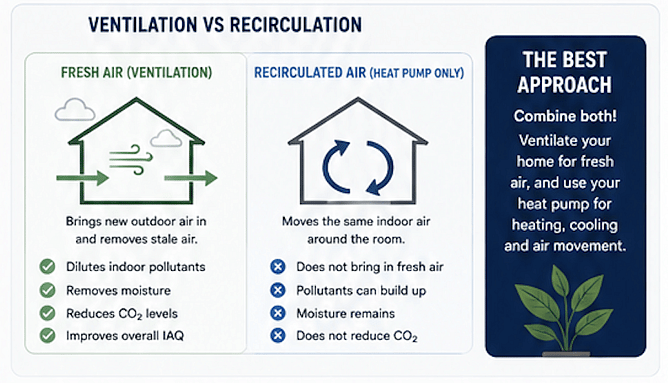
A standard heat pump does not necessarily bring fresh outdoor air into your home.
Many heat pumps and air conditioners primarily recirculate the air already inside the room.
Health New Zealand specifically notes that heat pumps, air conditioners and ceiling fans do not introduce new fresh air; they move existing indoor air around.
That means a heat pump can be excellent for heating and cooling while still not replacing the need for ventilation.
Think of the difference:
Heat pump = heating/cooling and air movement
Ventilation = fresh air exchange
They can work together, but they aren't the same thing.
8. Use filtration to capture airborne particles
Filtration is another important layer of indoor air quality.
A suitable high-efficiency filter can capture airborne particles including:
Dust
Pollen
Some mould spores
Other particulate matter
Health New Zealand notes that HEPA filters can remove dust, pollen, mould, bacteria and aerosols, with HEPA filters capable of filtering 99.97% of particles under the specified testing conditions. It also emphasises that HEPA filtration doesn't replace ventilation, because filtration does not supply fresh outdoor air or reduce CO₂.
This distinction is important.
Filtration removes particles. Ventilation replaces air.
You may need both.
9. Reduce indoor sources of pollution
Sometimes the best way to improve air quality is to stop pollutants entering the air in the first place.
Consider the following:
Avoid smoking indoors
Tobacco smoke introduces a large range of pollutants into indoor air.
Be careful with candles and incense
Combustion can produce particulate matter and other pollutants.
Use your rangehood when cooking
Cooking can release particles, moisture and gases.
Avoid unflued gas heaters
Health New Zealand warns that unflued gas heaters can increase indoor pollutants including nitrogen dioxide and carbon monoxide. It recommends considering heating options that don't produce indoor air pollution, such as electric heating or reverse-cycle air conditioning.
Choose low-emission products where practical
Paints, adhesives, cleaning products, furnishings and other materials can contribute VOCs and other emissions.
Good ventilation is particularly important when using products that release fumes.
11. Deal with mould — don't just cover it up
If you see mould, it's a sign that something needs attention.
Small areas of mould may be able to be cleaned appropriately, but recurring or extensive mould should prompt investigation into the underlying moisture problem.
Health New Zealand recommends controlling moisture to prevent mould growth and provides guidance on cleaning mould.
For larger areas of mould or significant contamination, professional advice may be appropriate.
And remember:
UVC is not a replacement for mould remediation.
UVC can be used as an additional microbial-control measure in appropriately designed HVAC applications, but it won't fix a leaking roof, remove moisture from a damp wall or physically remove established mould.
The moisture problem still needs to be addressed.
12. Monitor your CO₂ levels
One of the easiest ways to get an indication of ventilation effectiveness is to monitor carbon dioxide (CO₂).
People naturally produce CO₂ when they breathe.
If a room is occupied and poorly ventilated, CO₂ can build up.
Health New Zealand states that:
Below 800 ppm indicates a well-ventilated space.
Above 800 ppm suggests more outdoor air may be needed.
Above 2,000 ppm sustained for more than 15 minutes suggests poor ventilation and a much higher risk of airborne infection transmission.
A CO₂ monitor can therefore be a useful tool for understanding whether your current ventilation strategy is working.
Importantly, CO₂ isn't a complete measure of indoor air quality.
A room can have acceptable CO₂ while still having issues with particles, mould, VOCs or other pollutants.
Think of CO₂ as one useful indicator — not the entire picture.
13. Consider humidity and moisture monitoring
A simple humidity monitor can also be useful.
If you regularly see condensation on windows or notice that your home feels damp, measuring relative humidity can help identify whether moisture levels are consistently elevated.
Humidity can vary considerably throughout a home.
Bathrooms, kitchens, bedrooms and laundry areas may have different conditions.
Monitoring can help you identify patterns.
For example:
Showering → humidity increases
Extractor fan → humidity falls
Windows opened → humidity falls
Clothes drying indoors → humidity rises
Understanding these patterns can help you decide where ventilation or moisture-control measures are needed.
14. Consider UVC as an additional layer of HVAC protection
Once you've addressed the fundamentals, technologies such as UVC can provide another layer of indoor air quality management.
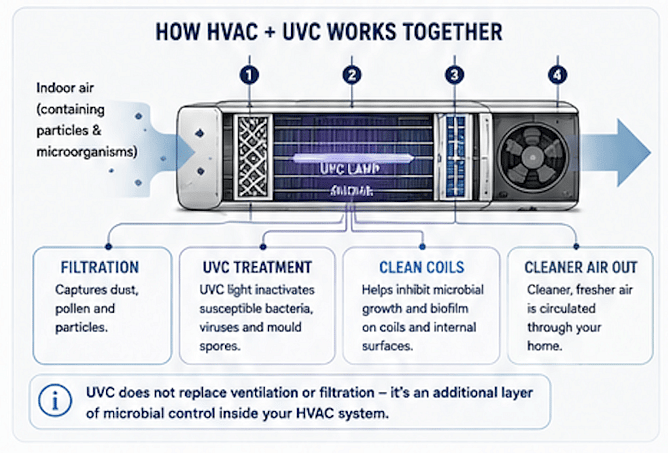
UVC uses germicidal ultraviolet energy to inactivate susceptible microorganisms when they receive a sufficient dose.
In HVAC applications, UVC can be installed within the equipment or air-handling pathway.
Depending on the system design, it can provide treatment of:
Air passing through the treatment zone
Cooling coils
Internal HVAC surfaces
Other areas where microbial growth may occur
This is particularly relevant because HVAC systems can contain moisture and organic material that may support microbial growth.
But UVC doesn't replace the basics.
Think of it as another layer:
Moisture control
↓
Ventilation
↓
Filtration
↓
HVAC maintenance
↓
UVC microbial control
Each layer performs a different function.
UVC vs filtration vs ventilation: what's the difference?
This is one of the most important concepts to understand.
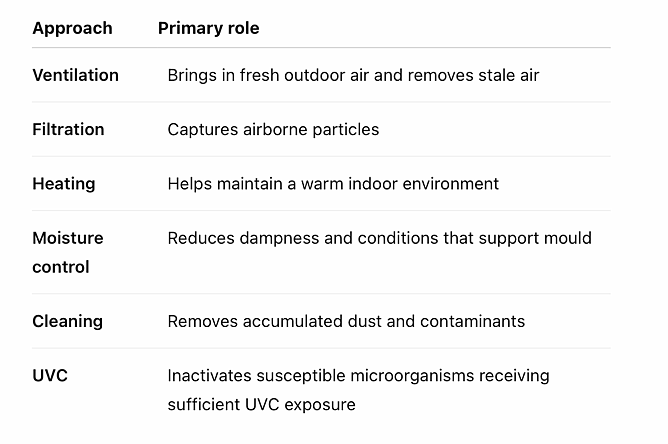
These technologies aren't necessarily competitors.
They can complement each other.
For example:
Ventilation helps remove stale air.
Filtration captures particles.
UVC provides microbial inactivation.
Moisture control helps prevent mould from growing in the first place.
HVAC maintenance keeps the system itself cleaner.
That's a much more effective way to think about indoor air quality.
15. Think about the HVAC system as part of your IAQ strategy
Your heat pump or HVAC system isn't just an appliance.
It is part of the environment that moves air around your home.
That means its condition matters.
A well-maintained system can:
Move air effectively
Maintain comfortable temperatures
Support filtration
Reduce the accumulation of dust and biological material
Provide an appropriate platform for additional technologies such as UVC
If you're renovating or building a new home, it's worth considering indoor air quality during the design stage, rather than trying to solve problems later.
New Zealand's current G4 ventilation documentation provides compliance pathways for ventilation and air purity, including both natural and mechanical ventilation approaches.
16. What about new or highly insulated homes?
A modern, well-insulated home can be much more energy efficient and comfortable.
But insulation alone doesn't guarantee good indoor air quality.
As homes become more airtight, deliberate ventilation becomes increasingly important.
The goal isn't:
"Make the home as airtight as possible."
Nor is it:
"Leave windows open all day."
The goal is:
A warm, dry, well-ventilated home with controlled airflow.
This can involve a combination of:
Insulation
Heating
Natural ventilation
Mechanical ventilation
Extraction
Filtration
Moisture control
HVAC maintenance
The right combination depends on the house.
A simple indoor air quality checklist for NZ homes
If you're not sure where to start, work through these questions:
Ventilation
Are you opening windows regularly?
Do bathrooms have effective extraction?
Does your kitchen rangehood remove air outside?
Does your home have a mechanical ventilation system?
Does that system bring in outdoor air or simply recirculate/filter indoor air?
Moisture
Do your windows regularly steam up?
Are there damp or musty areas?
Do you dry clothes inside?
Are there leaks or water-ingress issues?
Is mould repeatedly returning?
Heating
Is your home warm enough during winter?
Is your heating system appropriately sized and maintained?
Are you relying on an unflued combustion heater?
Filtration
Are HVAC filters clean?
Are filters being replaced according to manufacturer recommendations?
Would a higher-efficiency or HEPA filtration solution be appropriate?
HVAC
When was your heat pump last professionally cleaned?
Is there a musty smell when it starts?
Is there visible contamination inside the unit?
Could microbial growth or biofilm be present?
Monitoring
Have you measured CO₂?
Have you measured humidity?
Do you know which rooms have the poorest ventilation?
UVC
Could microbial control inside your HVAC system be beneficial?
Is the system designed specifically for HVAC use?
Is the UVC contained from occupants?
Has the equipment been appropriately tested and designed?
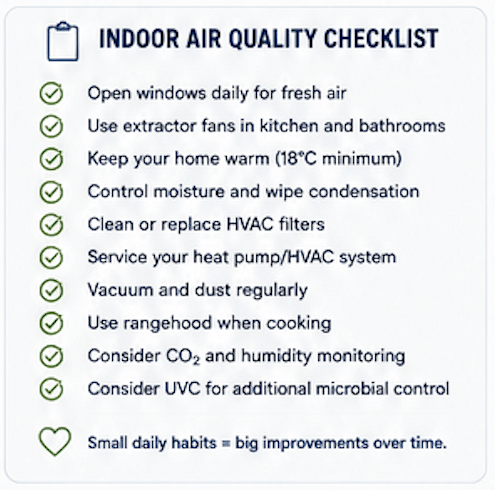
The five biggest mistakes homeowners make with indoor air quality
1. Thinking heating equals ventilation
It doesn't.
A heat pump can heat and circulate indoor air without bringing in fresh outdoor air.
2. Treating mould without fixing moisture
If the underlying moisture problem remains, mould can return.
3. Assuming a ventilation system automatically means fresh air
Some systems recycle or filter indoor air rather than introducing outdoor air.
Know what your system actually does.
4. Thinking an air purifier solves everything
Filtration can remove particles, but it doesn't fix moisture, replace ventilation or necessarily address every pollutant.
5. Ignoring the HVAC system itself
The equipment moving your air needs to be maintained too.
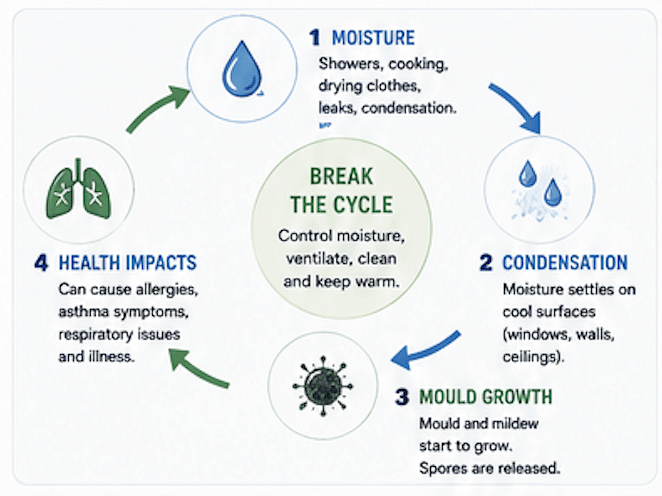
So, what is the best way to improve indoor air quality?
There isn't one single solution.
The strongest approach is layered.
1. Keep your home dry
Fix leaks, manage condensation and control moisture.
2. Keep it warm
Use effective heating and maintain a comfortable indoor temperature.
3. Ventilate
Bring in fresh outdoor air and remove stale, moisture-laden air.
4. Filter
Use appropriate filtration to capture airborne particles.
5. Clean
Regularly clean your home and maintain HVAC equipment.
6. Monitor
Use CO₂ and humidity measurements to identify problem areas.
7. Consider UVC
Where appropriate, use professionally designed UVC technology as an additional layer of microbial control within HVAC systems.
Where does AirTechnologies fit in?
At AirTechnologies NZ, we focus on one part of this larger indoor air quality picture:
HVAC-integrated UVC technology.
Our UVC systems are designed to work within heating, ventilation and air conditioning systems, including residential heat pumps and larger commercial HVAC applications.
Rather than treating UVC as a replacement for ventilation, filtration or cleaning, we see it as an additional layer of microbial control.
A properly designed HVAC UVC system can help inactivate susceptible microorganisms that receive sufficient UVC exposure and can help control microbial growth on exposed HVAC surfaces.
The result is a more comprehensive approach to the air your HVAC system circulates.
The bottom line: cleaner indoor air starts with the whole home
Good indoor air quality isn't created by one product.
It's created by understanding how your home manages air, moisture, heat and contaminants.
Start with the fundamentals:
Keep it dry.
Keep it warm.
Ventilate it.
Filter it.
Clean it.
Maintain your HVAC system.
And where appropriate, add technologies such as UVC to provide another layer of microbial control.
The goal isn't to create a perfectly sterile home.
It's to create a home with cleaner air, controlled moisture, effective ventilation and a well-maintained HVAC system.
For New Zealand homes, that's a much more practical — and sustainable — approach to indoor air quality.
Want to know whether UVC is suitable for your home?
If you're concerned about mould, musty heat pump smells, HVAC hygiene or indoor air quality, the AirTechnologies NZ team can assess your application and explain whether a UVC system could be appropriate.
Cleaner air starts with understanding what's happening inside your home — and inside the system moving your air.