If you're looking at ways to improve the air in your home, you've probably come across two popular options:
Air purifiers and UVC air purification systems.
But which one is better?
The answer isn't quite as simple as choosing one over the other.
That's because UVC and air purifiers don't actually do the same thing.
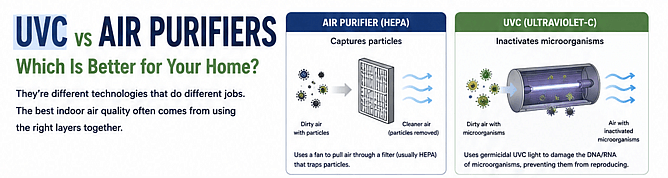
A typical HEPA air purifier is designed primarily to physically remove particles from the air.
UVC, on the other hand, uses germicidal ultraviolet radiation to inactivate susceptible microorganisms that receive a sufficient UVC dose.
One captures.
The other inactivates.
And in some situations, using both technologies together can provide a more comprehensive approach to indoor air quality.
Let's look at how they compare.
What is an air purifier?
"Air purifier" is a broad term covering a range of different technologies.
A typical portable air purifier uses a fan to draw air through one or more filters before returning the treated air to the room.
Many modern units use a HEPA filter for particle removal, while some also incorporate activated carbon for certain gases and odours.
HEPA filters are mechanical filters designed to capture very small airborne particles. The US EPA states that a true HEPA filter can theoretically remove at least 99.97% of particles at 0.3 microns, which is considered the most penetrating particle size for the filter.
Depending on the design, an air purifier can help capture:
Dust
Pollen
Pet dander
Fine particulate matter
Some mould spores
Airborne particles containing microorganisms
The effectiveness of a portable purifier also depends heavily on how much air it actually processes.
A highly efficient filter isn't particularly useful if the machine doesn't move enough air through it.
This is why CADR — Clean Air Delivery Rate — and appropriate sizing for the room matter. The EPA recommends selecting a portable air cleaner with a CADR appropriate for the space being treated.
What is UVC air purification?
UVC stands for ultraviolet-C.
Germicidal UVC uses ultraviolet radiation to damage the genetic material of microorganisms, preventing them from reproducing.
UVC has been used for decades in applications including:
HVAC systems
Healthcare facilities
Water treatment
Laboratories
Commercial buildings
Air treatment
In HVAC applications, UVC lamps can be installed inside air-handling equipment or ductwork.
As air passes through the treatment zone, microorganisms can receive UVC exposure.
With an appropriately designed system and sufficient dose, this can inactivate susceptible microorganisms.
ASHRAE describes in-duct UV-C as a technology that can be installed within HVAC units or associated ductwork and recommends coupling it with mechanical filtration.
The Biggest Difference: Remove vs Inactivate
This is the easiest way to understand the difference.
Air purifier:
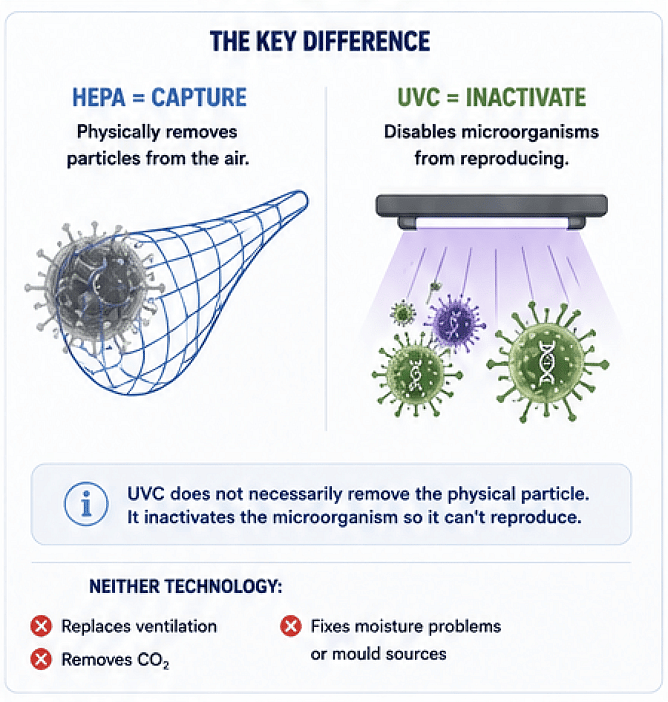
Captures particles.
UVC:
Inactivates susceptible microorganisms that receive sufficient UVC exposure.
Imagine a mould spore travelling through the air.
A HEPA filter can physically capture that particle.
UVC doesn't work like a net.
Instead, if the spore receives a sufficient UVC dose, the radiation can damage its genetic material and prevent it from reproducing.
That's why UVC and filtration aren't necessarily competitors.
They can perform different jobs within the same indoor air quality strategy.
UVC vs HEPA: A Simple Comparison
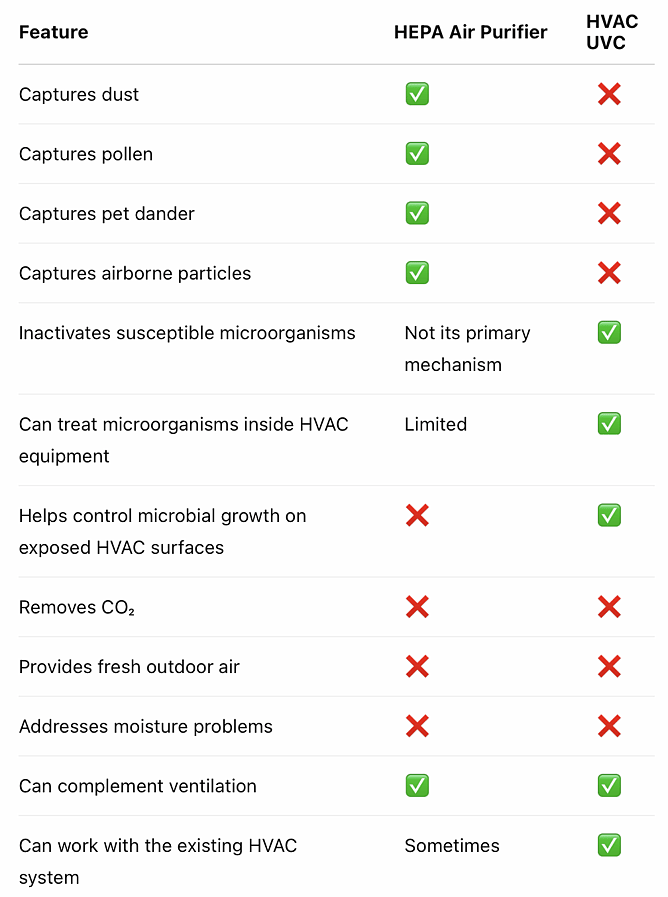
The important thing to notice is that neither technology does everything.
A HEPA purifier doesn't replace ventilation.
UVC doesn't replace filtration.
Neither one fixes a leaking roof or damp wall.
And neither one removes CO₂.
So which is better?
The important thing to notice is that neither technology does everything.
A HEPA purifier doesn't replace ventilation.
UVC doesn't replace filtration.
Neither one fixes a leaking roof or damp wall.
And neither one removes CO₂.
What does a HEPA filter actually remove?
HEPA filtration is particularly useful for particles.
The EPA notes that HEPA filters can capture dust, pollen, mould, bacteria and other airborne particles, with the 0.3-micron particle size being the standard worst-case efficiency point.
This makes HEPA filtration particularly useful when you're concerned about:
Allergens
Fine particles
Dust
Smoke
Pollen
Airborne particulate matter
However, there's an important limitation.
A filter only captures what reaches the filter.
Particles that have settled on:
Floors
Furniture
Bedding
Walls
Curtains
Other surfaces
aren't going to be removed by the purifier until they become airborne again.
The EPA notes that many larger allergens and particles spend much of their time settled on surfaces rather than suspended in the air.
That's why cleaning and source control still matter.
What does UVC actually do?
UVC is fundamentally different.
Instead of physically capturing a particle, UVC uses ultraviolet energy to inactivate susceptible microorganisms.
This can include microorganisms such as:
Certain bacteria
Certain viruses
Mould and fungal microorganisms
However, dose matters.
UVC isn't automatically effective simply because a lamp is present.
The effectiveness depends on factors including:
UVC wavelength
Irradiance
Exposure time
Distance
Air velocity
Lamp output
System geometry
Lamp age
Surface exposure
This is particularly important for HVAC applications because air can move relatively quickly through the treatment zone.
ASHRAE's guidance for in-duct UV-C specifically highlights the importance of achieving an appropriate UV dose and exposure time and recommends using UV-C alongside mechanical filtration.
What about mould?
This is where the difference between the technologies becomes particularly interesting.
A HEPA purifier can capture airborne mould spores.
That's useful.
But it doesn't address mould growing inside your HVAC system.
UVC can be installed within the HVAC equipment, where it can irradiate exposed surfaces such as cooling coils and other components.
The EPA's residential air-cleaner guidance notes that UVGI systems may be used to address biological pollutants that are airborne or growing on HVAC surfaces, including cooling coils, drain pans and ductwork.
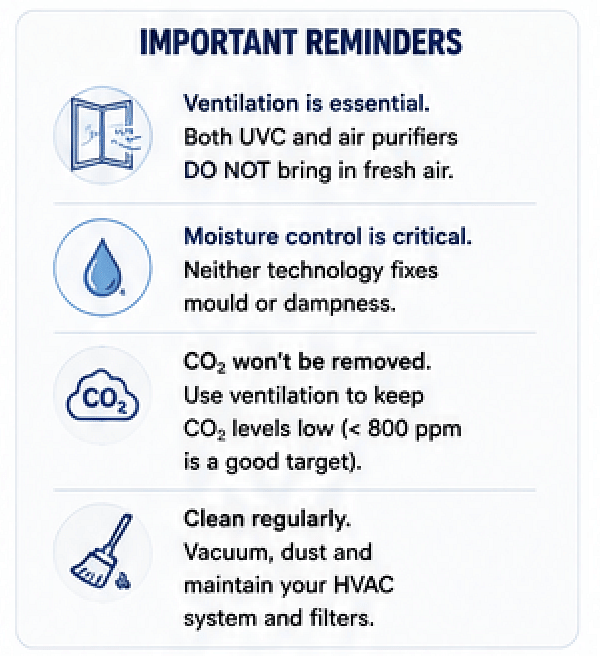
However, neither technology should be viewed as a replacement for addressing a moisture problem.
If you have mould growing because of a leaking roof, damp wall or persistent condensation, the moisture source needs to be fixed.
What about bacteria and viruses?
Both filtration and UVC can play a role, but through different mechanisms.
A HEPA filter can physically capture airborne particles that carry microorganisms.
UVC can inactivate susceptible microorganisms that receive sufficient UVC exposure.
The EPA describes UVGI as an established air-treatment approach based on the ability of UV light to inactivate microorganisms and notes that it can be used alongside effective ventilation and filtration.
This distinction is particularly important when discussing UVC.
UVC doesn't necessarily remove the physical particle from the air.
It can instead inactivate the microorganism contained within or associated with the particle, depending on the application and dose.
That is why combining filtration and UVC can be so useful.
Can you use UVC and a HEPA purifier together?
Yes — and in some applications, this may be the ideal approach.
Think of the technologies as different layers.
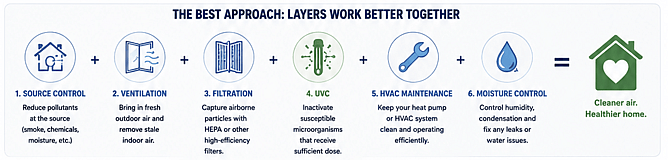
Layer 1 — Source control
Remove pollutants at their source.
For example:
Don't smoke indoors.
Fix leaks.
Address mould.
Use kitchen extraction.
Control moisture.
Layer 2 — Ventilation
Bring in appropriate amounts of clean outdoor air and remove stale indoor air.
Layer 3 — Filtration
Use HEPA or other appropriate filtration to capture airborne particles.
Layer 4 — UVC
Use properly designed UVC to inactivate susceptible microorganisms and help control microbial growth within HVAC systems.
This layered approach is consistent with guidance from organisations such as EPA and ASHRAE, which emphasise that no single air-cleaning technology should be treated as a complete replacement for ventilation and source control.
Portable Air Purifier vs HVAC UVC
There's another major difference that homeowners often overlook.
Portable air purifier
A portable purifier generally treats the air in one room or defined area.
You place it in a bedroom, lounge, office or other space and it draws room air through its filter.
The EPA describes portable air cleaners as devices designed to filter air in a single room or area.
HVAC UVC
An HVAC UVC system is installed within your existing heating or air-conditioning system.
Instead of adding another appliance to the room, the UVC technology works within the equipment that is already circulating air throughout the home.
This can provide a different type of coverage.
What if you have a ducted heat pump?
This is where HVAC-integrated UVC becomes particularly interesting.
A ducted system can distribute air throughout multiple rooms.
Installing UVC within the appropriate part of the HVAC system means the technology can operate as part of the central air-handling system.
Depending on the system design, UVC can be positioned to treat:
Air passing through the system
and/or
Internal HVAC surfaces.
This is fundamentally different from putting a small portable purifier in one bedroom.
What if you have a standard wall-mounted heat pump?
A wall-mounted heat pump is also circulating indoor air, but the design is different from a ducted system.
A UVC system can potentially be integrated into suitable heat pump units, depending on the equipment and available space.
The installation needs to consider:
Internal dimensions
Airflow
Coil location
Lamp positioning
Electrical requirements
Material compatibility
Safety
Access for maintenance
Not every heat pump is the same, so the system needs to be assessed rather than assuming one solution fits every unit.
Does a HEPA purifier replace ventilation?
No.
This is one of the most important misconceptions about air purifiers.
A HEPA purifier can remove particles from indoor air, but it doesn't bring fresh outdoor air into the home.
The EPA explicitly states that filtration can supplement source control and ventilation but does not replace the need for ventilation.
For example, imagine four people sitting in a closed room.
A HEPA purifier may continuously remove particles from the air.
But the people are still breathing.
CO₂ continues to accumulate.
A purifier doesn't solve that problem.
You need appropriate ventilation.
Does UVC replace ventilation?
No.
The same principle applies to UVC.
UVC is not a substitute for bringing fresh air into a home.
Ventilation is still necessary for managing:
CO₂
Excess moisture
Stale air
Indoor pollutants
UVC should instead be viewed as an additional air-treatment technology.
Does either technology remove CO₂?
No.
Neither a standard HEPA purifier nor UVC is designed to remove CO₂ from an occupied room.
If CO₂ is high, the solution is generally to improve ventilation and bring in more outdoor air.
This is another reason why indoor air quality should be approached as a system rather than simply buying an air purifier.
What about odours?
This depends on the type of odour and the technology being used.
Some air purifiers contain activated carbon, which can adsorb certain gases and odour-causing compounds.
The EPA notes that activated carbon filters can be effective for gases when sufficient carbon material is used.
HEPA alone isn't designed to remove gases.
UVC isn't a general-purpose odour filter either.
So if your primary concern is:
Cooking smells
VOC emissions
Pet odours
Smoke
you need to look at the specific pollutant and choose the appropriate technology.
Be careful with "air purifiers" that generate ozone
Not every product marketed as an air purifier is equivalent.
Some devices intentionally generate ozone or use technologies that may produce ozone as a by-product.
The EPA specifically advises against using ozone generators in occupied spaces because ozone can irritate the airways.
If you're considering an air-cleaning device, ask:
Does it intentionally generate ozone?
Has ozone emission been independently tested?
What filtration technology does it use?
Don't assume that "air purifier" automatically means "safe and effective."
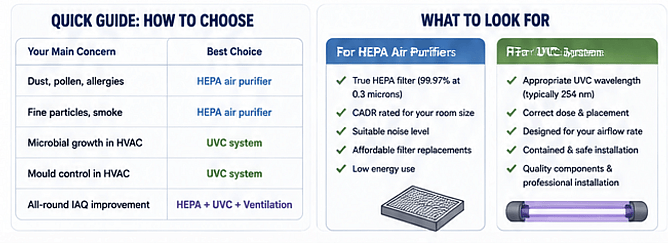
What should you look for in a HEPA air purifier?
If filtration is your priority, don't simply buy the largest-looking machine.
Look at:
HEPA specification
Is it actually using a HEPA filter?
CADR
How much clean air can it deliver?
Room size
Is it appropriately sized for your room?
Noise
Will you actually run it if it's noisy?
Filter replacement
How often do filters need to be replaced and what do replacement filters cost?
Energy consumption
How much electricity will it use over long periods?
The EPA recommends considering CADR and room size when selecting a portable air cleaner and notes that higher fan speeds and longer operating times generally increase the amount of air filtered.
What should you look for in a UVC system?
UVC systems should be evaluated differently.
Instead of simply asking:
"How many watts is the lamp?"
ask:
What wavelength does it use?
What UVC dose is being delivered?
What airflow is the system designed for?
Where is the lamp installed?
What surfaces are being treated?
How is occupant exposure prevented?
What maintenance is required?
What testing or technical data supports the system?
This is particularly important because UVC effectiveness depends on the dose actually delivered to the microorganism.
Which is better for allergies?
If your primary concern is airborne allergens such as pollen, dust or pet dander, filtration is likely to be the more directly relevant technology because these are particles that can be physically captured.
A properly sized HEPA purifier can therefore be a useful tool.
UVC isn't a replacement for particle filtration.
However, if microbial control within your HVAC system is also a concern, UVC may provide an additional layer.
Again, it's not necessarily UVC vs HEPA.
It can be:
UVC + HEPA + ventilation
Which is better for mould?
This requires a little more explanation.
HEPA:
Can capture airborne mould spores.
UVC:
Can inactivate susceptible microorganisms receiving sufficient UVC exposure and can be used to help control microbial growth on appropriately exposed HVAC surfaces.
Neither:
Fixes the moisture problem causing mould.
If mould is growing because your house is damp, the priority is to identify and fix the moisture source.
The EPA specifically states that air cleaners and HVAC filters do not solve mould problems because mould growth is caused by a moisture problem.
Which is better for a heat pump?
This depends on what you're trying to achieve.
If you're concerned about dust and airborne particles, filtration is important.
If you're concerned about microbial control within the heat pump, UVC can provide a different benefit.
And because a heat pump's internal coil can become damp during cooling operation, HVAC hygiene can be an important consideration.
A properly designed UVC installation can provide ongoing irradiation within the equipment while the system operates.
That doesn't eliminate the need for professional heat pump cleaning.
It adds another layer of protection.
The best solution may not be either/or
This is the biggest takeaway.
Instead of asking:
"Should I buy UVC or an air purifier?"
ask:
"What problem am I trying to solve?"
If you want to capture:
Dust → filtration
Pollen → filtration
Pet dander → filtration
Fine particles → filtration
If you want to provide microbial control:
Certain bacteria → UVC may help
Certain viruses → UVC may help
Mould microorganisms → UVC may help when sufficient dose is delivered
If you need to control:
CO₂ → ventilation
Moisture → moisture control
Established mould → fix moisture + clean/remediate
Certain gases/VOCs → source control + appropriate gas-phase filtration
The answer depends on the pollutant.
A better way to think about indoor air quality
Rather than looking for a single machine to solve every IAQ problem, think about your home as a system.
SOURCE CONTROL
Stop pollutants entering the air.
↓
VENTILATION
Bring in appropriate outdoor air.
↓
FILTRATION
Capture airborne particles.
↓
HVAC MAINTENANCE
Keep the equipment moving your air clean.
↓
UVC
Provide an additional layer of microbial control.
This approach is much more realistic than expecting one device to solve every indoor air quality problem.
So, should you buy a UVC system or an air purifier?
Here's the simple answer:
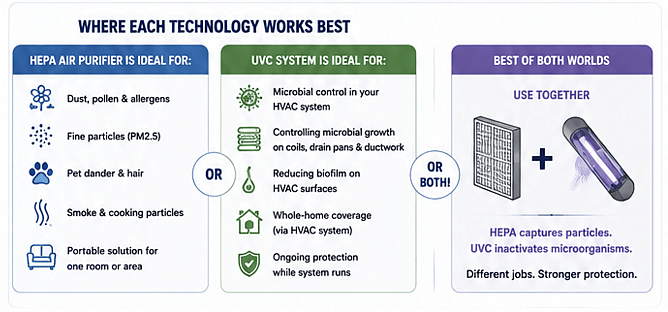
Choose a HEPA air purifier if:
You want to reduce airborne dust.
You have concerns about pollen.
You want to capture fine particles.
You have pets and want to reduce airborne dander.
You want a portable solution for one particular room.
Consider HVAC UVC if:
You're concerned about microbial growth inside your HVAC system.
Your heat pump or air conditioning system is a significant part of your home's air circulation.
You're concerned about biofilm or microbial contamination on HVAC surfaces.
You want ongoing microbial control integrated into the HVAC system.
You want an additional layer alongside filtration and ventilation.
Consider both if:
You want particle filtration and microbial control.
You have a central HVAC system.
You're taking a layered approach to indoor air quality.
UVC and air purifiers can work together
There is no reason to think of these technologies as enemies.
In fact, the strongest indoor air quality strategy may use several technologies together.
For example:
Ventilation
provides fresh outdoor air.
HEPA filtration
captures airborne particles.
UVC
provides microbial inactivation.
HVAC maintenance
keeps the equipment clean.
Moisture control
helps prevent mould growth.
Each technology addresses a different part of the problem.
ASHRAE specifically recommends coupling in-duct UV-C with mechanical filtration, recognising that layering technologies can increase overall air-cleaning performance through particle capture and microbial inactivation.
The bottom line
UVC and air purifiers aren't really competing technologies.
They work differently.
A HEPA air purifier is primarily a particle-removal system.
UVC is primarily a microbial-inactivation technology.
Neither replaces ventilation.
Neither fixes moisture problems.
Neither should be marketed as a complete solution to every indoor air quality problem.
But when correctly selected and applied, they can complement each other.
For many homes, the ideal approach isn't:
UVC vs HEPA.
It's:
Ventilation + filtration + HVAC maintenance + moisture control + UVC where appropriate.
The key is understanding what problem you're actually trying to solve.
Looking at UVC for your home?
AirTechnologies NZ specialises in UVC systems designed to integrate with residential and commercial HVAC equipment.
Rather than adding another appliance to the room, an HVAC-integrated UVC system works within the existing air-handling system to provide an additional layer of microbial control.
If you're unsure whether UVC, filtration or a combination of technologies is right for your home, talk to the AirTechnologies NZ team about your HVAC system and indoor air quality goals.