If you have ever looked inside a heat pump, air conditioning unit or commercial air-handling system, you may have noticed something that looks like a layer of dirt, slime or organic material building up around the coil or drain pan.
It isn't always just dirt.
In the right conditions, microorganisms can attach themselves to a surface and begin producing a protective matrix around themselves.
This is known as biofilm.
Biofilm is common throughout nature and can form on many surfaces where microorganisms have access to moisture and nutrients.
Inside HVAC systems, however, biofilm can become particularly relevant because components such as cooling coils, drain pans and other continuously or periodically damp surfaces can provide favourable conditions for microbial growth.
And once biofilm becomes established, it can be considerably more difficult to remove than loose contamination.
This is one of the reasons HVAC hygiene is an important part of indoor air quality and system maintenance.
It is also one of the areas where UVC technology can play an important supporting role.

What exactly is biofilm?
Biofilm isn't simply "bacteria growing on a surface."
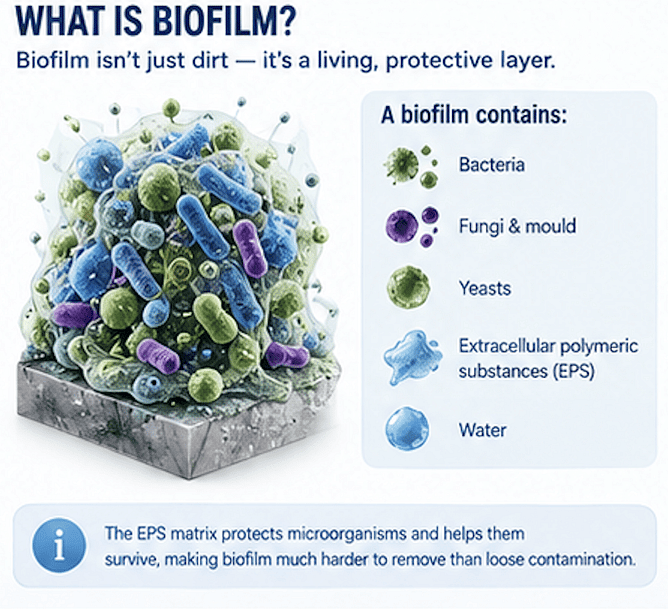
It is a structured community of microorganisms that attach to a surface and produce a sticky substance known as an extracellular polymeric substance (EPS) matrix.
This matrix can contain:
Polysaccharides
Proteins
Lipids
Extracellular DNA
Water
Microbial cells
The result is a kind of protective environment surrounding the microorganisms.
Think of it as a microscopic community living inside a protective layer.
Biofilms can contain different types of microorganisms, including:
Bacteria
Fungi
Yeasts
Other microorganisms
They can form on natural and man-made surfaces wherever the right conditions exist.
Why does biofilm form inside HVAC systems?
There are three major ingredients that make HVAC systems particularly interesting environments for microbial growth:
Moisture
Organic material
A surface for microorganisms to attach to
And HVAC systems can provide all three.
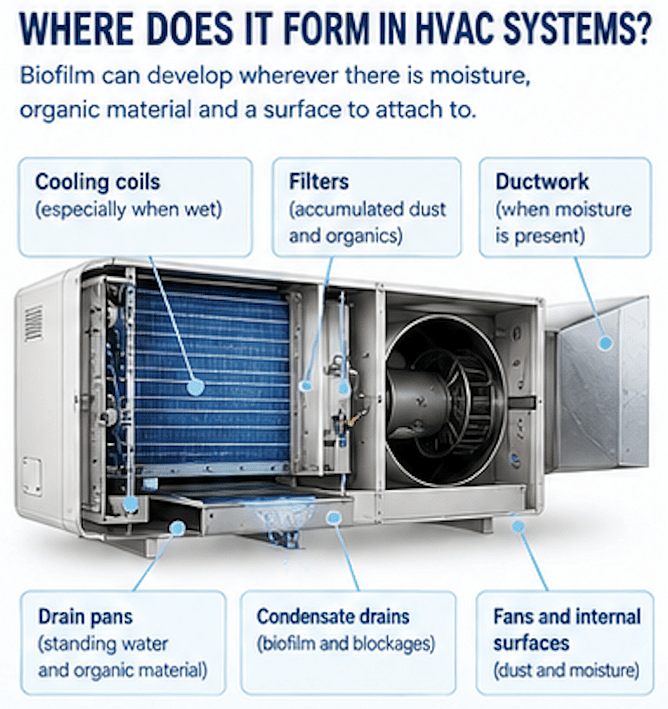
Cooling coils can become wet during normal operation.
Condensation can collect in drain pans.
Dust and airborne particles can accumulate on surfaces.
That combination can create an environment where microorganisms have an opportunity to establish themselves.
The US EPA has specifically identified HVAC components such as cooling coils, drain pans and ductwork as locations where biological contaminants can grow when moisture is present.
Where is HVAC biofilm most likely to form?
Biofilm can potentially develop on a range of HVAC components, but some areas are more susceptible than others.
Cooling Coils
Cooling coils are particularly important.
When warm, humid air passes over a cold cooling coil, moisture can condense on the coil surface.
That means the coil can periodically become a wet surface.
Dust and other particles can also accumulate on the coil.
This combination provides an environment where microorganisms may attach and grow.
Drain Pans
Drain pans collect condensate produced during cooling.
If water doesn't drain effectively, standing water can remain in the pan.
Poor drainage can increase the opportunity for microbial growth.
Condensate drains
Drain lines can also accumulate organic material and microbial growth.
A partially blocked or poorly maintained condensate system can create additional moisture problems.
Filters and surrounding surfaces
Filters capture airborne particles.
Over time, accumulated dust and organic material can become a potential nutrient source for microorganisms if moisture is also present.
Ductwork
Ductwork isn't automatically a biofilm problem.
However, where moisture enters duct systems or condensation occurs, microbial growth can become possible.
This is one reason moisture control is fundamental to HVAC hygiene.
Why is biofilm different from ordinary dirt?
This distinction is important.
A dusty coil is not necessarily a biofilm-covered coil.
Dust is primarily a collection of particles.
Biofilm involves microorganisms attached to a surface and embedded within a self-produced matrix.
The matrix can help protect the microorganisms from environmental stresses and make established biofilms more difficult to remove.
This is one reason simply increasing airflow or changing a filter doesn't necessarily eliminate biofilm that has already developed on an HVAC surface.
How Does Biofilm Develop?
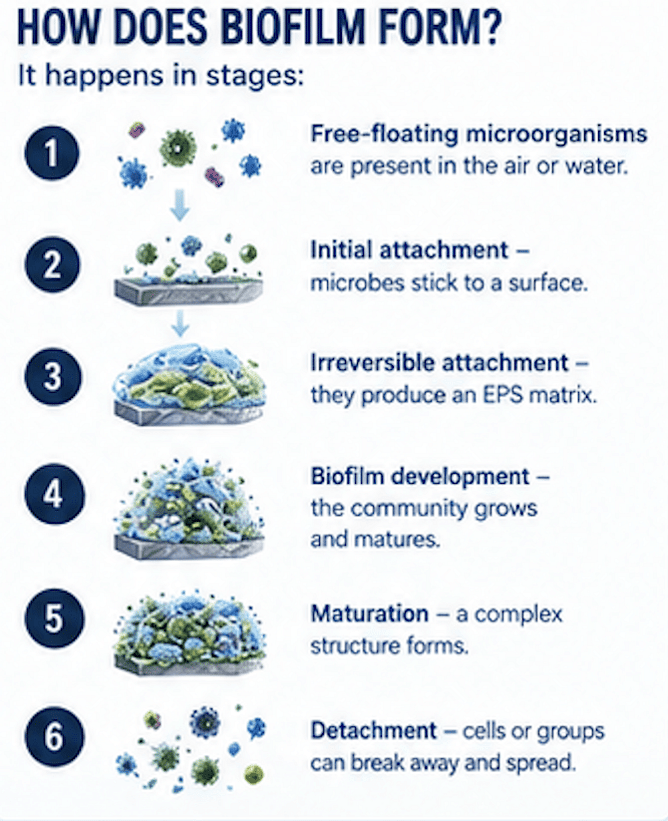
Biofilm formation can be thought of as a series of stages.
Stage 1 — Free-floating microorganisms
Microorganisms are present in the surrounding air or water.
↓
Stage 2 — Initial attachment
Some microorganisms come into contact with an HVAC surface and attach.
↓
Stage 3 — Irreversible attachment
The microorganisms become more firmly attached and begin producing extracellular polymeric substances.
↓
Stage 4 — Biofilm development
The microbial community grows and develops within its protective matrix.
↓
Stage 5 — Maturation
The biofilm becomes a more established and complex structure.
↓
Stage 6 — Detachment and dispersal
Individual cells or groups of cells can detach and move elsewhere.
This lifecycle is one of the reasons established biofilms can be persistent.
Why does HVAC biofilm matter?
Why does HVAC biofilm matter?
There are several reasons.
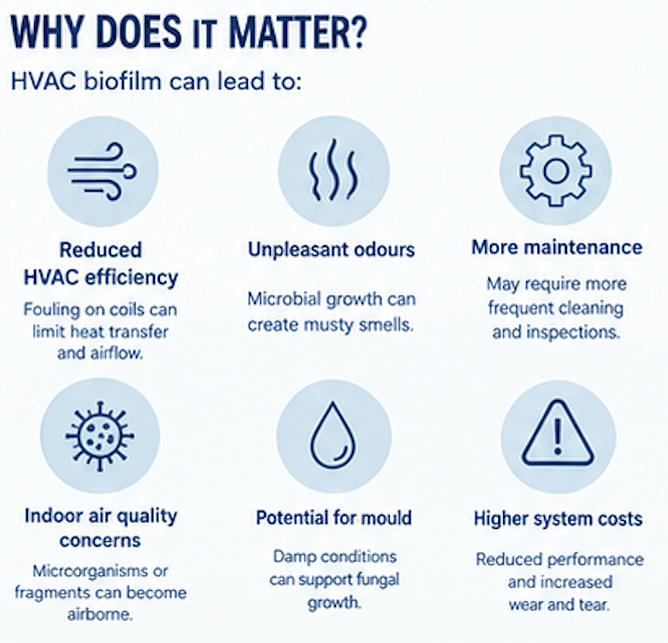
1. It can affect HVAC cleanliness
A contaminated coil can become visibly dirty and increasingly difficult to clean.
2. It can contribute to unpleasant odours
Microbial growth can contribute to musty or unpleasant smells associated with HVAC equipment.
3. It can affect heat-transfer surfaces
Accumulation of biological material and other contamination on cooling coils can interfere with heat transfer and airflow.
4. It can increase maintenance requirements
A system that repeatedly accumulates contamination may require more frequent cleaning.
5. It can contribute to indoor air quality concerns
If microorganisms or microbial fragments become airborne, they can potentially contribute to indoor environmental contamination.
The exact impact depends on the type of microorganism, extent of contamination, HVAC design and other environmental factors.
Biofilm and HVAC efficiency
One of the most interesting aspects of HVAC biofilm is its potential relationship with system performance.
Cooling coils are designed to transfer heat efficiently between the air and the refrigerant.
When a coil becomes coated with dust, biological material and other contaminants, the surface is no longer operating under ideal conditions.
Research has shown that coil fouling can reduce HVAC heat-transfer performance and increase pressure drop across coils.
This matters because even relatively small changes in coil condition can affect the performance of equipment operating for thousands of hours each year.
A cleaner coil can therefore contribute to better HVAC performance.
However, it's important to distinguish between biofilm specifically and general coil fouling.
Not every dirty coil contains biofilm, and not every efficiency loss is caused by microbial growth.
Why cleaning alone isn't always enough
Regular HVAC cleaning is essential.
But cleaning addresses the contamination that is already there.
It doesn't necessarily prevent microorganisms from returning.
Imagine cleaning a damp surface in your bathroom.
You remove the mould.
But if the surface stays constantly wet, mould may eventually return.
The same basic principle applies to HVAC systems.
Clean the contamination.
Address the moisture.
Reduce the conditions that allow regrowth.
And, where appropriate, add a control measure.
This is where UVC can become particularly interesting.
How can UVC help with HVAC biofilm?
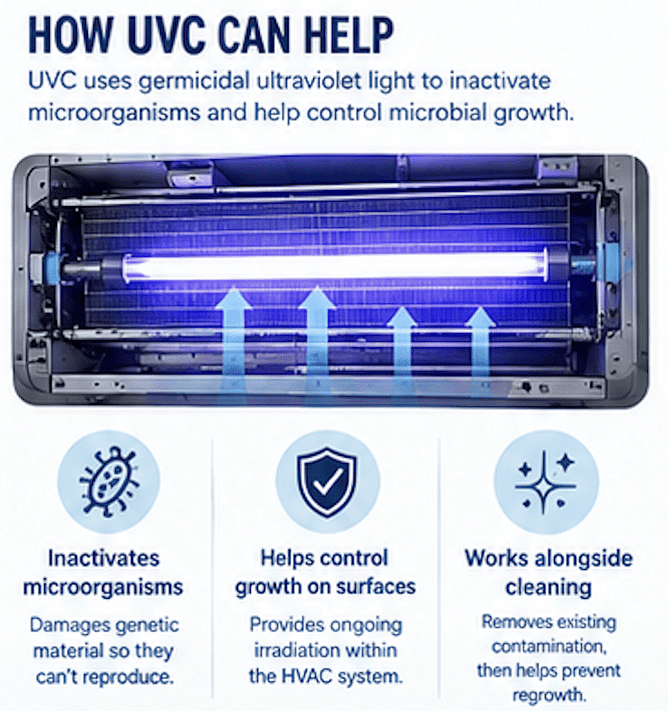
UVC — ultraviolet-C — uses germicidal ultraviolet radiation to damage the genetic material of microorganisms.
When microorganisms receive a sufficient UVC dose, their ability to reproduce can be impaired or they can be inactivated.
In HVAC systems, UVC lamps can be positioned so that they continuously irradiate specific components.
For example:
Cooling coil
Drain pan area
Internal HVAC surfaces
Depending on the system design.
This creates a fundamentally different approach from simply cleaning the system once every few months or years.
Instead of:
Clean → wait → contamination returns → clean again
the objective is to provide ongoing microbial control between maintenance cycles.
UVC doesn't "clean" a dirty coil
This is an important distinction.
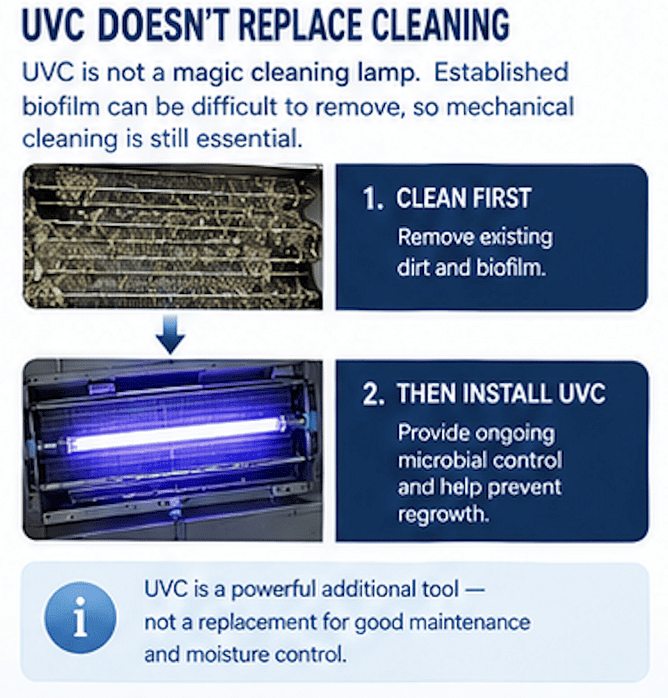
UVC should not be thought of as a magic cleaning lamp.
If a cooling coil is heavily contaminated with:
Dust
Dirt
Grease
Established biofilm
Other debris
it may need to be physically cleaned.
UVC doesn't replace mechanical cleaning.
Instead, its role can be to help control microorganisms and inhibit microbial growth after the system has been cleaned.
This is one of the strongest ways to position UVC.
Cleaning removes contamination.UVC helps control microbial growth.
They can complement each other.
Can UVC destroy existing biofilm?
UVC can have antimicrobial effects on microorganisms within biofilms, but established biofilms are considerably more difficult to control than free-floating microorganisms.
Why?
Because the biofilm matrix can reduce penetration and provide protection to microorganisms within the community.
This means you shouldn't assume that installing a UVC lamp will instantly eliminate a thick layer of established biofilm.
The more realistic approach is:
Clean first.
Remove established contamination.
Then install UVC.
Use continuous UVC irradiation to help control microbial regrowth.
This approach combines physical cleaning with ongoing microbial control.
Why continuous UVC exposure matters
One of the major advantages of HVAC-integrated UVC is that it can operate continuously or according to the system's operating schedule.
That means the HVAC surfaces can receive repeated UVC exposure over extended periods.
Compare this with manual cleaning.
A technician may clean a coil once or twice a year.
The coil then operates for months before the next service.
UVC can provide ongoing exposure between those maintenance events.
This is particularly relevant for systems operating for long periods or in environments where microbial growth is a recurring maintenance concern.
Does UVC prevent all mould?
No.
And this is an important distinction.
UVC can help control susceptible microorganisms when they receive a sufficient dose.
But UVC isn't a replacement for moisture control.
If an HVAC system has:
Standing water
Poor drainage
Persistent condensation
Water leaks
Excessive humidity
those problems still need to be addressed.
UVC does not fix a moisture problem.
If you want to control mould, you need to control the conditions that allow it to grow.
Biofilm, mould and HVAC systems
Biofilm is a broad term.
It doesn't necessarily mean mould.
A biofilm can contain different microorganisms.
Fungi can also grow on damp HVAC surfaces, and mould contamination is a separate but related issue.
This is why HVAC hygiene shouldn't be reduced to:
"Does my heat pump have mould?"
A better question is:
"Are there conditions inside my HVAC system that could support microbial growth?"
Moisture and accumulated organic material are two important factors.
What about bacteria?
Bacteria are among the microorganisms that can form biofilms.
In fact, biofilms are extremely common in natural and engineered water systems.
Inside HVAC equipment, bacterial growth can occur where moisture and suitable surfaces are present.
UVC is particularly relevant here because germicidal UV has been extensively studied for microbial inactivation.
However, effectiveness depends on the dose delivered to the microorganism.
A UVC lamp isn't automatically effective simply because it is installed.
UVC dose is critical
One of the most common misunderstandings about UVC is that lamp wattage equals effectiveness.
It doesn't.
A 100-watt lamp doesn't automatically provide the same microbial control as another 100-watt lamp.
What matters is the UVC dose received by the microorganism.
Dose is broadly related to:
Irradiance × exposure time
And irradiance is affected by factors such as:
Distance from the lamp
Lamp output
Lamp age
Reflectivity
Air velocity
Geometry
Surface orientation
This is why proper system design matters.
The objective isn't simply to install the biggest lamp possible.
It's to deliver the appropriate UVC exposure where it is needed.
What happens to a microorganism when UVC hits it?
Germicidal UVC can be absorbed by nucleic acids within microorganisms.
This can create photochemical damage that interferes with replication.
In simple terms:
Microorganism
↓
UVC exposure
↓
DNA/RNA damage
↓
Reduced ability to reproduce
↓
Inactivation
The exact response varies depending on the microorganism and the UVC dose.
That's why scientific claims about UVC should always be tied to a particular organism, wavelength and dose.
Why UVC can be particularly useful on HVAC coils
This is where HVAC UVC differs from a portable air purifier.
A portable HEPA purifier primarily treats air passing through its filter.
An HVAC UVC system can be positioned to irradiate the surfaces inside the HVAC system itself.
That means the technology can potentially address a location where microbial growth may occur.
For example:
Air purifier
Air → Filter → Cleaned air
Whereas:
HVAC UVC
Air → HVAC coil + UVC treatment → Air
while the UVC also irradiates the exposed coil surface.
This is one reason UVC is often used as a coil and surface treatment technology, not simply an airborne air purifier.
What are the benefits of controlling HVAC biofilm?
Depending on the system and application, controlling microbial growth can potentially contribute to:
Cleaner HVAC components
Less biological accumulation can help maintain cleaner internal surfaces.
Reduced odours
Controlling microbial growth may help reduce some musty HVAC-related odours.
Reduced maintenance burden
A cleaner system may require less intensive cleaning between scheduled maintenance.
Better heat-transfer conditions
Keeping coils cleaner can help maintain heat-transfer performance.
Improved HVAC hygiene
Reducing microbial growth helps maintain a cleaner air-handling environment.
Supporting indoor air quality
Reducing microbial contamination within the HVAC system can be one component of a broader IAQ strategy.
These benefits should not be interpreted as guaranteed outcomes for every installation.
System design, operating conditions and existing contamination all matter.
UVC vs HVAC cleaning
It isn't an either/or decision.
HVAC cleaning:
Removes existing contamination.
UVC:
Provides ongoing microbial control.
The strongest strategy can therefore be:
Clean → install UVC → maintain → monitor → clean as required
rather than trying to use UVC as a substitute for cleaning.
How often should HVAC systems be cleaned?
There isn't one universal answer.
The appropriate maintenance interval depends on:
System type
Operating hours
Indoor environment
Outdoor environment
Occupancy
Dust levels
Humidity
Coil condition
Filter performance
Existing contamination
Commercial kitchen HVAC systems, healthcare facilities and high-occupancy buildings can have very different maintenance requirements from a residential heat pump.
A professional assessment is therefore more useful than relying on a generic "clean every X months" rule.
Signs your HVAC system may need attention
Some warning signs include:
Musty or unusual smells
Particularly when the system first starts.
Visible contamination
Dark, slimy or organic-looking material around coils or drain areas.
Excessive condensation
Water accumulation beyond what the system is designed to produce.
Poor drainage
Standing water in the condensate pan.
Reduced airflow
Potentially caused by filters, coil fouling or other issues.
Increasing maintenance requirements
If the system seems to require increasingly frequent cleaning.
These symptoms don't automatically mean you have biofilm.
They indicate that the HVAC system should be inspected.
Can UVC improve indoor air quality?
Potentially, as part of a broader strategy.
UVC isn't a replacement for:
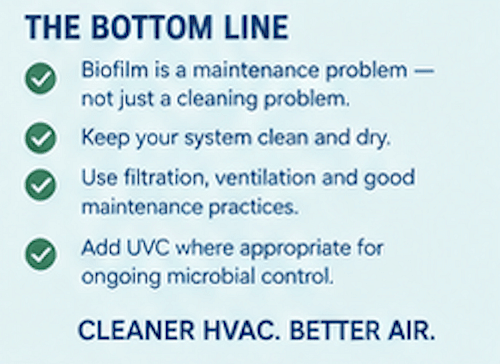
Ventilation
Filtration
Cleaning
Moisture control
Source control
Instead, it can complement those measures.
For example:
Ventilation
Brings fresh air into the building.
Filtration
Captures airborne particles.
Cleaning
Removes accumulated contamination.
Moisture control
Reduces the conditions that support microbial growth.
UVC
Provides ongoing microbial control within the HVAC system.
This layered approach is generally more effective than expecting one technology to solve every indoor air quality problem.
What about residential heat pumps?
Biofilm isn't just a commercial HVAC issue.
Residential heat pumps can also have cooling coils and condensate components that become wet during operation.
Over time, dust and organic material can accumulate.
This is particularly relevant in homes where:
The heat pump runs frequently.
Cooling is used extensively.
Indoor humidity is high.
Cleaning is infrequent.
The system is exposed to significant dust or airborne contaminants.
A properly selected UVC system can potentially be integrated into suitable residential heat pumps to provide ongoing microbial control.
However, not every heat pump is suitable for every UVC installation.
The equipment needs to be assessed for:
Available space
Coil configuration
Airflow
Lamp positioning
Electrical requirements
Material compatibility
Safety
Maintenance access
What about commercial HVAC?
Commercial systems can present an even greater opportunity for UVC.
Large air-handling units can contain:
Large cooling coils
Multiple condensate zones
Extensive ductwork
High airflow volumes
Long operating hours
They can also serve buildings with large numbers of occupants.
This is why UVC is used in a range of commercial HVAC applications, including:
Offices
Hotels
Healthcare
Education
Retail
Manufacturing
Food facilities
Aged care
Large commercial buildings
The larger and more complex the system, the more important proper engineering and dose calculations become.
Is HVAC biofilm dangerous?
It is important not to overstate the issue.
Finding microbial growth inside an HVAC system does not automatically mean that occupants are being exposed to dangerous levels of microorganisms.
The health implications depend on many factors, including:
What microorganisms are present
How much contamination exists
Whether contaminants become airborne
Building conditions
Occupant susceptibility
However, uncontrolled moisture and microbial growth are legitimate HVAC hygiene concerns and should be addressed appropriately.
The sensible approach is not panic.
It's inspection, cleaning, moisture control and ongoing maintenance.
How UVC fits into a preventative maintenance strategy
For facilities managers and building owners, UVC can be viewed as a preventative maintenance technology rather than simply an air purifier.
A typical strategy might look like:
1. Inspect
Assess coil, drain pan and HVAC condition.
↓
2. Clean
Remove existing dirt and microbial contamination.
↓
3. Correct moisture problems
Address drainage, leaks or excessive condensation.
↓
4. Install UVC
Position the system to irradiate relevant surfaces.
↓
5. Maintain
Replace lamps and clean equipment according to the manufacturer's requirements.
↓
6. Monitor
Continue inspecting HVAC condition during scheduled maintenance.
This is a much more realistic approach to long-term HVAC hygiene.
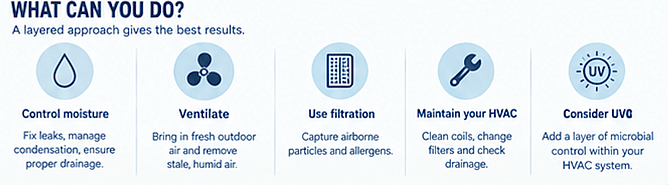
The bottom line: biofilm is a maintenance problem — not just a cleaning problem
HVAC biofilm forms when microorganisms attach to suitable surfaces and develop within a protective matrix.
Moisture, nutrients and suitable surfaces can create favourable conditions for microbial growth inside HVAC systems.
Once established, biofilm can be difficult to remove and may contribute to HVAC cleanliness, odour and maintenance issues.
The solution isn't simply:
"Install UVC."
Nor is it simply:
"Clean the coil."
The better strategy is:
Clean the system.Control moisture.Maintain the equipment.Use filtration where appropriate.And consider UVC for ongoing microbial control.
UVC can provide continuous irradiation of appropriately exposed HVAC surfaces and can help inhibit microbial growth between maintenance cycles.
It doesn't replace professional cleaning.
It doesn't eliminate the need for moisture control.
And it doesn't make a contaminated HVAC system instantly clean.
But when properly designed and installed, UVC can be a powerful additional tool for maintaining HVAC hygiene and supporting indoor air quality.
Could UVC help your HVAC system?
At AirTechnologies NZ, we specialise in UVC systems designed for integration with residential and commercial HVAC equipment.
If you're dealing with:
Repeated coil contamination
Musty HVAC odours
Frequent cleaning
Microbial growth
High HVAC maintenance requirements
Indoor air quality concerns
UVC may be worth considering as part of your preventative maintenance strategy.
The right solution starts with understanding the HVAC system, the operating conditions and where microbial growth is occurring.
Contact AirTechnologies NZ to discuss your HVAC application and find out whether UVC could be suitable.