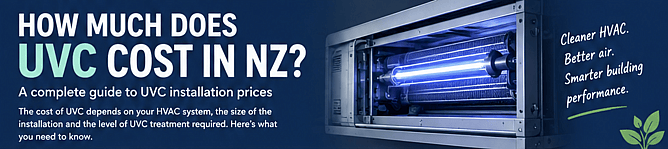
A Complete Guide to UVC Installation Prices
If you've started looking into UVC for your home, heat pump, air conditioning system or commercial HVAC system, one of the first questions you'll probably ask is:
How much does UVC cost in New Zealand?
The short answer is:
It depends on the HVAC system, the size of the installation and the level of UVC treatment required.
A small residential UVC system can cost a few hundred dollars, while larger commercial HVAC installations can run into several thousand dollars or more.
The good news is that UVC doesn't necessarily require replacing your existing HVAC system.
In many applications, UVC can be retrofitted directly into existing heat pumps, air conditioning systems, air-handling units and ventilation systems.
So what should you expect to pay?
Let's break it down.
What determines the cost of UVC installation?
There isn't one standard UVC installation price because every HVAC system is different.
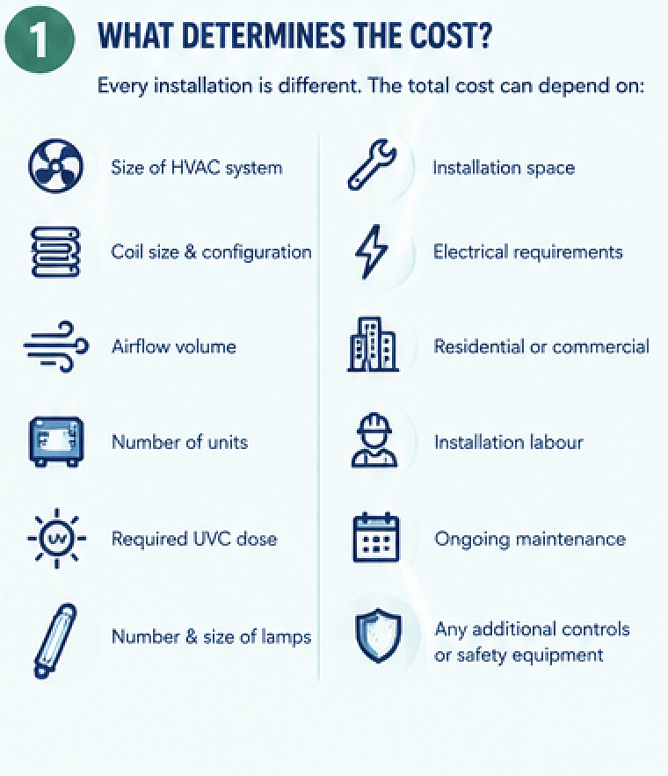
The total cost can depend on:
The size of the HVAC system
Coil size and configuration
Airflow volume
Number of HVAC units
Required UVC dose
Number and size of lamps
Available installation space
Electrical requirements
Access to the HVAC equipment
Whether the installation is residential or commercial
Whether additional controls or safety equipment are required
Installation labour
Ongoing lamp replacement and maintenance
This is why simply comparing the wattage or price of two UVC lamps doesn't necessarily tell you which system is appropriate.
A properly selected system should be sized around the HVAC application and the required UVC exposure, rather than simply choosing the cheapest lamp.
How much does residential UVC cost in NZ?
For a typical residential heat pump or small HVAC system, UVC is generally one of the more affordable ways to add an additional layer of microbial control.
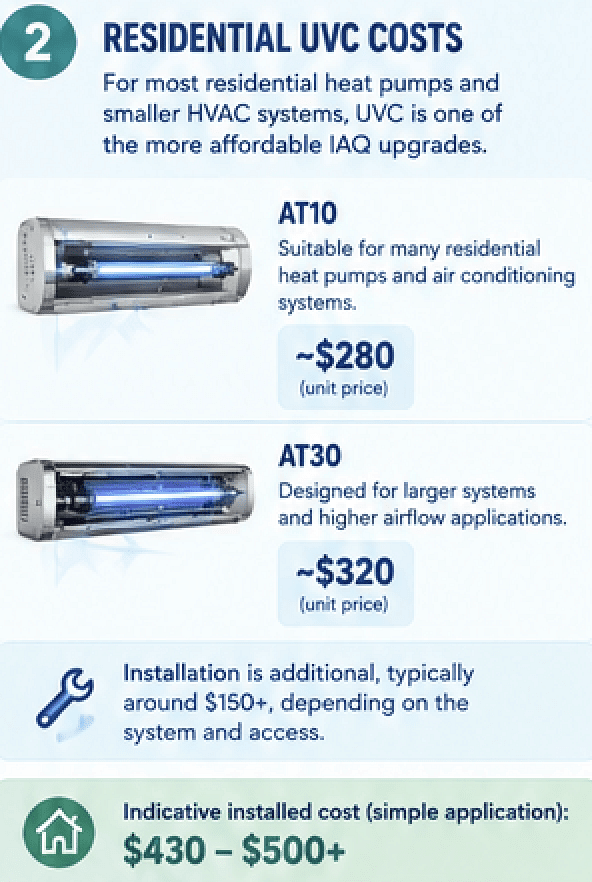
At AirTechnologies NZ, residential systems such as the AT10 and AT30 are designed specifically for integration into suitable heat pumps, air conditioning units and smaller HVAC applications.
Typical product pricing is in the few-hundred-dollar range, before installation.
For example:
AT10
Suitable for many residential heat pump and air conditioning applications.
Approximately $280 NZD for the unit.
Installation is additional and depends on the HVAC equipment and electrical requirements.
AT30
Designed for larger residential systems, larger air conditioning units and higher-airflow applications.
Approximately $320 NZD for the unit.
Again, installation is additional.
These prices are indicative and can change, so it's always worth checking the current product pricing before making a purchasing decision.
AirTechnologies NZ offers residential UVC systems designed to retrofit into suitable existing HVAC equipment.
How much does UVC installation cost?
The UVC unit is only part of the total cost.
For a residential installation, you'll also need to consider professional installation.
The actual installation price depends on the equipment.
For example, a straightforward installation into an accessible wall-mounted heat pump may be very different from installing a system into a difficult-to-access ducted unit.
Factors include:
Access to the indoor unit
Available space
Lamp positioning
Electrical connection
Whether wiring needs to be modified
Whether additional safety measures are required
How much disassembly is required
Whether the HVAC system is already being serviced
As a general guide, residential UVC installation can often add around $150+ to the cost, depending on the application.
That means a simple residential UVC installation may potentially be in the region of:
$430–$500+ NZD installed
for a straightforward application.
However, this should be treated as an indicative starting point rather than a fixed installation price.
More complex installations can cost more.
What about larger commercial HVAC systems?
This is where UVC pricing can vary considerably.
A commercial HVAC system may have:
Much larger coils
Higher airflow
Larger air-handling units
Multiple cooling stages
Larger treatment areas
Longer operating hours
Multiple HVAC systems
More demanding microbial-control requirements
Instead of installing one small lamp, a commercial application may require a purpose-designed UVC array.
AirTechnologies NZ supplies systems ranging from smaller HVAC applications through to larger commercial and industrial air-handling systems. Product selection considers factors including coil face area, airflow velocity, target UVC dose, installation depth and maintenance access.
Typical commercial UVC cost ranges
While every commercial project needs to be assessed individually, a useful way to think about commercial UVC pricing is in broad project categories.
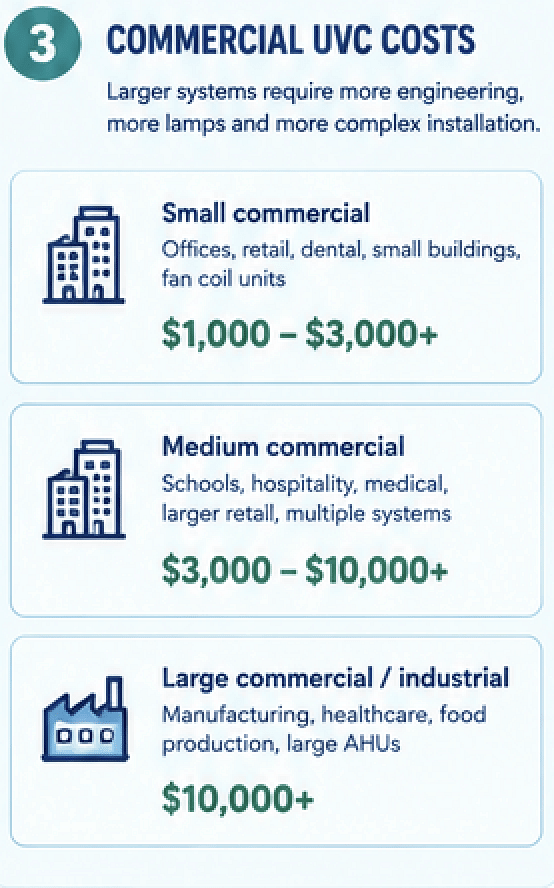
Small commercial HVAC system
Approximately $1,000–$3,000+
Suitable applications might include:
Small offices
Retail premises
Dental practices
Small commercial buildings
Individual fan coil units
Smaller air-handling systems
Medium commercial HVAC system
Approximately $3,000–$10,000+
This could include:
Larger offices
Schools
Hospitality
Medical facilities
Larger retail environments
Multiple HVAC systems
Medium-sized AHUs
Large commercial or industrial system
$10,000+
Large projects can involve:
Multiple AHUs
Large coil arrays
Multiple UVC banks
Centralised ventilation
Manufacturing facilities
Large healthcare facilities
Food production
Large commercial buildings
At this scale, the system should be engineered around the actual HVAC configuration and required UVC dose rather than selected from a simple retail price list.
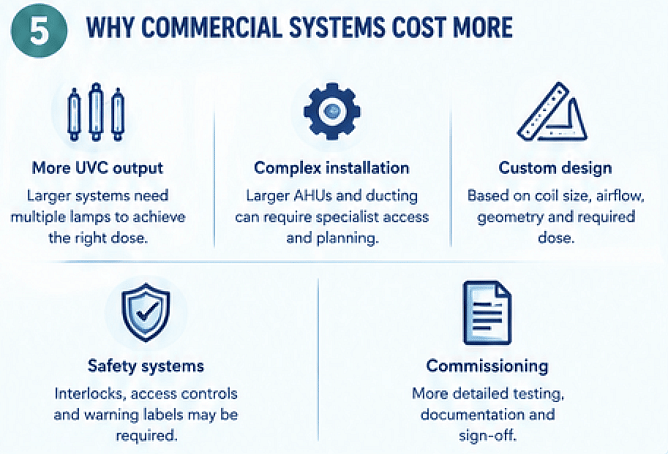
Why are commercial UVC systems more expensive?
It's not simply because the lamps are bigger.
A commercial UVC installation may require significantly more engineering and equipment.
For example:
More UVC output
Larger systems may require multiple lamps to achieve the required treatment level.
More installation work
Large AHUs can require specialist access, electrical work and installation planning.
Custom sizing
UVC performance depends on factors including:
Coil dimensions
Air velocity
Lamp output
Lamp-to-surface distance
Exposure time
Target microorganism
Required dose
Safety systems
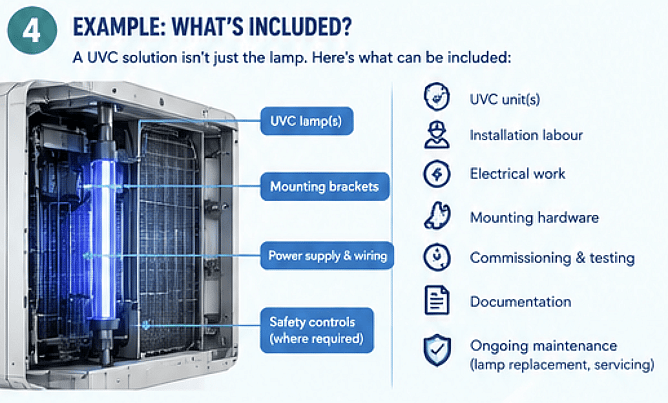
Commercial installations may require appropriate access controls, warning labels, interlocks or other safety measures depending on the system design.
Commissioning
Larger installations may also require more detailed commissioning and documentation.
AirTechnologies NZ's engineering guidance specifically identifies lamp irradiance, airflow velocity, coil geometry, lamp positioning and maintenance access as important design considerations.
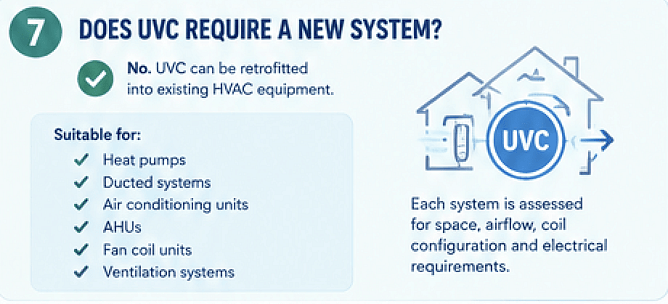
Does UVC require a new HVAC system?
No.
This is one of the reasons UVC can be an attractive option.
UVC can potentially be retrofitted into existing HVAC equipment.
For residential applications, this may mean installing a compact UVC system inside an existing heat pump.
For commercial buildings, UVC can potentially be integrated into:
AHUs
Fan coil units
Heat pumps
VRF systems
Packaged units
Fresh-air systems
Mechanical ventilation systems
Ductwork
The suitability of the equipment needs to be assessed before installation.
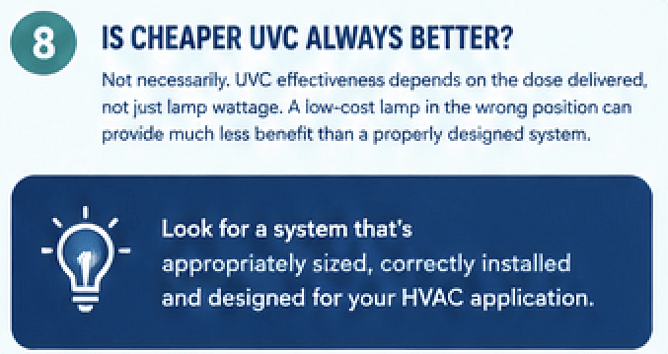
Is cheaper UVC always better?
Not necessarily.
This is one of the most important things to understand when comparing UVC products.
You shouldn't simply compare:
Lamp wattage → price → cheapest option
UVC effectiveness depends on the dose delivered to the target.
Dose is broadly related to:
Irradiance × exposure time
And factors such as lamp output, distance, airflow, geometry and lamp age can all affect the result.
A cheap lamp installed in the wrong position may provide considerably less useful treatment than a properly designed system.
AirTechnologies NZ's product selection process considers coil area, airflow velocity, target dose and available installation space.
What about ongoing UVC costs?
The initial installation isn't the only cost to consider.
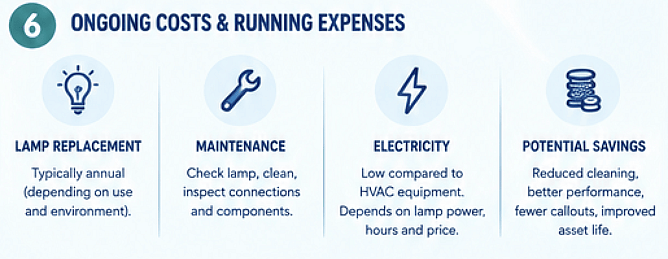
Like other HVAC components, UVC systems require ongoing maintenance.
One of the main ongoing costs is lamp replacement.
UVC lamps gradually lose output over their operating life, even if the lamp still appears to be working.
AirTechnologies NZ generally recommends regular maintenance and typically annual lamp replacement, depending on operating conditions and the particular system.
Other maintenance can include:
Inspecting the lamp
Cleaning the lamp surface
Checking electrical connections
Checking installation condition
Inspecting HVAC components
Confirming correct operation
The exact maintenance schedule depends on the system and application.
What about electricity costs?
UVC systems are designed to operate with relatively low electrical consumption compared with the HVAC equipment itself.
The exact running cost depends on:
Lamp power
Number of lamps
Operating hours
Electricity price
Whether the UVC operates continuously or with the HVAC system
For example, a small residential system using a relatively low-power lamp will have a very different annual running cost from a large commercial UVC array containing multiple lamps.
This is something that can be calculated for a specific installation.
Can UVC actually save money?
Potentially — but this is where it's important to be realistic.
UVC isn't simply an energy-saving device.
Its potential financial value can come from several areas:
Reduced cleaning requirements
If microbial and biological accumulation is reduced, HVAC components may require less intensive cleaning.
Cleaner coils
Keeping heat-transfer surfaces cleaner can help support HVAC performance.
Reduced maintenance
Less contamination can potentially reduce maintenance requirements.
Improved asset performance
Maintaining cleaner HVAC components may help equipment operate closer to its intended condition.
Indoor air quality
There may also be value in improving the overall hygiene of the HVAC system and supporting a broader IAQ strategy.
AirTechnologies NZ positions UVC as both an indoor air quality technology and an HVAC asset-management tool.
However, savings are not guaranteed.
The actual financial return depends on the HVAC system, baseline condition, cleaning frequency, operating hours, energy use and other site-specific factors.
What is the ROI of UVC?
This is one of the most common questions we receive.
The answer is:
It depends on what the UVC installation is replacing or preventing.
For example, consider a commercial HVAC system that currently requires:
Frequent coil cleaning
Regular chemical cleaning
Significant maintenance labour
Occasional emergency callouts
High operating hours
The potential financial benefit of UVC may be considerably greater than in a small residential heat pump that is cleaned once every few years.
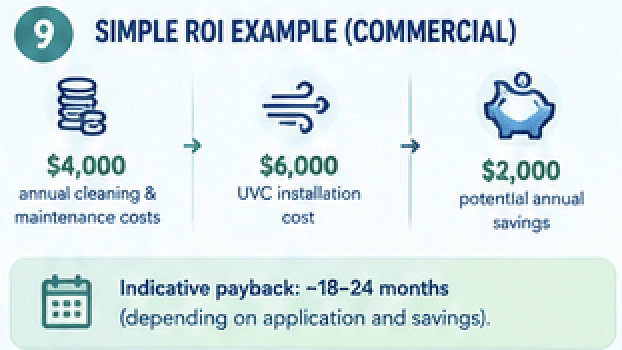
For larger commercial projects, AirTechnologies NZ has indicated that positive ROI can potentially occur within approximately 18–24 months, depending on the application and baseline costs. This should be treated as a project-specific estimate rather than a guaranteed payback period.
A simple UVC ROI example
Imagine a commercial building spends:
$4,000 per year
on additional HVAC cleaning and maintenance associated with recurring contamination.
Suppose a UVC installation costs:
$6,000
and helps reduce those costs by:
$2,000 per year
The simple maintenance-only payback would be:
$6,000 ÷ $2,000 = 3 years
If the installation also contributes to measurable energy or operational savings, the overall return could be different.
This is why a proper ROI assessment should look at the whole HVAC operating picture, rather than simply asking how much the UVC equipment costs.
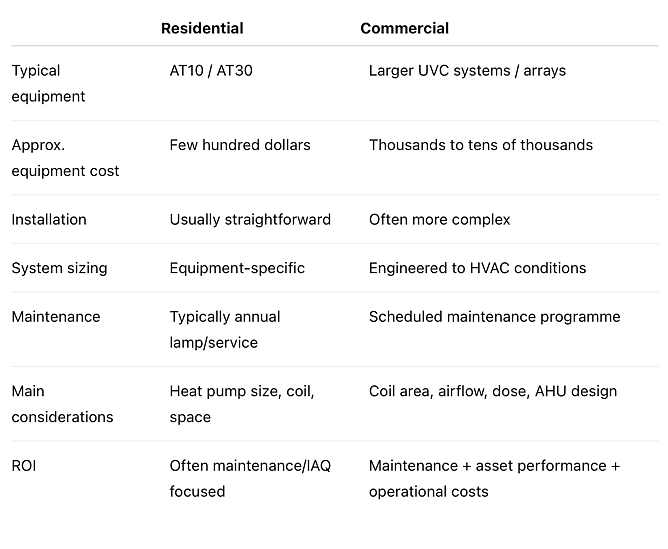
Residential UVC vs commercial UVC cost
What should you ask a UVC supplier?
Before purchasing a UVC system, don't just ask:
"How much is it?"
Ask:
1. Is the system suitable for my HVAC equipment?
Not every UVC system is suitable for every heat pump or AHU.
2. How is the system sized?
Ask what factors are used to determine the appropriate lamp or system.
3. What UVC dose will be delivered?
Lamp wattage alone doesn't tell you enough.
4. Where will the UVC be installed?
The position affects exposure, performance and safety.
5. How is occupant exposure prevented?
For HVAC applications, UVC should be properly contained within the treatment area.
6. What maintenance is required?
Ask about lamp replacement, cleaning and servicing.
7. What will installation cost?
The equipment price isn't necessarily the installed price.
8. What evidence or technical documentation is available?
A reputable supplier should be able to provide appropriate technical information for the product and application.
Is UVC worth the cost?
There isn't a universal answer.
For some homes, the primary reason for installing UVC may be HVAC hygiene and indoor air quality.
For a commercial building, the calculation may be much broader.
It may include:
UVC investment
↓
Cleaner HVAC components
↓
Potentially reduced contamination
↓
Potentially lower maintenance requirements
↓
Potentially improved system performance
↓
Long-term operating value
The right question therefore isn't simply:
"How much does UVC cost?"
It's:
"What does it cost to install UVC in my HVAC system, and what value could it provide over the life of the equipment?"
Why AirTechnologies NZ takes a system-based approach
At AirTechnologies NZ, we don't believe UVC should be selected purely by price or lamp wattage.
Our systems range from compact residential solutions through to larger commercial and industrial HVAC applications.
For a suitable installation, we consider factors including:
HVAC configuration
Coil dimensions
Airflow
Available installation space
UVC positioning
Required dose
Electrical requirements
Safety
Maintenance access
This allows the UVC system to be matched to the actual HVAC application rather than simply selecting a generic lamp.
AirTechnologies NZ provides UVC systems for residential, commercial and industrial HVAC applications throughout New Zealand.
So, how much should you budget?
As a very broad guide:
Residential heat pump
From around $430–$500+ installed
for a straightforward small-system installation, depending on the equipment and installation requirements.
Small commercial system
Approximately $1,000–$3,000+
Medium commercial system
Approximately $3,000–$10,000+
Large commercial / industrial HVAC
$10,000+
These are indicative ranges, not fixed quotes.
The actual cost can only be determined after considering the HVAC equipment, required UVC treatment, installation requirements and project conditions.
The bottom line
UVC doesn't have to be an expensive technology.
For a residential heat pump, a suitable UVC system can be a relatively modest investment.
For commercial HVAC, the cost can increase significantly because the system may require multiple lamps, engineered sizing, more complex installation and commissioning.
But the purchase price is only one part of the equation.
When assessing UVC, consider:
Installation cost
Ongoing maintenance
Energy use
Cleaning and maintenance requirements
HVAC performance
Indoor air quality objectives
Expected service life
The goal isn't to find the cheapest UVC system.
It's to find a system that is appropriately sized, correctly installed and capable of delivering the required UVC exposure for the HVAC application.
Want to know what UVC would cost for your HVAC system?
AirTechnologies NZ supplies and installs UVC systems for residential, commercial and industrial HVAC applications throughout New Zealand.
If you're wondering whether UVC is suitable for your:
Heat pump
Ducted system
Air conditioning system
AHU
Fan coil
Commercial HVAC system
Ventilation system
we can assess the application and provide an appropriate solution.
Get in touch with AirTechnologies NZ for a UVC assessment or quote.
Cleaner HVAC. Better air. Smarter building performance.