Schools and early childhood centres are busy indoor environments.
Every day, children, teachers, kaiako, staff and visitors share classrooms, activity rooms, sleep spaces, offices and common areas.
That makes indoor air quality, ventilation and HVAC hygiene important considerations for facility managers and building operators.
New Zealand's Ministry of Education recommends good ventilation in schools and early learning services, with fresh air helping reduce the risk of spreading airborne illness. The Ministry also recommends monitoring CO₂ as an indicator of ventilation performance.
But ventilation is only one part of the picture.
Where buildings rely on mechanical heating, cooling or air-handling systems, there is another question worth asking:
What is happening inside the HVAC system itself?
Cooling coils, filters, drain pans and other internal components can accumulate dust, moisture and biological contamination over time.
This is where UVC technology may provide an additional layer of HVAC hygiene.
Why indoor air quality matters in schools and ECE centres
Schools and early learning centres have several characteristics that make indoor air quality particularly important.
They often have:
High occupant density
Long periods of occupancy
Young children
Frequent movement between indoor and outdoor spaces
Heating and cooling requirements
High levels of daily activity
Multiple rooms with different ventilation characteristics
HVAC and ventilation systems that require regular maintenance
The Ministry of Education states that good ventilation helps reduce the risk of spreading airborne illnesses and recommends regularly refreshing indoor air.
For schools, the Ministry says CO₂ levels above 800 ppm for more than one hour suggest that more ventilation is needed, while sustained levels above 2,000 ppm require action.
For early learning services, similar guidance applies.
This makes ventilation monitoring an important part of managing indoor environments.
But there is an important distinction:
Ventilation brings in fresh air.Filtration removes particles from air passing through a filter.UVC provides microbial inactivation where sufficient UVC dose is delivered.
These technologies can have different roles.
Does UVC replace ventilation?
No.
This is probably the most important point for schools and ECE facilities to understand.
UVC should not be viewed as a replacement for adequate outdoor-air ventilation.
New Zealand's Ministry of Education specifically states that air purifiers do not replace good ventilation because they filter and recirculate air rather than bringing in fresh air or reducing CO₂. Heat pumps also generally recirculate indoor air rather than introducing fresh outdoor air.
UVC should be approached in the same layered way.
A good indoor air quality strategy may include:
Fresh outdoor air
↓
Ventilation
↓
Filtration
↓
HVAC maintenance
↓
Moisture control
↓
UVC where appropriate
Each addresses a different part of the indoor environment.
What does UVC actually do?
UVC stands for ultraviolet-C.
Germicidal UVC can damage the genetic material of microorganisms, reducing their ability to reproduce or resulting in inactivation when an appropriate dose is delivered.
In HVAC applications, UVC lamps can be installed inside suitable equipment so that they continuously irradiate targeted areas.
For example:
Cooling coils
Internal HVAC surfaces
Air-handling units
Fan coil units
Suitable ductwork
Other areas where the system has been designed for UVC treatment
ASHRAE recognises UV-C systems as a technology used in HVAC and air-handling applications, and its 2024 HVAC Systems and Equipment Handbook expanded guidance around UV-C safety, terminology, installation and commissioning.
What would a school or ECE centre consider UVC?
UVC stands for ultraviolet-C.
Germicidal UVC can damage the genetic material of microorganisms, reducing their ability to reproduce or resulting in inactivation when an appropriate dose is delivered.
In HVAC applications, UVC lamps can be installed inside suitable equipment so that they continuously irradiate targeted areas.
For example:
Cooling coils
Internal HVAC surfaces
Air-handling units
Fan coil units
Suitable ductwork
Other areas where the system has been designed for UVC treatment
ASHRAE recognises UV-C systems as a technology used in HVAC and air-handling applications, and its 2024 HVAC Systems and Equipment Handbook expanded guidance around UV-C safety, terminology, installation and commissioning.
Where could UVC be installed?
The exact location depends on the HVAC equipment.
Potential applications include:
Ducted HVAC systems
UVC can potentially be installed within suitable ducted air-handling equipment.
Air-handling units
Larger AHUs can provide suitable locations for engineered UVC systems.
Fan coil units
Suitable fan coil systems may be able to incorporate UVC treatment.
Heat pumps
Some larger or appropriately configured heat pumps may be suitable for UVC retrofit.
Mechanical ventilation systems
UVC can potentially be incorporated into suitable ventilation equipment depending on system design.
The key word is suitable.
UVC isn't something that should simply be placed inside any HVAC unit without assessing the equipment, airflow, available space, materials and safety requirements.
What happens inside the HVAC system?
Imagine a ducted HVAC system serving a classroom.
Air enters the system.
↓
The air passes through filtration.
↓
The air passes across the HVAC coil.
↓
A properly positioned UVC system irradiates the targeted surfaces and/or airstream.
↓
Conditioned air is distributed throughout the classroom.
The UVC isn't intended to replace the ventilation system.
Instead, it can operate as an additional treatment layer within the HVAC system.
UVC and HVAC coils
One of the most interesting applications for UVC in schools and ECE centres is the treatment of HVAC surfaces.
Cooling coils can become wet during normal operation.
Dust and other particles can also accumulate on them.
This creates an environment where microbial growth can potentially occur.
UVC installed to irradiate the coil surface can provide ongoing exposure between cleaning and maintenance cycles.
The objective is not to make the coil magically self-cleaning.
Instead:
Clean the coil.
↓
Control moisture.
↓
Install appropriately designed UVC.
↓
Provide ongoing microbial control.
↓
Continue normal HVAC maintenance.
This is a much more realistic approach.
What about mould?
Mould is an important issue for educational facilities, but UVC should not be presented as a mould-removal solution.
If a building has mould, the underlying moisture problem needs to be addressed.
That could mean investigating:
Leaks
Condensation
Poor drainage
Excess humidity
Water ingress
Inadequate ventilation
Damp materials
The Ministry of Education's ventilation guidance also highlights the importance of keeping learning environments appropriately ventilated and maintained.
UVC is not a substitute for fixing moisture.
If a ceiling is leaking, fix the leak.
If an HVAC drain is blocked, fix the drain.
If a room isn't adequately ventilated, improve ventilation.
UVC can then be considered as an additional HVAC hygiene measure where appropriate.
UVC vs HEPA air purifiers in schools
This is another area where facility managers can become confused.
A portable HEPA air purifier and an HVAC UVC system aren't necessarily competing technologies.
They perform different functions.
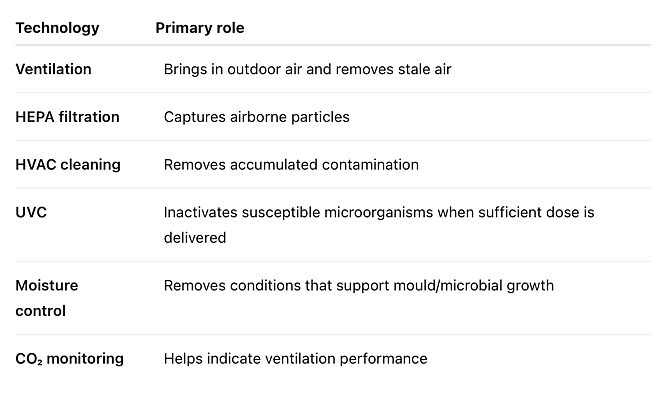
The Ministry of Education specifically recommends air purifiers in areas that are difficult to ventilate, while noting that they don't replace fresh-air ventilation.
This illustrates why layered IAQ strategies are generally more useful than looking for one technology to solve every problem.
Could UVC help with airborne microorganisms
Yes.
UVC can be used for airborne microbial inactivation when microorganisms receive a sufficient dose.
ASHRAE Standard 185.1 specifically addresses testing UV-C lights used in air-handling units or air ducts to inactivate airborne microorganisms. Standard 185.2 addresses testing UV-C lamps for use in HVAC/R units or air ducts to inactivate microorganisms on irradiated surfaces.
However, effectiveness depends on the actual application.
Factors include:
UVC irradiance
Exposure time
Air velocity
Lamp output
Lamp age
Distance
Geometry
Target microorganism
Installation position
This means:
A UVC lamp being installed does not automatically mean a particular level of microbial inactivation will occur.
Proper system selection and design matter.
Why UVC dose matters
One of the biggest mistakes when discussing UVC is focusing only on lamp wattage.
A 30 W lamp and another 30 W lamp don't necessarily provide the same treatment.
What matters is the UVC dose delivered to the target.
Broadly:
Dose = Irradiance × Exposure time
In an HVAC system, exposure can be influenced by:
Distance from the lamp
Airflow velocity
Lamp configuration
Surface geometry
Lamp output
Lamp age
Reflective surfaces
Installation position
For schools and ECE centres, this is particularly important because UVC systems should be selected according to the actual HVAC application rather than simply choosing the highest-wattage lamp.
What about safety around children?
This is critical.
Direct exposure to germicidal UVC can cause injury to skin and eyes.
That means UVC systems need to be properly designed, installed and contained so that occupants are not exposed to hazardous levels of UVC.
For an HVAC installation, the objective is to keep the UVC radiation inside the equipment or treatment area while allowing the HVAC system to operate normally.
Safety considerations can include:
Correct lamp positioning
Shielding
Equipment enclosure
Access controls
Interlocks where required
Warning labels
Maintenance procedures
Electrical safety
Appropriate installation and commissioning
ASHRAE's current HVAC handbook includes expanded guidance on UV-C safety, installation and commissioning.
For schools and ECE facilities, safety should always be considered as part of the overall system design — not added as an afterthought.
Does UVC replace HVAC cleaning?
No.
This is another important distinction.
If a coil is dirty, it should be cleaned.
If a filter needs changing, change it.
If a drain pan is contaminated, clean it.
If a ventilation system needs servicing, service it.
UVC can then provide an additional ongoing control measure.
Think of it as:
Clean
Remove existing contamination.
Maintain
Keep filters, coils and drainage systems functioning properly.
Control moisture
Address the conditions that support microbial growth.
Add UVC
Provide ongoing microbial control where appropriate.
This layered approach is more sensible than expecting UVC to replace normal facility maintenance.
UVC and the NZ Building Code
Schools and early learning facilities still need to meet the applicable New Zealand Building Code requirements.
The current G4/AS1 fifth edition for ventilation became effective on 28 July 2025 and provides a compliance pathway for ventilation of buildings, including natural, mechanical and combined ventilation systems. G4/VM1 fifth edition provides a verification pathway covering ventilation rate and air purity.
UVC should therefore be considered in addition to appropriate ventilation design and operation, not as a way around ventilation requirements.
For a new building or major HVAC project, UVC should be discussed with the appropriate mechanical/HVAC engineer and design team.
What should facility managers look at first?
Before considering UVC, start with the basics.
1. Check ventilation
Are classrooms and activity rooms receiving sufficient fresh air?
2. Monitor CO₂
CO₂ can provide a useful indication of ventilation performance.
New Zealand Ministry of Education guidance identifies sustained levels above 800 ppm as an indication that more ventilation may be needed.
3. Inspect HVAC equipment
Look at:
Filters
Coils
Drain pans
Condensate drains
Fans
Internal surfaces
4. Check for moisture
Look for:
Condensation
Leaks
Standing water
Poor drainage
Damp materials
5. Review maintenance schedules
Make sure HVAC equipment is being cleaned and serviced appropriately.
6. Consider filtration
Where appropriate, assess whether existing filtration is suitable for the HVAC system.
7. Then consider additional technologies
This could include UVC where the HVAC system and application make it appropriate.
What types of facilities could consider UVC?
UVC may be relevant to a range of educational and childcare environments.
Early childhood centres
Particularly where multiple rooms have HVAC or ducted systems.
Primary schools
Classrooms, administration areas, libraries and other mechanically ventilated spaces.
Secondary schools
Classrooms, laboratories, offices, libraries and larger communal areas.
Kindergartens
Where HVAC equipment is used for heating, cooling or ventilation.
Tertiary education
Universities, polytechnics and training facilities can have larger and more complex HVAC systems.
Specialised learning environments
Some facilities may have additional IAQ or HVAC hygiene requirements that warrant a more detailed assessment.
The suitability of UVC should always be considered on a room-by-room and system-by-system basis.
What should facility managers ask their HVAC contractor?
If you're considering UVC, ask:
What type of HVAC system do we have?
Understanding the equipment is the starting point.
Where could UVC be installed?
Not every location is suitable.
What UVC dose would the system deliver?
Don't rely solely on lamp wattage.
What surfaces would be treated?
Coils, drain pans, internal surfaces and/or the airstream may have different requirements.
How will the system be made safe?
Ask about shielding, access and maintenance.
How will the installation affect maintenance?
The system should remain serviceable.
What ongoing maintenance is required?
Ask about lamp replacement, cleaning and inspections.
Can the installation be integrated into our existing maintenance programme?
Ideally, UVC should become part of the facility's overall HVAC maintenance strategy.
A practical school or ECE HVAC strategy
A well-managed indoor environment could look something like this:
1. Ventilation
Bring in adequate outdoor air.
↓
2. CO₂ monitoring
Check whether ventilation is performing as expected.
↓
3. Filtration
Capture appropriate airborne particles.
↓
4. HVAC maintenance
Clean coils, filters, fans and condensate systems.
↓
5. Moisture control
Address leaks, condensation and drainage.
↓
6. UVC
Where appropriate, provide ongoing microbial control within suitable HVAC equipment.
↓
7. Monitor and maintain
Continue checking the system and adjusting the strategy as required.
This is a layered approach to indoor air quality.
What are the potential benefits of UVC for schools and ECE?
Depending on the HVAC system and application, UVC may help support:
HVAC hygiene
Ongoing UVC exposure can help control microbial growth on appropriately exposed HVAC surfaces.
Cleaner coils
UVC can be used as part of a strategy to help control biological growth on irradiated surfaces.
Maintenance
Controlling microbial growth may complement routine HVAC cleaning and maintenance.
Odour control
Microbial growth can contribute to some HVAC-related odours, so microbial control may help in appropriate applications.
Indoor air quality
UVC can form one part of a broader IAQ strategy alongside ventilation and filtration.
Building management
For facility managers, UVC can provide an additional tool for managing HVAC systems between scheduled maintenance visits.
These outcomes are application-dependent and shouldn't be treated as guaranteed results for every installation.
Is UVC suitable for every school or ECE centre?
No.
And that's actually a good thing.
A reputable UVC assessment should first determine whether UVC is appropriate for the equipment and the facility.
Questions include:
What HVAC system is installed?
What is the airflow?
What are the coil dimensions?
Where can UVC be positioned?
What surfaces need treatment?
What UVC dose is required?
How will the system be accessed for maintenance?
What safety controls are required?
What are the facility's IAQ objectives?
Sometimes the best investment may be improving ventilation.
Sometimes it may be upgrading filtration.
Sometimes it may be fixing moisture or drainage problems.
And sometimes UVC is a useful additional layer.
The objective should always be to solve the actual building problem, rather than simply install a technology.
The bottom line
Schools and early childhood centres have a responsibility to provide healthy, well-managed indoor environments.
The foundation is good ventilation, appropriate heating, moisture control, filtration and regular HVAC maintenance.
UVC doesn't replace those measures.
Instead, where suitable HVAC equipment is available, UVC can provide an additional layer of microbial control.
For facility managers, the opportunity is particularly interesting because UVC can be integrated into existing HVAC systems without necessarily replacing the equipment.
The strategy is simple:
Ventilate.
Filter.
Clean.
Control moisture.
Maintain.
Consider UVC where appropriate.
That is a much stronger approach than relying on any single technology.
Could UVC be suitable for your school or ECE centre?
AirTechnologies NZ specialises in 254 nm UVC systems designed for integration into suitable HVAC and air-handling equipment.
We can assess applications including:
Heat pumps
Ducted systems
Fan coil units
Air-handling units
Mechanical ventilation systems
Commercial HVAC systems
If you're a school property manager, ECE centre owner, facilities manager, mechanical contractor or building consultant, we'd be happy to discuss the HVAC system and determine whether UVC is worth investigating.
The right UVC solution starts with the building, the HVAC system and the problem you're trying to solve.
AirTechnologies NZ — New Zealand's Air Quality Specialists.