Indoor air quality is becoming an increasingly important consideration in modern workplaces.
We spend a significant portion of the working day indoors, often in offices where heating, cooling and ventilation systems continuously circulate air throughout occupied spaces. While these systems are essential for maintaining comfortable indoor conditions, their internal cleanliness and ongoing maintenance can also influence the overall indoor environment.
One technology increasingly being considered as part of a broader indoor air quality strategy is 254nm ultraviolet-C (UVC).
When correctly designed and installed within suitable HVAC and air-handling systems, UVC can provide an additional layer of microbial control — helping maintain cleaner HVAC components and supporting a healthier, better-managed indoor environment.
Importantly, UVC does not replace ventilation, filtration, cleaning or normal HVAC maintenance.
It works alongside them.
Why Indoor Air Quality Matters in Offices
Modern offices can contain a range of potential indoor air contaminants, including:
Airborne particles and dust
Allergens
Outdoor pollutants
Volatile organic compounds (VOCs)
Moisture
Mould spores
Bacteria and other microorganisms
Contaminants generated by occupants and everyday activities
At the same time, offices can have relatively high occupant densities, shared meeting rooms and enclosed spaces.
This makes effective ventilation, filtration, moisture management and HVAC maintenance particularly important.
A well-managed indoor air quality strategy therefore needs to look beyond simply heating and cooling the building.
The Role of HVAC in Indoor Air Quality
HVAC systems can operate for thousands of hours every year.
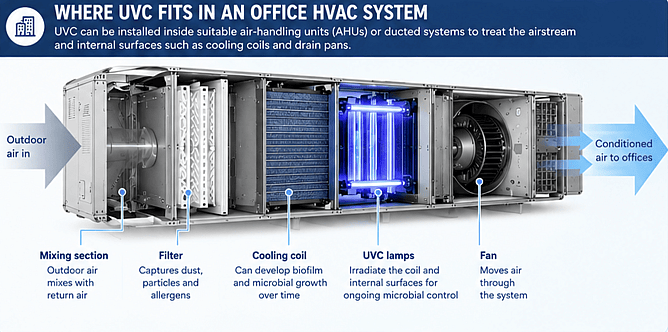
Depending on the system, air may pass through filters, cooling and heating coils, drain pans, fans, ductwork and other internal components before being supplied back into occupied areas.
Cooling coils are particularly important.
When warm air passes across a cold cooling coil, condensation can form. Combined with dust, organic material and other contamination, these damp conditions can potentially support microbial growth and HVAC biofilm.
Over time, contamination on internal HVAC surfaces may contribute to:
Reduced HVAC cleanliness
Unpleasant odours
Increased cleaning requirements
Coil fouling
Reduced heat-transfer performance
Ongoing maintenance issues
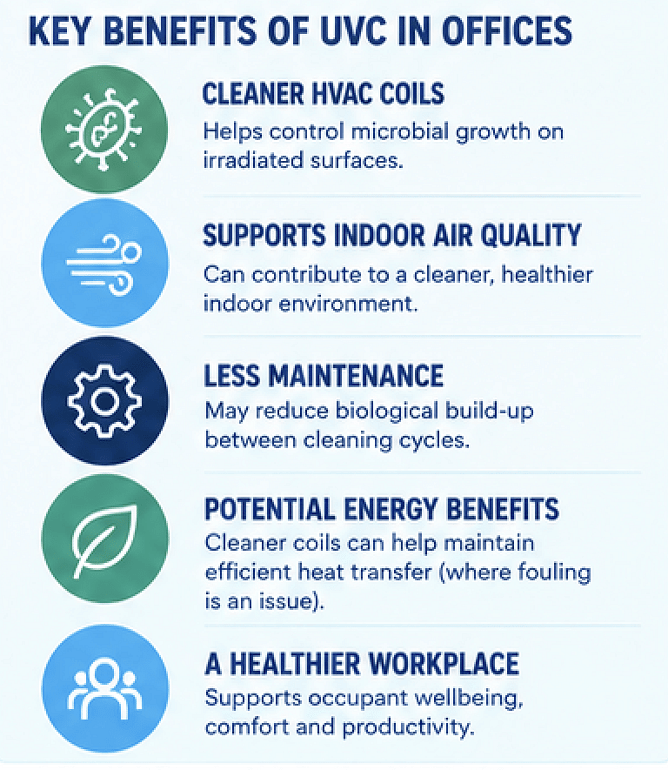
This is one of the areas where UVC can be particularly useful.
What Is UVC?
Ultraviolet-C is a portion of the ultraviolet spectrum.
254nm UVC has been used for microbial control applications for decades.
When microorganisms receive a sufficient UVC dose, the radiation can damage their genetic material and interfere with their ability to reproduce.
Within HVAC systems, UVC can generally be applied in two ways:
1. Surface Treatment
UVC lamps can be positioned to continuously irradiate areas such as:
Cooling coils
Drain pans
Internal HVAC surfaces
This can help control susceptible microbial growth on irradiated surfaces and maintain cleaner HVAC internals between normal maintenance cycles.
2. Airstream Treatment
UVC can also be designed to treat microorganisms travelling through the HVAC airstream.
However, effective airborne treatment depends heavily on UVC dose.
Airflow velocity, lamp output, distance, exposure time, HVAC geometry and lamp positioning all need to be considered.
Simply placing a UVC lamp inside an air-conditioning system does not automatically guarantee effective airborne treatment.
How UVC Can Support Office Indoor Air Quality
Cleaner HVAC Coils
Cooling coils can provide favourable conditions for microbial growth because they are frequently exposed to moisture.
Continuous UVC irradiation can help control susceptible microorganisms on appropriately exposed coil surfaces.
Rather than allowing biological contamination to build up between cleaning intervals, UVC provides ongoing treatment whenever the system is operating as designed.
HVAC Biofilm Control
Biofilm is a layer of microorganisms embedded within a protective biological matrix that can develop on wet or contaminated HVAC surfaces.
Once established, biofilm can be difficult to manage through occasional cleaning alone.
UVC can provide an additional tool for controlling microbial growth on continuously irradiated surfaces.
It does not remove the need for physical cleaning, but it may help maintain cleaner conditions between maintenance visits.
Supporting Airborne Microbial Control
Correctly designed in-duct UVC systems may also provide microbial inactivation within the moving airstream.
This can be particularly relevant in offices with:
High occupant density
Shared meeting rooms
Large open-plan areas
Centralised air-handling systems
Significant recirculated airflow
The effectiveness of any airborne UVC application should be assessed against the actual HVAC configuration and required UVC dose.
Supporting HVAC Performance
There can also be an operational benefit to maintaining cleaner cooling coils.
Contamination and biological build-up on heat-transfer surfaces can potentially restrict airflow and interfere with efficient heat transfer.
Where coil contamination is an existing issue, maintaining cleaner coil surfaces may therefore support HVAC performance and potentially reduce unnecessary energy use.
The actual savings will vary considerably between buildings and should be assessed using the condition and operating data of the individual HVAC system.
UVC Is Not a Replacement for Ventilation
This is one of the most important distinctions for building owners and facility managers.
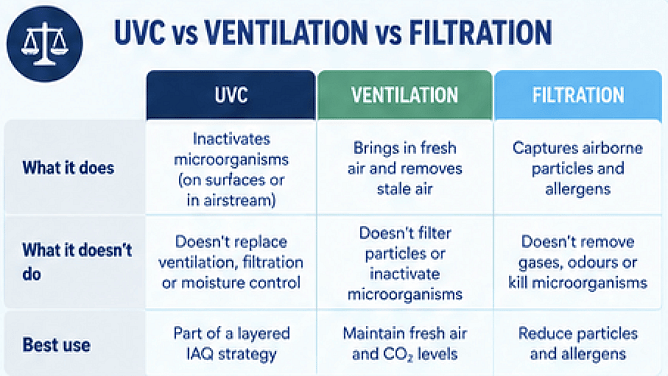
UVC does not introduce fresh outdoor air into an office.
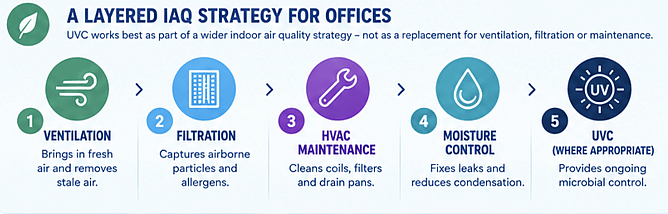
A good indoor air quality strategy should instead use multiple complementary controls.
A practical hierarchy could include:
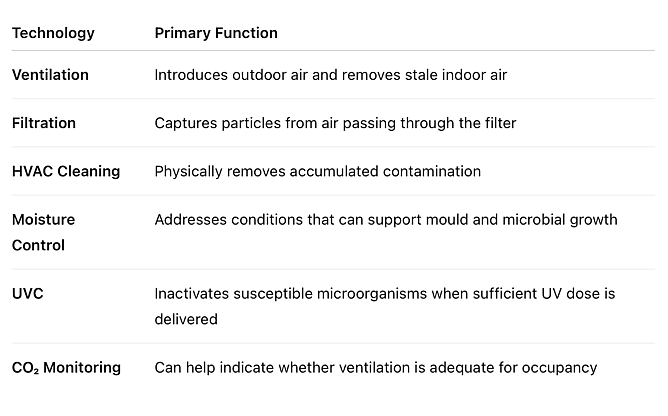
Outdoor air → Ventilation → Filtration → HVAC maintenance → Moisture control → UVC → Ongoing monitoring
Each addresses a different part of indoor air quality.
UVC should therefore be considered an additional engineering control, rather than a replacement for existing building systems.
UVC vs Ventilation vs Filtration
The strongest approach is generally not choosing one technology over another.
It is combining appropriate technologies into a layered indoor air quality strategy.
Where Can UVC Be Installed in an Office Building?
Depending on the building and HVAC configuration, UVC may potentially be integrated into:
Air-handling units
Commercial ducted HVAC systems
Fan coil units
Cooling coil sections
Return-air systems
Supply-air systems
Mechanical ventilation systems
Suitable heat-pump systems
Not every HVAC system is automatically suitable.
Before installation, the equipment should be assessed to determine the appropriate lamp configuration, location, exposure, electrical requirements and safety controls.
What About UVC Safety?
Direct exposure to conventional germicidal UVC can be harmful to the eyes and skin.
For this reason, HVAC UVC systems should be designed so occupants are not directly exposed to the UVC source.
In suitable applications, lamps are installed inside enclosed HVAC equipment or ductwork, where the radiation can treat the intended air or surfaces while remaining isolated from normal building occupants.
Appropriate shielding, access controls, warning labels, electrical isolation and maintenance procedures should form part of the installation.
Could UVC Help Reduce HVAC Maintenance?
Potentially.
If a facility repeatedly experiences microbial growth or biological contamination on cooling coils, drain pans or other HVAC components, continuous UVC treatment may help maintain cleaner surfaces between scheduled maintenance.
This could potentially mean:
Less biological build-up
Cleaner cooling coils
Easier ongoing maintenance
Reduced recurrence of some contamination
Better long-term HVAC hygiene
However, UVC should not be used as an excuse to reduce appropriate preventative maintenance.
Filters still need replacing.
Coils still need inspecting.
Drainage systems still need checking.
HVAC systems still need servicing.
UVC simply provides another tool.
What About Energy Efficiency?
For larger commercial HVAC systems, this can be an interesting part of the business case.
Cooling coils rely on effective heat transfer between the coil surface and the air passing across it.
If a coil becomes significantly contaminated, its performance can be affected.
Where biological fouling is present, maintaining cleaner heat-transfer surfaces through appropriately designed UVC treatment may support more efficient HVAC operation.
The opportunity will vary considerably between buildings, which is why AirTechnologies NZ recommends assessing the actual HVAC equipment rather than applying generic energy-saving percentages.
For larger air-handling systems, analysing coil condition, airflow, fan energy, operating hours and HVAC energy consumption can help determine whether there is a meaningful financial case.
Which Offices Could Benefit?
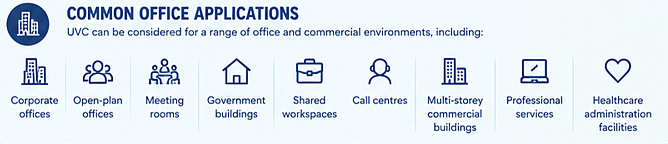
UVC may be worth investigating in:
Corporate offices
Government buildings
Shared workplaces
Large open-plan offices
Call centres
Professional services offices
Multi-storey commercial buildings
Medical and healthcare administration facilities
High-occupancy workplaces
Buildings with central air-handling systems
Offices experiencing recurring HVAC contamination or odour issues
The best opportunities are often buildings where there is a specific problem to solve rather than simply installing UVC everywhere.
For example, a building may have one air-handling unit experiencing persistent coil contamination.
That can be an ideal system to assess first.

A Pilot Installation Can Be a Good Starting Point
For larger commercial buildings, UVC does not necessarily need to begin with a building-wide rollout.
A practical approach is to identify one representative HVAC system or AHU and assess whether it is suitable for a pilot installation.
The condition of the system can then be documented before installation and monitored afterwards.
Depending on the objective, this might include monitoring:
Coil cleanliness
Microbial build-up
Maintenance requirements
Odour complaints
Airflow
Pressure drop
HVAC energy consumption
Fan performance
Coil performance
This provides building owners and facility managers with site-specific information before considering wider deployment.
Questions Facility Managers Should Ask Before Installing UVC
Before selecting a UVC system, ask:
What problem are we trying to solve?
Where will the UVC lamps be installed?
Are we treating the cooling coil, airstream or both?
How has the required UVC dose been determined?
How does airflow affect the application?
How will occupants and maintenance personnel be protected from direct exposure?
What maintenance will the UVC system require?
How will its performance be assessed?
Can the system be retrofitted into our existing HVAC equipment?
Could we trial the technology on one representative HVAC system first?
A credible UVC solution should be designed around the HVAC system — not simply around the lamp.
Designing Healthier Office Buildings
Indoor air quality is increasingly becoming part of the wider conversation around healthy buildings, employee wellbeing, sustainability and building performance.
The HVAC system is central to that conversation.
UVC provides facility managers, building owners and HVAC professionals with another technology that can be incorporated into suitable systems to help manage microbial contamination and maintain cleaner internal HVAC surfaces.
But the key is integration.
Ventilate properly.
Filter appropriately.
Control moisture.
Maintain the HVAC system.
Keep coils clean.
Use UVC where it provides a genuine benefit.
That is where UVC can become a valuable part of a broader indoor air quality strategy.
Considering UVC for Your Office or Commercial Building?
AirTechnologies NZ specialises in 254nm UVC systems for HVAC and air-handling applications throughout New Zealand.
We can assess existing HVAC equipment, discuss the objective of the project and determine whether there is an appropriate UVC application.
For larger facilities, this can start with one suitable HVAC system or pilot installation, allowing the technology and results to be evaluated before considering a wider rollout.
AirTechnologies NZ — New Zealand’s Air Quality Specialists.