Your HVAC cooling coils might be hidden inside an air-handling unit, but their condition can have a significant impact on how the system performs.
Every day, large volumes of air pass across HVAC coils.
Along with that air can come dust, fibres, pollen, organic material and other airborne contaminants. Add moisture from condensation, and the cooling coil can become an environment where dirt and biological contamination gradually accumulate.
The result?
A coil that was designed to efficiently transfer heat can slowly become covered by a layer of contamination.
And that isn't necessarily just a cleaning issue.
It can become an HVAC performance, maintenance, energy and asset-management issue.
So what is actually happening inside your HVAC system — and what could dirty coils be costing your building?
Why Do HVAC Cooling Coils Get Dirty?
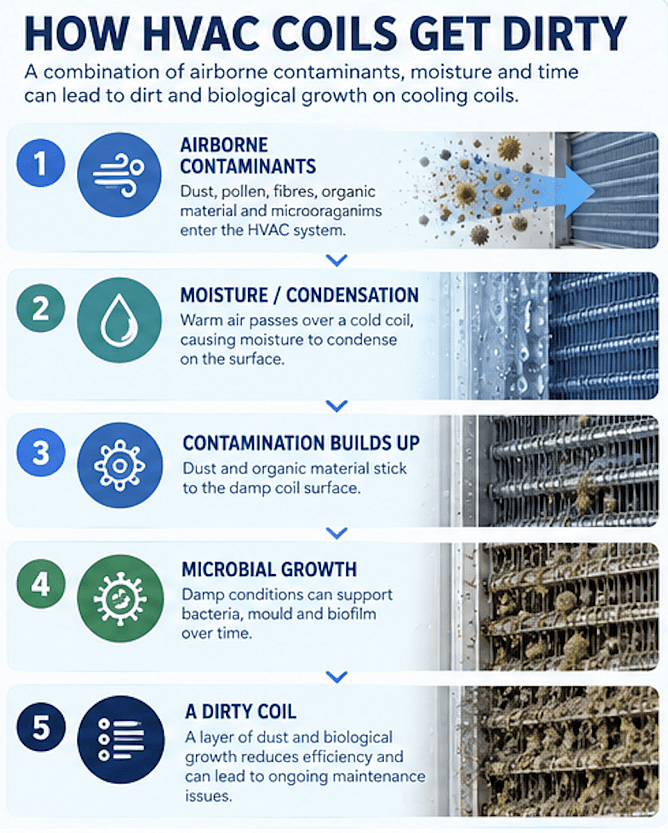
Cooling coils operate under challenging conditions.
As warm air passes across a cold coil, heat is transferred from the air into the coil.
If the coil surface is below the dew point of the incoming air, moisture condenses onto it.
This is completely normal.
The problem is what happens when that moisture combines with contaminants entering the HVAC system.
These may include:
Dust
Pollen
Fibres
Organic material
Microorganisms
Contamination that passes through or around filtration
Over time, material can accumulate on the coil fins and surrounding surfaces.
Because cooling coils can remain damp for extended periods, they can also provide conditions capable of supporting microbial growth.
What Is HVAC Biofilm?
One of the less visible problems that can develop on wet HVAC surfaces is biofilm.
Biofilm is a community of microorganisms attached to a surface and embedded within a protective biological matrix.
Inside HVAC equipment, it may develop on areas such as:
Cooling coils
Coil fins
Drain pans
Condensate areas
Other persistently damp internal surfaces
Once established, biological contamination may become an ongoing maintenance problem.
A coil can be physically cleaned, only for microbial growth to gradually return if the conditions supporting it remain.
That is why recurring coil contamination should not always be viewed simply as:
“The coil needs another clean.”
A better question may be:
“Why does this coil keep becoming contaminated?”
A Dirty Coil Isn't Just an Indoor Air Quality Issue
When people hear about dirty HVAC systems, the conversation often focuses on indoor air quality.
That is important.
But for commercial buildings, there is another significant consideration:
HVAC performance.
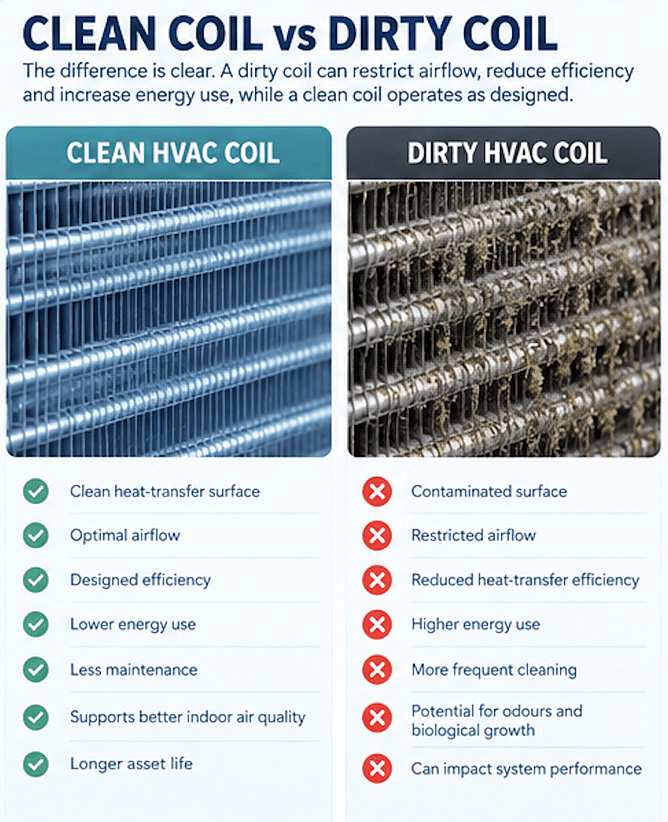
A cooling coil is a heat exchanger.
Its job is to transfer heat efficiently between the air moving across the coil and the refrigerant or chilled water flowing through it.
If contamination accumulates on that heat-transfer surface, it can potentially interfere with that process.
Think about putting an insulating layer over something designed to exchange heat.
The equipment may still operate.
It may still cool the building.
But it may have to work harder to achieve the same result.
What Can a Dirty HVAC Coil Cost Your Building?
The real cost isn't necessarily one large invoice.
It can appear across several areas of building operation.
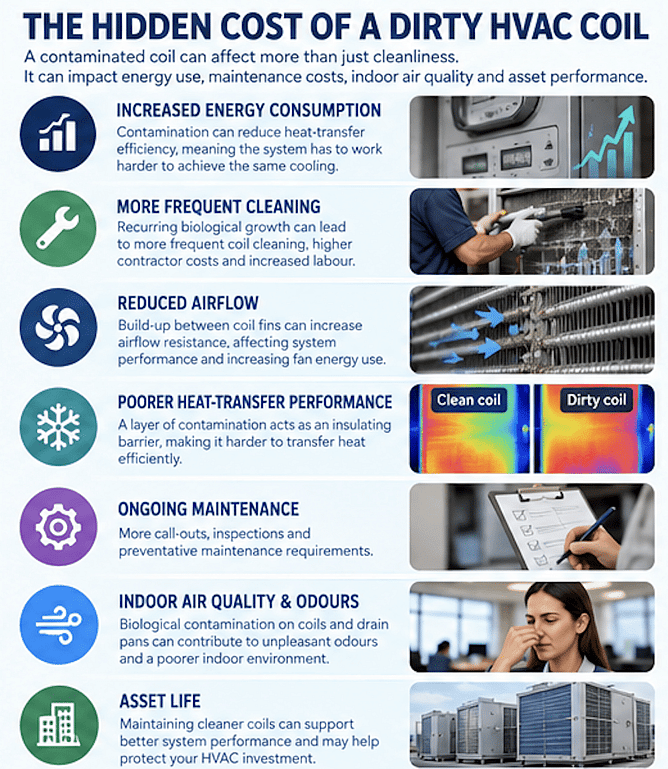
1. Increased HVAC Energy Consumption
HVAC systems are often one of the largest energy users within commercial buildings.
Where significant coil fouling is present, contamination may reduce heat-transfer efficiency and potentially increase resistance to airflow.
That can mean the HVAC system has to operate harder or longer to maintain the required indoor conditions.
The exact energy impact will depend on factors including:
Coil condition
System design
Airflow
Fan configuration
Building load
Operating hours
Climate
Level and type of contamination
For that reason, energy-saving claims should be assessed against the actual HVAC equipment rather than relying on a generic percentage.
But in a large building operating thousands of hours each year, even relatively small improvements in HVAC performance can become commercially significant.
2. More Frequent Coil Cleaning
Commercial HVAC coils require routine inspection and cleaning.
But some facilities experience recurring contamination that requires more frequent intervention.
That can involve:
HVAC contractor labour
Specialist coil cleaning
Chemical cleaning products
Access equipment
Building disruption
Equipment shutdowns
Additional preventative maintenance
One coil clean may not seem particularly significant.
Repeated across numerous AHUs and over many years, the cost can become substantial.
3. Reduced Airflow
As contamination accumulates between tightly spaced coil fins, airflow resistance can increase.
That may affect the volume of air the system can move and increase the pressure the fan needs to overcome.
In severe cases, this can contribute to poor HVAC performance and additional fan energy requirements.
This is another reason coil condition matters beyond appearance.
4. Reduced Heat-Transfer Performance
The cooling coil is designed to maximise contact between the moving air and the heat-transfer surface.
Contamination creates an unwanted layer between the two.
If that layer becomes significant enough, heat transfer can be affected.
The HVAC system may then require more runtime or additional energy to deliver the required cooling.
5. Ongoing Maintenance Labour
Dirty HVAC equipment doesn't maintain itself.
Every recurring contamination problem creates additional work for facilities and maintenance teams.
That could mean:
Inspect → Clean → Reassemble → Monitor → Repeat.
If the same coil continually requires attention, there may be value in investigating whether the underlying contamination can be better controlled between maintenance intervals.
6. Drain Pan and Condensate Issues
The coil isn't the only surface exposed to moisture.
Condensate from the coil flows into a drain pan and drainage system.
If these areas become contaminated, facilities teams may encounter issues including:
Slime or biological build-up
Blocked drains
Standing water
Odours
Additional cleaning requirements
UVC cannot correct poor drainage or a badly designed condensate system.
Those problems need to be fixed directly.
But microbial control can form part of a broader strategy for maintaining cleaner wet HVAC surfaces.
7. Indoor Air Quality and Odours
HVAC cleanliness can also influence the quality of the indoor environment.
Dirty or biologically contaminated internal components may contribute to unwanted odours and poorer HVAC hygiene.
This becomes particularly important in environments such as:
Offices
Healthcare facilities
Aged-care facilities
Hotels
Schools
Early childhood centres
Gyms
Laboratories
Retail centres
High-occupancy commercial buildings
Maintaining clean HVAC equipment should therefore be viewed as part of both asset management and indoor environmental quality.
Why Doesn't Filtration Stop Coils Getting Dirty?
Good filtration is extremely important.
But filtration and coil cleanliness are not the same thing.
Filters capture particles from the air passing through them.
Their effectiveness depends on factors such as:
Filter efficiency
Filter condition
Correct installation
Air bypass
Maintenance intervals
Particle size
Even with good filtration, some contamination can still reach downstream HVAC components.
More importantly, filtration does not remove the moisture created by condensation on a cooling coil.
That is why a well-maintained HVAC system can still develop biological contamination on wet internal surfaces.
Cleaning the Coil vs Keeping the Coil Clean
Traditional coil cleaning is periodic.
The coil becomes contaminated.
It is inspected.
It is cleaned.
The system goes back into operation.
Contamination begins accumulating again.
This creates a cycle:
Contamination → Cleaning → Operation → Recontamination → Cleaning
For some buildings, that is perfectly manageable.
For others, particularly where biological growth repeatedly develops on cooling coils, it may be worth considering a continuous microbial-control strategy.
This is where UVC can be useful.
How UVC Can Help Keep HVAC Coils Cleaner
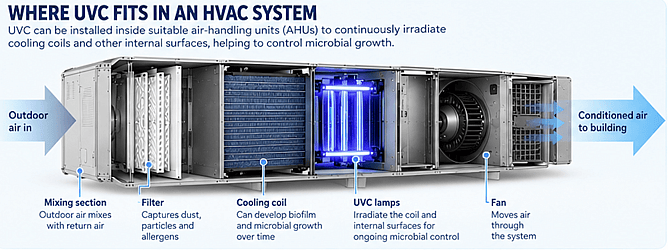
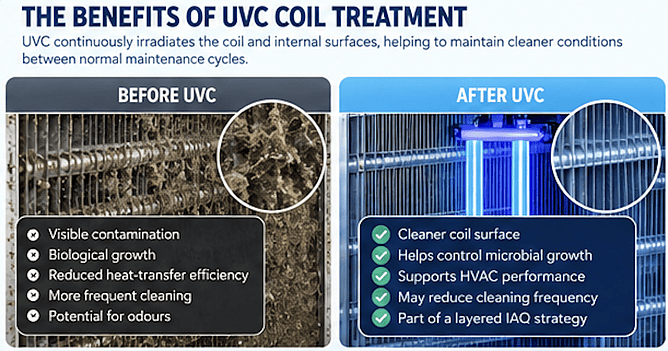
254nm ultraviolet-C can be installed inside suitable HVAC equipment and positioned to continuously irradiate cooling coils, drain pans and other targeted internal surfaces.
When susceptible microorganisms receive a sufficient UVC dose, the radiation damages their genetic material and interferes with their ability to reproduce.
For coil applications, the objective is straightforward:
Control microbial growth where it is occurring.
Instead of waiting for biological contamination to accumulate before addressing it, appropriately designed UVC provides ongoing treatment to the irradiated surfaces.
This may help maintain cleaner coil surfaces between normal maintenance cycles.
UVC Doesn't Replace Coil Cleaning
This distinction is important.
UVC is not a pressure washer.
It does not physically remove dust, fibres, debris or heavy existing contamination from a coil.
A heavily contaminated coil may need to be properly cleaned before a UVC system is commissioned.
The strategy then becomes:
1. Inspect the coil
2. Establish its current condition
3. Physically clean it if required
4. Correct drainage, moisture or maintenance issues
5. Install appropriately designed UVC where suitable
6. Continue normal HVAC inspections and maintenance
The aim is not to eliminate HVAC maintenance.
It is to help prevent biological contamination from simply returning to the same extent between maintenance cycles.
Could Cleaner Coils Reduce Energy Consumption?
Potentially — particularly where biological fouling is affecting heat-transfer or airflow performance.
But this needs to be approached carefully.
Installing UVC does not automatically create a fixed percentage energy saving.
If a coil is already clean and performing well, the energy opportunity may be limited.
If a heavily fouled coil is affecting system performance, maintaining that coil in a cleaner condition may provide a much stronger operational benefit.
That is why the best commercial UVC projects begin with measurement.
Measure the Problem Before You Solve It
For facility managers considering UVC, one of the most useful approaches is to identify an HVAC system with an existing problem.
For example:
One AHU has recurring coil contamination and requires regular cleaning.
Instead of immediately installing UVC throughout the entire building, that unit can become a pilot.
Before installation, establish baseline information.
Depending on the system, this might include:
Photographs of coil condition
Cleaning frequency
Maintenance costs
Airflow
Pressure drop
Fan energy
Supply and return temperatures
Coil entering and leaving air temperatures
Operating hours
HVAC electricity consumption
Maintenance observations
The coil can then be cleaned, appropriately designed UVC installed, and the same indicators monitored over time.
This gives the facility manager something far more useful than a generic claim.
It gives them site-specific evidence.
A Simple Example
Consider a commercial building with several large air-handling units.
One AHU requires its cooling coil to be professionally cleaned multiple times because biological contamination continues to return.
The building owner is paying for:
Cleaning labour + contractor costs + equipment access + downtime + administration + potentially unnecessary HVAC energy use.
Instead of treating each clean as an isolated maintenance expense, the facility manager could calculate the annual cost of the recurring problem.
If UVC can help maintain the coil in a cleaner condition and reduce some of those recurring costs, it becomes possible to assess the technology as an investment.
The calculation becomes:
Current annual cost of coil contamination
versus
UVC installation + operation + maintenance
That is a much more meaningful way to evaluate ROI.
Which Buildings Should Investigate UVC Coil Treatment?
UVC coil treatment may be particularly worth investigating in buildings with:
Large air-handling units
Long HVAC operating hours
High cooling demand
Persistent coil contamination
Recurring biological growth
Frequent coil-cleaning requirements
High HVAC energy consumption
Critical indoor environments
Large facilities portfolios
Potential applications include:
Commercial offices
Hospitals and healthcare
Laboratories
Aged-care facilities
Universities
Schools
Hotels
Shopping centres
Airports
Data centres
Gyms and fitness facilities
Manufacturing facilities
Pharmaceutical and life-science environments
What Should Facility Managers Look For?
You don't necessarily need specialist equipment to begin investigating.
During your next HVAC inspection, ask:
What does the cooling coil actually look like?
Look for:
Visible contamination
Biological build-up
Slime
Blocked or dirty fins
Dirty drain pans
Standing water
Recurring odours
Evidence of poor drainage
Then ask your maintenance team:
“How often are we cleaning this?”
And then:
“Why does it keep getting dirty?”
Those two questions can reveal whether you have a routine maintenance task — or an ongoing problem worth solving.
Don't Just Look at the Purchase Price
When evaluating UVC, it is easy to compare the cost of a UVC system against the cost of one coil clean.
That can miss the bigger picture.
Instead, consider the whole-life cost of the existing problem.
That may include:
Maintenance + cleaning + labour + energy + disruption + equipment performance + asset management.
Then compare that against:
UVC installation + lamp energy + maintenance + lamp replacement.
For some buildings, the business case may be compelling.
For others, it may not be.
The important thing is to calculate it properly.
The Cheapest HVAC System Isn't Always the Cheapest to Operate
Building owners spend significant amounts of money purchasing HVAC equipment.
But the real cost of that equipment is accumulated over years of operation.
Energy.
Maintenance.
Cleaning.
Repairs.
Replacement components.
Contractor call-outs.
Asset life.
That is why HVAC hygiene should be considered an asset-performance issue, not simply a cleanliness issue.
A clean coil is doing exactly what it was designed to do:
Transfer heat efficiently.
Before You Clean That Coil Again…
If the same cooling coil is being repeatedly cleaned because biological contamination keeps returning, it may be worth asking whether there is another approach.
Fix moisture and drainage problems.
Maintain appropriate filtration.
Keep the HVAC system serviced.
Clean contaminated equipment properly.
And where recurring biological growth remains an issue, investigate whether continuous UVC coil irradiation could help maintain cleaner surfaces between maintenance cycles.
Because the question isn't simply:
“How much does it cost to clean this coil?”
The better question is:
“How much is this dirty coil costing our building every year?”
Want to Find Out?
AirTechnologies NZ specialises in 254nm UVC technology for suitable commercial HVAC and air-handling systems.
Rather than starting with an entire building, we can assess a suitable AHU or HVAC system and identify whether there is a worthwhile application for UVC.
For facilities with recurring coil contamination, we can also explore a pilot installation, allowing the condition and performance of one system to be monitored before considering a wider rollout.
AirTechnologies NZ — New Zealand’s Air Quality Specialists.