Could something as simple as keeping your HVAC cooling coils cleaner help reduce your building's energy consumption?
For commercial building owners, facility managers and HVAC contractors, energy efficiency is an ongoing priority.
Heating, ventilation and air-conditioning systems can account for a significant portion of a building's electricity consumption, particularly in large facilities operating for extended hours.
But while much of the conversation around energy efficiency focuses on equipment upgrades, smart controls and improved building insulation, one important factor is often overlooked:
The condition of the cooling coils inside your HVAC system.
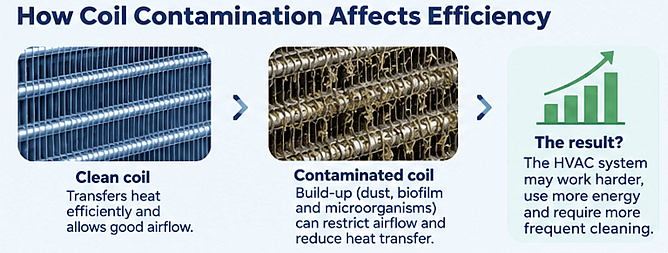
When biological contamination accumulates on cooling coils, it can interfere with heat transfer and increase resistance to airflow.
This raises an interesting question:
Could ultraviolet-C (UVC) technology help maintain HVAC efficiency by preventing microbial build-up on cooling coils?
Research suggests that it can, particularly in systems experiencing biological fouling.
However, the evidence also highlights why energy savings should never be treated as automatic or guaranteed.
Let's look at what the science actually says.
Why Cooling Coil Cleanliness Matters for Energy Efficiency
A cooling coil is a heat exchanger.
Its purpose is to remove heat from the air passing through an HVAC system.
To do this efficiently, air needs to move through the coil while heat is transferred across the coil's surfaces.
But cooling coils operate in conditions that can encourage contamination.
When warm air meets a cold coil, condensation can form.
Combine this moisture with dust, organic material and microorganisms, and the conditions may support biological growth.
Over time, this can create a layer of contamination known as biofilm.
Biofilm can interfere with HVAC performance in two important ways.
1. Reduced Heat Transfer
A contaminated coil may not transfer heat as effectively as a clean coil.
Biological material can create additional resistance between the air and the heat-transfer surface.
Where fouling becomes significant, the HVAC system may require additional operation to deliver the same cooling performance.
2. Increased Airflow Resistance
Cooling coils contain closely spaced fins designed to maximise heat transfer.
When contamination accumulates between these fins, resistance to airflow can increase.
Depending on the fan and control system, this may increase fan energy consumption, reduce delivered airflow or affect cooling performance.
The result is an HVAC system that may be working harder than necessary.
How Does UVC Help?
254nm ultraviolet-C is used in appropriately designed HVAC applications to control microbial growth on exposed internal surfaces.
UVC damages the genetic material of susceptible microorganisms, interfering with their ability to reproduce.
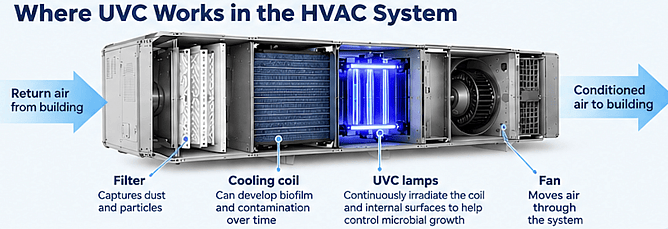
When lamps are correctly positioned inside an air-handling unit, they can continuously irradiate targeted surfaces such as:
Cooling coils
Coil fins
Drain pans
Other suitable internal HVAC surfaces
This helps control biological growth on irradiated surfaces between normal maintenance cycles.
The potential energy benefit comes from maintaining cleaner heat-transfer surfaces and reducing biological fouling that would otherwise interfere with HVAC performance.
UVC doesn't directly make a fan or chiller more efficient. It may help the HVAC system maintain its intended performance by controlling contamination.
That distinction is essential.
What Does the Scientific Evidence Say?
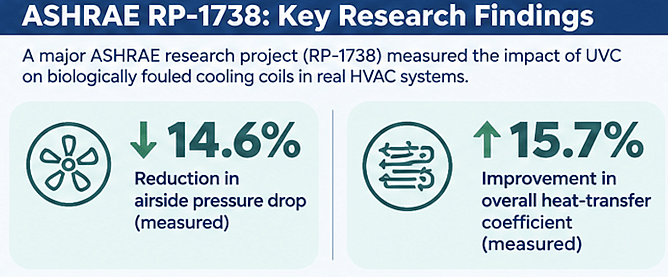
One of the most relevant research projects is ASHRAE Research Project RP-1738, which investigated how UVC cooling-coil irradiation affects airflow resistance, heat-transfer performance and HVAC energy consumption.
The research included field measurements from operating HVAC systems and subsequent energy modelling.
ASHRAE RP-1738: Measured Coil Performance Improvements
Researchers examined cooling coils experiencing biological fouling and measured changes following UVC treatment.
These findings are significant because they demonstrate that UVC coil irradiation can improve the physical performance of biologically fouled cooling coils.
However, they are not equivalent to a 14.6% or 15.7% reduction in electricity consumption.
The results describe specific coil-performance measurements at one study location.
A second site in Pennsylvania produced different results, reinforcing that outcomes depend on operating conditions and the initial condition of the equipment.
Source: Field Measurement and Modeling of UVC Cooling Coil Irradiation for HVAC Energy Use Reduction — Part 1. <Cite refs={["turn824716search0","turn824716search6"]}/>
What Did the Energy Modelling Find?
The second part of RP-1738 examined potential energy savings across different building types and climates.
The modelling produced a range of results depending on the assumed impact of biological fouling.
The research found that:
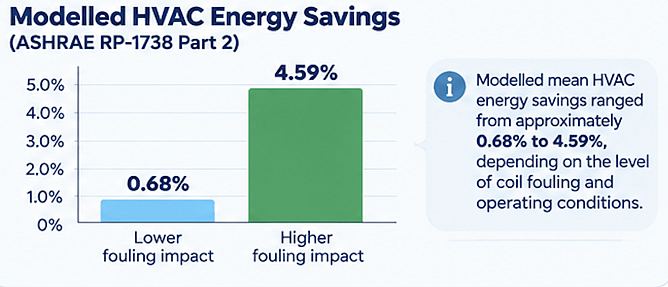
Modelled mean HVAC energy savings ranged from approximately 0.68% to 4.59% across the two pressure-drop assumptions.
Fan energy reductions were generally the largest contributor.
The estimated savings were highly sensitive to the amount of coil fouling.
In some cases, UVC's own electricity consumption could outweigh the HVAC energy savings.
These findings demonstrate why it is important to understand the condition of the cooling coil before estimating the financial return.
Source: ASHRAE RP-1738 — Part 2: Energy, Indoor Air Quality, and Economic Modeling. <Cite ref="turn824716search4"/>
What About More Recent Research?
A 2024 study published in Building and Environment examined UVC treatment in an air-handling unit operating in a cool, humid climate.
The researchers reported improvements in cooling-coil thermal performance and reductions in energy consumption under the conditions investigated.
The study included a reported 15.62% improvement in overall enthalpy-based thermal conductance, alongside site-specific energy and financial findings.
These results provide further evidence that UVC treatment can deliver operational benefits in some HVAC applications.
However, individual case-study results should not be applied automatically to different buildings, equipment types or climates.
The starting condition of the coil and the operating environment matter enormously.
Why UVC Energy Savings Vary Between Buildings
Not every HVAC system will experience the same benefit.
Several factors influence the potential outcome.
1. Existing Coil Condition
A heavily fouled cooling coil may offer a greater opportunity for performance improvement than a coil that is already clean.
If there is little biological contamination to control, UVC may deliver limited measurable energy savings.
2. Climate and Humidity
Cooling coils in warm, humid environments may remain wet for longer periods.
These conditions can favour microbial growth.
Buildings operating in drier climates or with shorter cooling seasons may experience different results.
3. HVAC Operating Hours
A commercial AHU operating for long periods may have a different financial opportunity from a small system operating intermittently.
4. UVC System Design
Not all UVC installations are equal.
Effective coil treatment depends on:
Lamp positioning
Irradiance reaching the target surfaces
Exposure time
Coil geometry
Fin spacing and shadowing
Lamp output and ageing
Surface condition
Equipment compatibility
Safe installation and maintenance access
Correct engineering is essential.
5. Fan and Cooling-System Controls
A reduction in coil pressure drop does not automatically translate into an equivalent reduction in fan electricity consumption.
The outcome depends on the fan type, control strategy and operating conditions.
Similarly, improved coil heat transfer does not necessarily produce an identical percentage reduction in chiller energy use.
This is why system-level measurement is more useful than relying on individual coil-performance percentages.
Does UVC Use Electricity?
Yes.
UVC lamps require electricity to operate.
This consumption must be included when evaluating potential energy savings.
For example, consider an illustrative UVC installation with a total electrical demand of 180 watts operating continuously.
Annual UVC electricity consumption:
180 W × 8,760 hours ÷ 1,000 = 1,576.8 kWh per year
At an illustrative electricity rate of $0.25/kWh, this would cost approximately $394 per year.
This is only an example, not a specification for a particular AirTechnologies product.
The actual cost will depend on the installed electrical demand, operating schedule and electricity tariff.
Any claimed HVAC energy savings need to be considered after accounting for the electricity required to operate the UVC system.
A Practical Example: What Could Energy Savings Look Like?
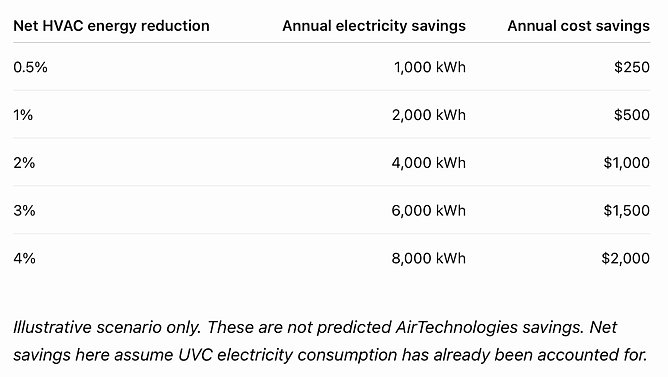
For a facility with multiple large AHUs, energy savings could be more financially significant.
However, the actual opportunity depends on the degree of fouling and how the HVAC system responds to cleaner coils.
Energy Savings Are Only One Part of the Business Case
For many commercial buildings, energy consumption is only one part of the total cost of HVAC operation.
There are also maintenance and asset-management considerations.
Biological fouling can contribute to:
Repeated coil cleaning
Contractor labour
Maintenance call-outs
Additional inspections
Drain-pan contamination
Cleaning-related downtime
Reduced HVAC hygiene
Where UVC successfully controls recurring microbial growth, some of these costs may potentially be reduced.
This is particularly relevant in buildings where coil contamination is an established, recurring maintenance problem.
The ASHRAE Handbook also notes that the economic performance of UVC coil treatment can become more favourable when maintenance-related benefits are considered alongside energy savings.
How to Calculate the Potential ROI of UVC
A proper return-on-investment assessment should include both the expected benefits and the total cost of ownership.
Potential annual benefits
Energy savings + avoided cleaning costs + other verified operational savings
Annual operating costs
UVC electricity + lamp replacement + inspections and servicing
Initial investment
Equipment + installation + commissioning
An indicative simple payback can then be calculated as:
Initial investment ÷ annual net financial benefit = simple payback period
For example, consider a hypothetical commercial installation:
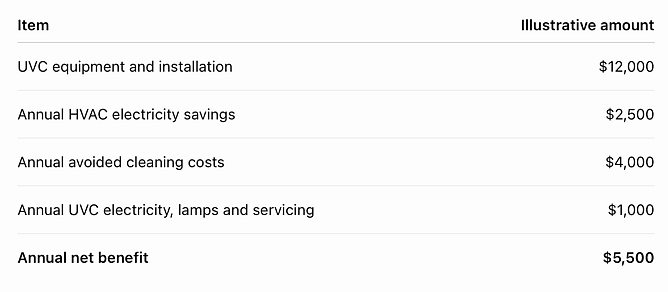
Simple payback: $12,000 ÷ $5,500 = approximately 2.2 years.
This is a hypothetical calculation only. It is not a quoted price, verified case study or guaranteed financial return.
Actual results may be substantially better or worse, and some systems may not achieve a positive financial return.

How Can Facility Managers Measure the Results?
Rather than relying on generic performance claims, we recommend starting with one suitable HVAC system.
A pilot installation can help establish whether UVC provides a measurable benefit in the building's actual operating environment.
Before installation
Record baseline information such as:
Cooling-coil condition
Photographs of contamination
Airflow and coil pressure drop
Coil entering and leaving air conditions
Fan electricity consumption
Cooling-system energy use
Cleaning frequency
Maintenance costs
Operating hours
After installation
Monitor the same indicators over an agreed period.
Measurements should be adjusted where possible for changes in:
Weather
Cooling load
Occupancy
Airflow
Operating schedules
Maintenance activities
This makes it easier to distinguish improvements associated with UVC from normal seasonal or operational changes.
The goal should be measured performance, not simply installing a product and assuming a saving.
Could UVC Support Building Sustainability Goals?
Potentially.
If a UVC installation delivers a genuine net reduction in electricity consumption, it may also contribute to reducing the emissions associated with that electricity use.
But the carbon benefit must be calculated from verified net energy savings, using an appropriate electricity-emissions factor.
UVC lamps also consume electricity and require periodic replacement, so these operating and lifecycle considerations should be included.
A building should not claim carbon savings simply because UVC has been installed.
The reduction needs to be demonstrated.
Which Buildings May Have the Strongest Opportunity?
UVC coil treatment may be particularly worth investigating in:
Large commercial offices
Hospitals and healthcare facilities
Hotels
Shopping centres
Universities
Airports
Aged-care facilities
Laboratories
Manufacturing facilities
Pharmaceutical facilities
Buildings with centralised air-handling units
However, building type alone does not determine suitability.
The most promising opportunities are often HVAC systems with documented recurring biological fouling, high operating hours or measurable performance deterioration.
So, Can UVC Actually Reduce HVAC Energy Consumption?
Yes, under the right conditions.
Research supports the potential for UVC coil irradiation to improve heat-transfer performance and reduce airflow resistance in biologically fouled HVAC cooling coils.
Energy modelling and selected field studies also indicate that these improvements can translate into lower HVAC energy consumption.
But the evidence does not support promising the same percentage saving for every building.
A clean coil may have little room for improvement.
A heavily contaminated coil may present a much stronger opportunity.
And even when coil performance improves, the financial benefit depends on the complete HVAC system and the cost of operating the UVC installation.
The most defensible approach is to assess the equipment, identify an existing problem and measure the results.
The Bottom Line: Cleaner Coils Can Support More Efficient HVAC
UVC should not be viewed as a shortcut to energy efficiency.
It should be considered an additional technology that may help maintain cleaner cooling coils and support HVAC performance where biological fouling is a genuine issue.
For commercial building owners and facility managers, the opportunity is not simply about reducing electricity consumption.
It is about looking at the full picture:
Cleaner coils. Better HVAC hygiene. Potentially lower maintenance requirements. Improved heat-transfer performance. And measurable operational savings where conditions support them.
The important question isn't:
“How much energy does UVC save?”
It's:
“How much performance are we losing because our HVAC coils are contaminated — and could UVC help us recover or maintain it?”
Want to Understand the Potential Savings in Your Building?
At AirTechnologies NZ, we specialise in 254nm UVC systems designed for integration into suitable commercial HVAC and air-handling equipment.
Our team can work with facility managers, building owners and HVAC contractors to assess existing equipment and determine whether UVC coil treatment is appropriate.
For larger facilities, we can begin with one suitable air-handling unit, establishing the current condition and identifying what could realistically be measured through a pilot installation.
With nearly 30 years of HVAC industry experience, our director Levi can also assist with technical discussions around system suitability, equipment configuration and installation requirements.
Interested in understanding whether UVC could support your building's HVAC efficiency and maintenance strategy?
Contact AirTechnologies NZ to discuss your equipment and potential next steps.
AirTechnologies NZ — New Zealand's Air Quality Specialists.

Research and Further Reading
ASHRAE RP-1738 — Part 1: Field Measurement and Modeling of UVC Cooling Coil Irradiation for HVAC Energy Use Reduction: Field Measurements. Read the research
ASHRAE RP-1738 — Part 2: Energy, Indoor Air Quality, and Economic Modeling. Read the research
ASHRAE Handbook — HVAC Applications: Chapter 62, Ultraviolet Air and Surface Treatment. ASHRAE technical guidance
Building and Environment (2024): An energy efficiency and cost analysis of utilizing high-intensity profile UVC systems on air handling unit under cool-humid climate. Read the study